Korea Federation of SMEs Analyzes Business Performance of Companies Introducing Win-Win Smart Factories
The Korea Federation of SMEs, together with the Ministry of SMEs and Startups and POSCO, announced on the 15th that the sales growth rate of small and medium-sized enterprises (SMEs) that introduced smart factories was 42.9 percentage points higher than that of non-adopting companies, according to an analysis of the management performance of the 'Large and Small Business Win-Win Smart Factory Support Project.'
This performance analysis was conducted by comparing the financial statements before and after the introduction of smart factories of 292 SMEs that participated in the Large and Small Business Win-Win (POSCO) Smart Factory Support Project from 2019 to 2021 and introduced smart factories, with 970 companies in the same industry and sales bracket that did not introduce smart factories.
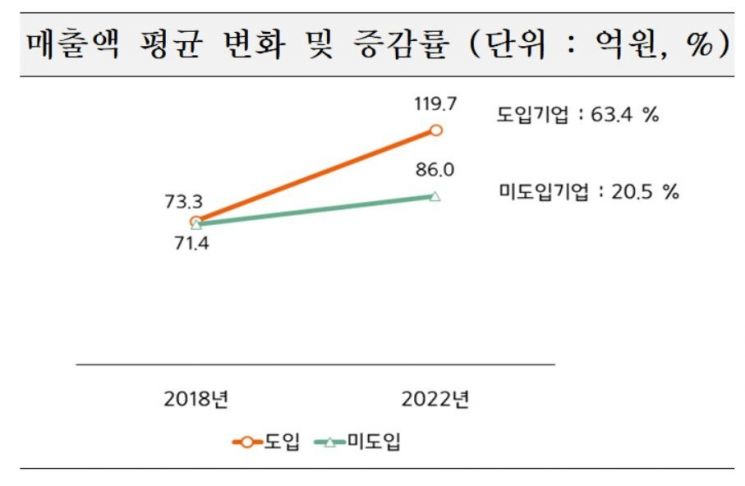
The analysis showed that companies that introduced smart factories had a sales growth rate 42.9 percentage points higher, an operating profit growth rate 40.6 percentage points higher, and an R&D investment growth rate 6.9 percentage points higher than companies that did not introduce smart factories. The employee number decline rate was 2.4 percentage points lower, indicating that companies with smart factories showed higher growth potential than those without.
In terms of sales, companies that introduced smart factories increased from 7.33 billion KRW in 2018 before introduction to 11.97 billion KRW in 2022 after introduction, a 63.4% increase, whereas non-adopting companies increased by only 20.5% during the same period. Regarding operating profit, companies with smart factories increased from 280 million KRW before introduction to 420 million KRW after introduction, a 50.5% increase. In contrast, non-adopting companies saw only a 9.9% increase during the same period.
Regarding R&D investment, which can serve as a medium for sustainable corporate growth, companies that introduced smart factories increased their investment by 6.7% compared to before introduction, while non-adopting companies decreased by 0.2% during the same period. As for the number of employees, companies with smart factories saw only a 1.3% decrease compared to before introduction, whereas non-adopting companies experienced a 3.7% decrease during the same period. Contrary to some concerns that smart factory adoption reduces employment, the analysis showed that the employee decline rate was lower in companies that introduced smart factories than in those that did not.
Yang Chan-hoe, Head of the Innovation Growth Division at the Korea Federation of SMEs, said, "POSCO’s Win-Win Smart Factory Support Project is one of the successful cases of practicing mutual growth, significantly contributing not only to the establishment of smart factories but also to improving the management performance of SMEs," adding, "In order for SMEs to respond well to recent changes in the industrial environment such as ESG management and industrial safety, it is more important than anything else to receive know-how accumulated through trial and error by large companies along with innovative efforts like smart factories."
© The Asia Business Daily(www.asiae.co.kr). All rights reserved.
![Clutching a Stolen Dior Bag, Saying "I Hate Being Poor but Real"... The Grotesque Con of a "Human Knockoff" [Slate]](https://cwcontent.asiae.co.kr/asiaresize/183/2026021902243444107_1771435474.jpg)
















