"Result Reflects Wishes of Taiwanese Wanting Status Quo"
"Low Possibility of War but Diplomatic Isolation May Deepen"
In the Taiwanese presidential election, the pro-American and pro-independence incumbent Democratic Progressive Party candidate Lai Ching-te was elected, drawing attention to the diplomatic and economic repercussions in Northeast Asia. This election has been regarded as a proxy war between the United States and China over dominance of the Taiwan Strait. Experts predict that China’s diplomatic and economic pressure on Taiwan will intensify going forward.
Professor Wang Shufeng from Ajou University, who is originally from Taiwan, interpreted Lai Ching-te’s victory as reflecting the Taiwanese people's desire to maintain the status quo. In an interview on SBS Radio’s 'Kim Tae-hyun’s Political Show' on the 15th, Professor Wang said, "The Taiwanese people actually strongly want to maintain the status quo. They neither want independence nor do they want to be unified under China."
However, he assessed the possibility of a Chinese military invasion as low. Professor Wang stated, "If a war breaks out, not only the Chinese economy but the entire world would suffer significant damage, so the likelihood of China threatening or unifying Taiwan by force is very low. Instead, diplomatic and economic retaliation is expected first." He added, "Since Lai Ching-te is from a pro-American party, relations with China will gradually become more distant, and Taiwan will face significant diplomatic and economic pressure from China."
Regarding the possibility of sanctions related to the semiconductor industry, he said, "About 30% of Taiwan’s exports to China are semiconductor-related. China is a country that needs semiconductors very much, so I believe they will avoid imposing sanctions on semiconductors due to concerns about their own economic impact."
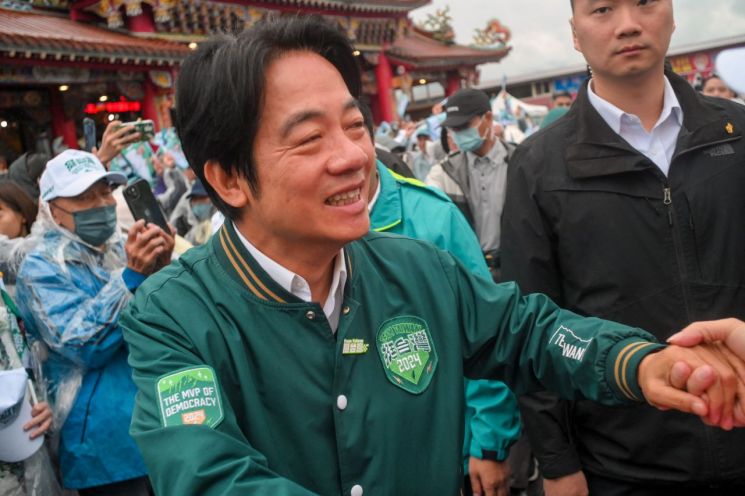 Lai Ching-te, the President-elect of Taiwan, greeting supporters in Yilan County in the eastern region on the 21st of last month.
 [Image source=Yonhap News]
Professor Moon Il-hyun from China’s Zhengfa University also predicted that China would exert comprehensive pressure on Taiwan. In an interview on SBS Radio that day, Professor Moon said, "Taiwan currently has diplomatic relations with 13 countries, and China will pressure these countries to further isolate Taiwan diplomatically."
Professor Moon foresaw three critical phases in the future U.S.-China relationship: ▲ from now until the Taiwanese president’s inauguration day ▲ from the inauguration day until the U.S. presidential election ▲ and if former U.S. President Donald Trump wins the U.S. presidential election. He said, "The first critical phase is from now until May 20, the day of the Taiwanese president’s inauguration. During this period, it depends on how satisfied China is with the behind-the-scenes talks among Taiwan, China, Japan, and the U.S."
He continued, "The second phase is until the U.S. presidential election. China will publicly demand recognition of the One-China principle or the '1992 Consensus' (which acknowledges One China but allows each side to interpret it as they see fit) in the Taiwanese president’s inaugural speech. If this demand is not accepted, China will respond very strongly." Furthermore, "The third phase is the U.S. presidential election. If Donald Trump succeeds in his re-election and maintains his current stance, China’s view of Taiwan might change again. During his term, Trump showed reactions such as 'What does the U.S. gain by intervening in the Taiwan issue?' and 'Taiwan’s semiconductors are, after all, stealing from the U.S. semiconductor industry,'" he added.
© The Asia Business Daily(www.asiae.co.kr). All rights reserved.

















