Demanding Unrealistic Production Time Reduction from Outsourcing Companies
Outsourcing Companies Report Defect Reduction Instead of Quality Control
Recent consecutive accidents involving Boeing passenger planes have been attributed to long-standing outsourcing practices that ignored quality control in order to cut costs.
Outsourcing to Maximize Added Value... Outsourcing Structure Remained Unchanged Despite 2018 and 2019 Crashes
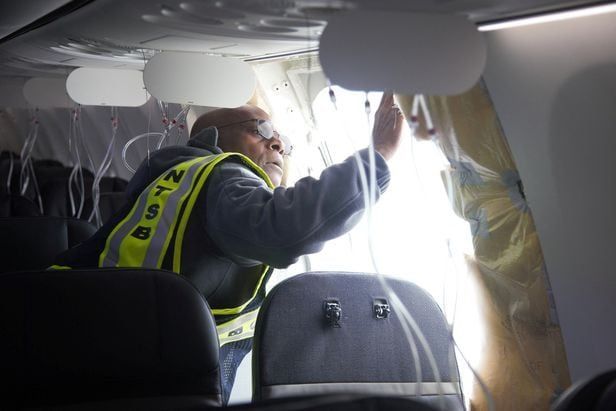 An investigator from the U.S. National Transportation Safety Board (NTSB) is examining the emergency exit door plug of Alaska Airlines Flight 1282 Boeing 737 Max 9 aircraft, which was torn off during flight in Portland, Oregon. [Image source=Yonhap News]
On the 13th (local time), the American daily The Wall Street Journal (WSJ) pointed out the operational realities of Spirit AeroSystems (Spirit), Boeing's airframe production subcontractor, and the structural problems in the industry that disregard safety.
The Spirit plant in Wichita, Kansas, which manufactured the Boeing 737 Max 9 airframe that recently suffered an accident where a large hole was torn in the fuselage wall during flight, was operated directly by Boeing until 2005. However, at that time, Boeing adopted a strategy to maximize added value by focusing on final assembly, which led to the sale of the plant.
Since then, Spirit has become the sole supplier providing airframes to Boeing but has experienced production issues and quality degradation. Due to Boeing's excessive demands to increase production speed, current and former Spirit employees are reportedly struggling to meet unrealistic quotas. When producing two aircraft per day, the number of holes to be filled with bolts and rivets in a month reaches 10 million.
Cornell Beard, head of the Spirit Wichita plant branch of the International Association of Machinists and Aerospace Workers, said, "Because Spirit rushes employees so much, planes with unnoticed problems have ended up all over the world."
What is more problematic is that Boeing did not correct these structural issues even after the crashes in 2018 and 2019. Shortly after the 2018 crash, a memo written by Ed Pearson, the production manager at the plant that assembled the crashed plane, was revealed during a U.S. congressional hearing. The memo stated, "I regret that for the first time in my life, I hesitate to put my family on a Boeing plane." Since 2000, Boeing has more than doubled the proportion of outsourcing in its parts manufacturing process.
"Boeing Demanded Defect Reduction... But Defect Reporting Was Reduced, Not Defects Themselves"
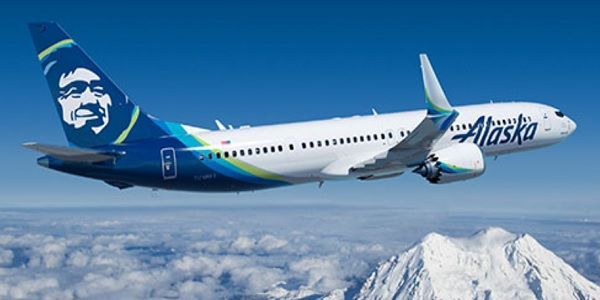 Alaska Airlines Boeing 737 Max 9 aircraft. This model has been indefinitely grounded due to an incident where some windows and wall panels were torn off.
 [Image source=Alaska Airlines]
Boeing also pledged to strengthen quality control but left the outsourcing structure intact. Former Spirit quality inspector Joshua Dean claimed he was fired after pointing out incorrectly drilled holes in the airframe. Dean testified, "After the 2018 and 2019 crashes, Boeing demanded defect reduction from suppliers," adding, "This led not to improved quality but to reduced defect reporting."
Spirit employees said that quality concerns rarely reach upper management, and quality inspectors fear retaliation if they report too many issues. Last fall, the Spirit union protested the replacement of inspectors who found numerous defects with contract workers. However, Dave Calhoun, Boeing's CEO, dismissed calls to resolve outsourcing issues through acquiring Spirit even when defects were found in the 787 Dreamliner model last year.
Mike Whitaker, administrator of the U.S. Federal Aviation Administration (FAA), who is investigating the recent accident, said in an interview, "Initial investigation results strongly suggest that the cause of the accident is a manufacturing defect, not a design flaw," adding, "Whatever happened over the past few years, it had no effect."
Meanwhile, on the 5th, Alaska Airlines Flight 1282, a Boeing 737 Max 9 carrying 171 passengers and 6 crew members, experienced an accident where a window and part of the fuselage were torn off shortly after taking off from Portland International Airport in Oregon. The detached part, the "door plug," was manufactured by the subcontractor Spirit AeroSystems.
Additionally, on the 13th (Korean time), cracks were found in the cockpit window of All Nippon Airways (ANA) Flight 1182, a Boeing 737 flying from Hokkaido to Toyama Prefecture, causing the plane to return to New Chitose Airport around 11:20 a.m.
© The Asia Business Daily(www.asiae.co.kr). All rights reserved.
!["The Woman Who Threw Herself into the Water Clutching a Stolen Dior Bag"...A Grotesque Success Story That Shakes the Korean Psyche [Slate]](https://cwcontent.asiae.co.kr/asiaresize/183/2026021902243444107_1771435474.jpg)

















