[K-Convenience Store Global 1000th Store Era]②
Interview with Barkhatan Digital Concept COO
Franchise Agreement between GS Retail and Convenience Stores
"By 2025, we aim to open more than 200 stores and become the number one CVS (convenience store)."
BAKHATKHAN Khavid, Chief Operating Officer (COO) of Digital Concept, recently stated in an interview at the Ulaanbaatar office in Mongolia, "There are several reasons why Korean-style convenience stores are bound to succeed in Mongolia," adding, "Although foreign capital inflows such as Carrefour continue, the growth trend of Korean-style convenience stores will persist."
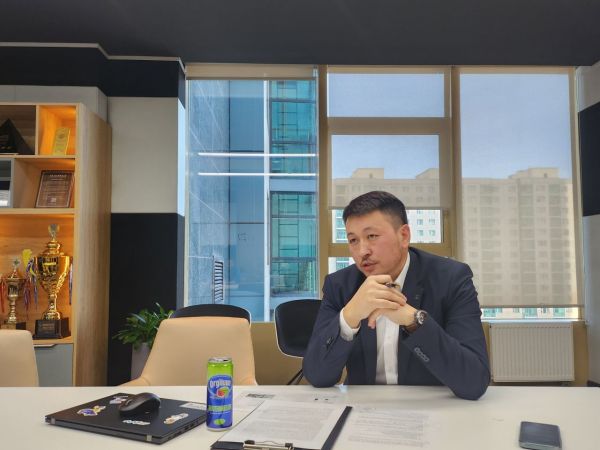 BAKHATKHAN Khavid, Chief Operating Officer (COO), is explaining the business strategy at the Digital Concept headquarters located in the center of Ulaanbaatar, Mongolia.
 [Photo by Minji Lee]
Digital Concept is a company operating the GS25 convenience store in Mongolia together with GS Retail. It is a subsidiary of the Shunkolai Group, the second-largest business conglomerate in Mongolia. The Shunkolai Group became interested in the convenience store business while considering more efficient ways to sell products produced by the group. In Mongolia, where manufacturing facilities are lacking, they decided to secure retail distribution channels after contemplating how to market products from 'APU,' which accounts for 70% of the beverage and liquor market and produces milk, vodka, beverages, and beer.
COO BAKHATKHAN said, "In the past, it was common to buy a week's worth of groceries at once from a mart, but nowadays, people tend to buy what they need nearby as needed," adding, "Besides APU, we saw the potential to operate convenience stores by utilizing affiliates such as gas stations and telecommunications companies."
To reduce trial and error, Digital Concept took its first step into the business by signing a master franchise agreement with GS25, the Korean convenience store operator, rather than operating directly.
There was also confidence that Korean-style convenience stores would succeed. What first caught their attention was the product management method of Korean convenience stores. They believed that quickly updating products according to trends and creating new items suited Mongolians who like change. The method of launching new ready-to-eat and convenience foods was something not found in Circle K or local convenience stores. Affordable coffee was also an attractive factor. Mongolians who had visited Korea increasingly sought coffee after meals, and the fact that Korean convenience stores sold delicious coffee at one-third the price of the market was appealing.
However, the start was not smooth. It was a series of challenges. Digital Concept opened the first GS25 store in Ulaanbaatar around May 2021, during the peak of the COVID-19 pandemic. At that time, it was difficult to find crowds walking around the city center of Ulaanbaatar, where 45% of Mongolia's economically active population resides. It also took a long time to help employees understand the convenience store business. He explained, "It was important to quickly absorb know-how with the help of Korean GS25 consultants, but it was difficult due to the lack of people during the COVID-19 period," adding, "We could not directly apply Korean precedents in understanding the IT system and working methods."
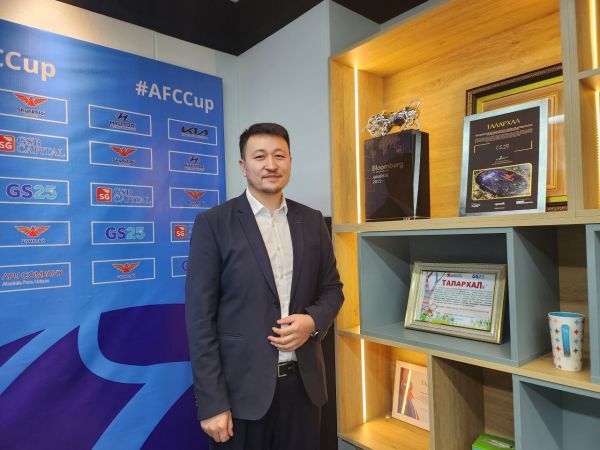 BAKHATKHAN Khavid, Chief Operating Officer (COO), is posing after finishing the interview.
 [Photo by Minji Lee]
Digital Concept dreams of becoming a leader in the convenience store industry through bold investments. The investment areas can be broadly divided into store openings, factories, and IT system enhancements. The goal is to achieve more than 500 stores by 2025. To this end, franchise business has been piloted since December last year. After testing until May, they plan to officially launch the franchise business in the second half of this year.
The goal is to open 50 franchise stores in the second half of next year and 100 stores thereafter. He said, "It will take about another year to reach profitability," adding, "We are considering expanding the franchise business to suburban areas outside Ulaanbaatar." However, since stores in Ulaanbaatar have reached saturation, the plan is to transform existing general retail stores into convenience stores. COO BAKHATKHAN emphasized, "Before convenience stores entered Mongolia, small marts were located in each apartment complex, and these marts can transform into franchisees of convenience stores." It was also confirmed that sales increased by about 15-30% compared to before when the business was changed to a convenience store.
Digital Concept is also building a new factory to enhance competitiveness in ready-to-eat meals. They decided on a 1.7 billion KRW investment this year, determined to have a factory capable of producing and supplying products directly. Currently, they sell products such as Poz (meat dumplings), Choiwang (fried noodles), and bread supplied by local companies. In the IT sector, they plan to introduce GS Retail's integrated system to improve efficiency between headquarters, store owners (ordering), and POS systems. COO BAKHATKHAN emphasized, "Having a proper IT system is essential to smoothly supply goods and maintain the quality of convenience stores when running a franchise business," adding, "For ready-to-eat meals, we will introduce differentiated products from competitors."
© The Asia Business Daily(www.asiae.co.kr). All rights reserved.


















