Ischemic Retinopathy Treatment, Promoting Vascular Normalization
A technology has been developed that can easily treat retinopathy occurring in premature infants or diabetic patients with eye drops. It attracts attention by enabling the recovery of lost blood vessels and allowing highly efficient treatment with a small dosage.
UNIST (President Yong-Hoon Lee) announced on the 14th that Professor Byungheon Kang's team from the Department of Life Sciences, together with Professor Dongho Park's team from Kyungpook National University Hospital, developed a technology that can improve ischemic retinopathy caused by oxygen deficiency in the retina, such as retinopathy of prematurity and diabetic retinopathy.
This technology blocks the alteration of mitochondrial properties, which is the fundamental cause of the disease. Compared to existing treatment methods, it can be applied to a wider range of patients and can be easily treated with eye drop-type medication.
Retinal diseases are caused by the abnormal growth of retinal blood vessels due to excessive production of factors that generate blood vessels in response to insufficient oxygen supply to the retinal tissue. Once it occurs, symptoms can be delayed but full recovery is difficult.
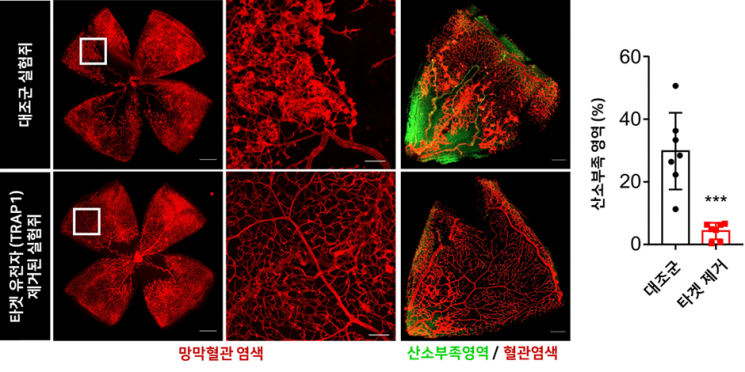
Professor Byungheon Kang said, “We confirmed that the excessive production of angiogenic factors is due to changes in mitochondrial properties.”
In the cell tissues where retinopathy occurs, the expression of a protein called TRAP1 increases, altering mitochondrial function. In other words, inhibiting TRAP1 can improve retinopathy.
Existing treatments have excellent therapeutic effects but are limited to treating specific patients, making it difficult to apply to all patients. They also require inconvenient eye injections once every month or two.
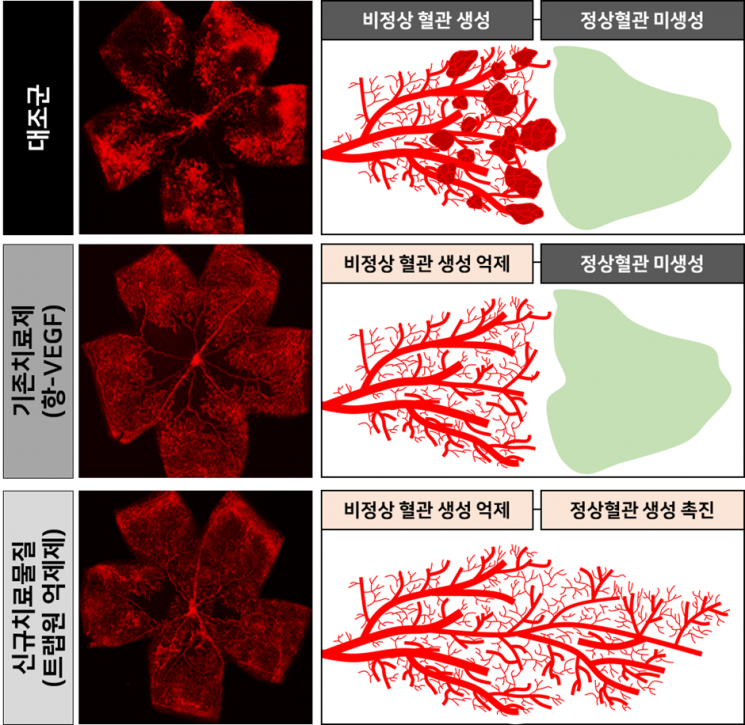
The substance developed by the research team regulates mitochondria to control the abnormally activated transcription factor hypoxia-inducible factor 1-alpha (HIF1α). It fundamentally reduces the expression of abnormally activated genes.
With the development of eye drop-type drugs that enhance bio-transparency, it can be applied to various patients and used conveniently.
So-yeon Kim, the first author and a researcher at UNIST’s Department of Life Sciences, said, “Targeting and controlling HIF1α and mitochondria activated by oxygen deficiency is a completely new approach,” adding, “While existing treatments only prevent disease progression, the developed substance can restore angiogenic factors to normal levels and promote normalization of blood vessels.”
Professor Byungheon Kang of the Department of Life Sciences emphasized, “This research result can be utilized to develop innovative treatments that overcome the limitations of existing drugs by securing both excellent activity and convenient usability.”
 (From left) Professor Kang Byungheon of UNIST, first author researcher Yoon Namgu, first author researcher Kim Soyeon.

The therapeutic substance is being developed by Smartin Bio, a faculty startup company at UNIST led by Professor Byungheon Kang, and is currently undergoing preclinical trials.
This research was published on January 12 in the internationally renowned journal Advanced Science. The study was supported by the Ministry of Science and ICT’s Mid-career Researcher Support Project and the National New Drug Development Project’s New Drug R&D Ecosystem Establishment Research.
© The Asia Business Daily(www.asiae.co.kr). All rights reserved.



















