Although the decision to initiate a workout (corporate financial restructuring) for Taeyoung Construction has been made, the heightened sense of crisis in the construction industry does not seem to be dissipating. Difficulties may arise in asset sales during Taeyoung Construction’s workout period, and there is a possibility that additional insolvencies could be discovered. With no guarantee of Taeyoung Construction’s management normalization, the risk of a chain collapse among local and small-scale construction companies continues to be raised, keeping market vigilance high.
Taeyoung Construction Workout... Subsidiary Sales Are Key
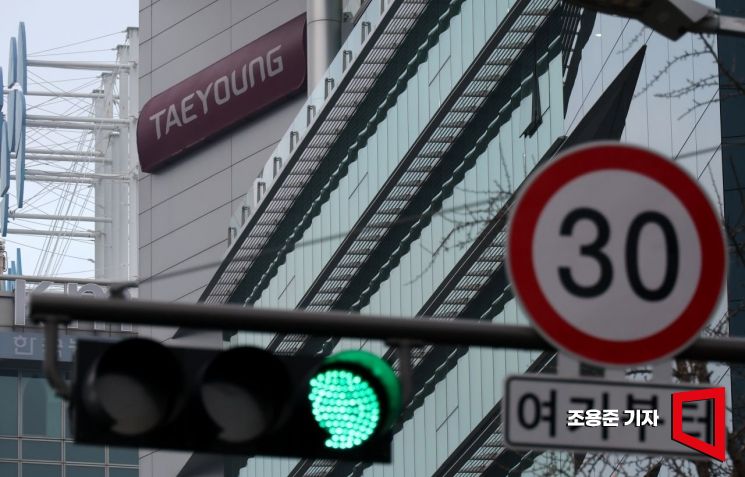
Taeyoung Construction’s main creditor bank, KDB Industrial Bank, and the creditor group agreed on the initiation of the workout for Taeyoung Construction on this day. The Industrial Bank announced on the 12th that, after receiving the creditor group’s resolution by midnight the previous day, the workout initiation was approved with a 96.1% consent rate. Accordingly, the creditor group will conduct due diligence on Taeyoung Construction and then prepare a financial restructuring plan together with the company. This plan will be finalized at the second creditors’ meeting scheduled for April 11.
With the start of the workout, the exercise of financial claims against Taeyoung Construction will be deferred for up to four months. During this period, Taeyoung Construction will prepare a plan to graduate from the workout. They will analyze the progress stage and business feasibility of each project site, establish handling measures, and specify debt adjustment and restructuring plans.
A key issue is whether the sale of subsidiaries, which will be used as rehabilitation funds for Taeyoung Construction, can proceed smoothly. Global private equity firm Kohlberg Kravis Roberts (KKR) and Taeyoung Group’s holding company TY Holdings have decided to jointly sell their shares in Ecobit, but it is known that there is a significant difference in their positions. From Taeyoung’s perspective, a quick sale is necessary, but KKR must represent the interests of fund beneficiaries, making it difficult to sell below market price. Ecobit is a comprehensive environmental company engaged in water treatment, waste, and resource circulation businesses, with an asset value reportedly ranging from 2 to 3 trillion won.
On the other hand, Taeyoung expects liquidity shortages to be resolved by April through the implementation of self-help measures. Among these measures, the 154.9 billion won from the sale of Taeyoung Industry was injected into Taeyoung Construction.
Additionally, there is a possibility that large-scale additional insolvent assets may be discovered after the creditor group’s due diligence or that Taeyoung may delay implementing the self-help plan. The creditor group plans to suspend the workout if Taeyoung does not provide collateral such as shares of TY Holdings or SBS when requested to supplement funds.
Payment of Construction Fees Possible During Workout Period
Taeyoung Construction plans to pay construction fees to partner companies during the workout. Unlike the deferral of financial claim exercises due to the workout initiation, general commercial claims such as labor costs and construction payments must be repaid as they mature. It is known that there are 581 partner companies subcontracted by Taeyoung Construction and 494 suppliers. At a press conference held at its headquarters in Yeouido, Seoul, on the 9th, Taeyoung Construction emphasized, "There was an issue with wage payments during the settlement process of accounts receivable collateral loans, but we have a firm intention to repay commercial claims." They added, "Wages are divided into outsourcing costs and labor costs, and we intend to prioritize resolving labor costs."
The Fair Trade Commission, in collaboration with the Ministry of Land, Infrastructure and Transport, is conducting an urgent inspection to ensure that payment guarantees for subcontracting fees in the construction industry are properly implemented. According to relevant laws, when construction is subcontracted, the original contractor (construction company) must provide a payment guarantee to the subcontractor within 30 days from the contract date. The Ministry of Employment and Labor will also investigate wage arrears at 105 construction sites nationwide where Taeyoung Construction is working from the 15th of this month to August 8.
Construction Industry’s Sense of Crisis Continues Despite Taeyoung Construction Workout

About two weeks after the workout application on the 28th of last month, the Taeyoung Construction crisis has entered a phase of resolution. However, the construction industry appears unable to shake off the real estate project financing (PF) insolvency crisis triggered by Taeyoung Construction.
According to Korea Ratings, as of the end of September last year, the total amount of PF loan guarantees by 16 major domestic construction companies was 28.3 trillion won, a 75% increase from 16.1 trillion won at the end of 2020. Additionally, Korea Investors Service surveyed 23 securities companies on PF risk exposure maturing in the first half of this year, which amounted to 11.9 trillion won.
The industry is closely watching whether companies like Shinsegae Construction and Kolon Global will become the next Taeyoung Construction. Korea Investors Service changed the credit rating outlook of Shinsegae Construction’s unsecured bonds to ‘negative’ last month. This was influenced by the cost of sales ratio rising to 99.2% as of the end of September last year and the recognition of bad debts at poorly sold projects such as Villiv Radice (19.6 billion won), Villiv Lucent (11.4 billion won), and Villiv Heritage (5.5 billion won) located in Daegu. The debt ratio was also classified as ‘high risk’ at 467.9%. In the construction industry, a debt ratio exceeding 200% is considered risky, and over 300% is classified as high risk. Taeyoung Construction’s debt ratio reached 478.8%.
Kolon Global, ranked 19th in construction capability, also had a high debt ratio of 313% as of the end of September last year. Furthermore, as of the end of August, the scale of unstarted PF contingent liabilities was 612.1 billion won, about three times the cash assets held during the same period (237.7 billion won). This is why analysts say it would be difficult to respond with internal cash if PF risks materialize due to the cooling of the construction and real estate markets. In response, Kolon Global stated, "Most of our sites have high sales rates, and unstarted sites will begin construction as planned this year."
A construction industry official said, "Although construction companies have been gradually restructured through crises such as the 1997 foreign exchange crisis and the global financial crisis, there are still many companies," adding, "Small construction companies in various local areas are already applying for court receivership."
According to the ‘January Monthly Construction Market Trends’ published by the Korea Construction Industry Research Institute, the number of closure announcements for general construction companies last year totaled 581, an increase of 219 from the previous year. This is the highest annual record since 629 in 2005. By year, the numbers were around 300: 327 in 2020, 305 in 2021, and 362 in 2022. Then, last year, it suddenly surged to 581. This means that nearly 50 construction companies closed every month on average.
Timing-wise, closures were higher in the second half of the year with 333 cases compared to 248 in the first half, and December last year recorded the highest monthly number at 74. Additionally, the number of bankrupt companies last year was six, one more than the previous year.
Some voices call for reviewing the scale of real estate PF insolvencies and risks and, if necessary, taking bold restructuring measures such as workouts. A construction industry official said, "Rather than continuing vague anxiety, it could be positive for the entire industry to address those who need restructuring."
© The Asia Business Daily(www.asiae.co.kr). All rights reserved.