If Interest Coverage Ratio Is Below 1, 'Potentially Distressed Company'
Impact of High Interest Rates Increases Interest Burden and Worsens Corporate Performance
Among the top 100 KOSPI-listed companies by market capitalization, 15 are potential distressed companies that struggle to even pay interest with their earnings. This is attributed to the continuous rise in interest rates since the second half of 2022, which increased financial costs, coupled with deteriorating corporate performance due to economic recession and inflation. As the high-interest rate trend continues, concerns over the worsening financial health of companies are expected to persist.
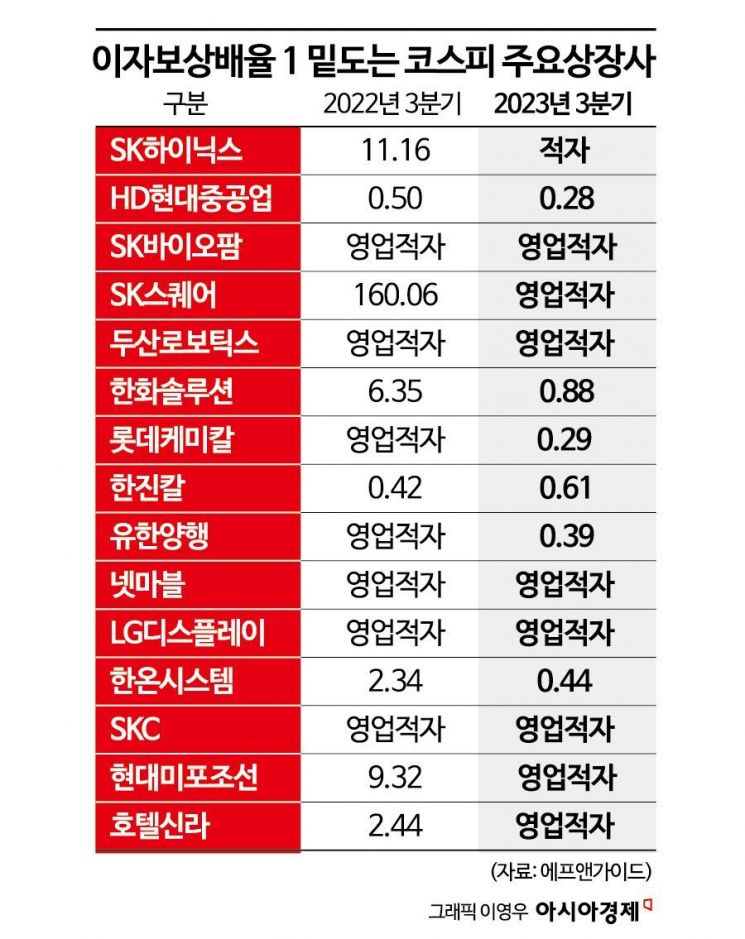
According to financial information provider FnGuide on the 12th, as of the third quarter of last year, 15 out of the top 100 KOSPI-listed companies by market capitalization had an interest coverage ratio below 1 (including operating losses). This accounts for 15% of the total, an increase of 3 companies compared to a year ago (12 companies). It is also more than the 12 companies recorded in the third quarter of 2020 when the COVID-19 pandemic broke out.
The interest coverage ratio is calculated by dividing operating profit by interest expenses and indicates a company's ability to repay debt. An interest coverage ratio below 1 means the company struggles to pay even the interest with its earnings. Generally, a ratio of 1.5 or higher indicates sufficient ability to repay debt, while below 1 classifies the company as potentially distressed. Furthermore, if the ratio remains below 1 for three consecutive years, the company is considered a marginal company.
Companies that struggled to pay interest with their earnings as of the third quarter include HD Hyundai Heavy Industries (0.28), Hanwha Solutions (0.88), Lotte Chemical (0.29), Hanjin KAL (0.61), Yuhan Corporation (0.39), and Hanon Systems (0.44). Hanjin KAL recorded operating losses due to a sharp decline in travelers during the COVID-19 pandemic, briefly improved its ratio in the fourth quarter of 2021, but has had an interest coverage ratio below 1 for seven consecutive quarters since then. LG Display improved its interest coverage ratio to 5.20 in the fourth quarter of 2021 but has recorded operating losses for six consecutive quarters since the second quarter of 2022.
Large conglomerates also appeared on the list of companies with low interest coverage ratios. SK Hynix is a representative example. SK Hynix, which served as the actual financial lifeline of the SK Group, posted an operating loss of approximately KRW 8.0763 trillion on a cumulative basis as of the third quarter last year due to the semiconductor market downturn. Considering that its interest coverage ratio was 26.25 times in the third quarter of 2022, its financial health has rapidly deteriorated. SK Group was also the company that increased corporate bond issuance the most among the top five domestic groups last year.
Besides SK Hynix, many companies recorded operating losses, including SK Biopharm, Netmarble, SK Square, SKC, Hyundai Mipo Dockyard, and Doosan Robotics. Hotel Shilla, which experienced an earnings shock in the third quarter last year, also belonged to companies with an interest coverage ratio below 1 (0.58). Due to operating losses in the duty-free sector, Hotel Shilla's third-quarter operating profit was KRW 7.7 billion, only about one-tenth of the market expectation (KRW 68.9 billion). Securities firms recently lowered their target prices one after another, citing slower-than-expected improvement in Hotel Shilla's duty-free business conditions.
The reason these companies' financial conditions worsened to the point where they cannot even pay interest is that high interest rates, economic recession, and inflation overlapped, worsening corporate management. The Bank of Korea's continuous base rate hikes increased interest burdens on loans, sharply raising funding costs for both companies and households.
Lee Seung-seok, a senior researcher at the Korea Economic Research Institute, said, "Most companies borrow funds from financial institutions, usually with variable interest rates. The burden of principal and interest repayments has increased due to rate hikes, significantly worsening corporate financial conditions."
The increased interest burden also dampened household consumption, which hurt corporate management. As households faced higher interest expenses linked to rate hikes and tightened their belts, corporate sales declined. In other words, due to high interest rates, operating profits decreased while interest burdens increased, creating a double burden.
The problem is that, considering this year's business environment, it seems difficult for companies to shed the label of potential distressed companies. According to the Korea Economic Research Institute, the annual interest burden on household loans is estimated to increase by at least KRW 17.4 trillion from September last year to the end of this year. When converted to individual households, this means an annual increase of about KRW 1.32 million in interest expenses.
Lee, the senior researcher, predicted, "The effects of the U.S. base rate cuts will not appear in corporate financial statements until at least the end of this year. The reduction in facility investments during the rate hike period will also affect future corporate performance."
© The Asia Business Daily(www.asiae.co.kr). All rights reserved.
![Clutching a Stolen Dior Bag, Saying "I Hate Being Poor but Real"... The Grotesque Con of a "Human Knockoff" [Slate]](https://cwcontent.asiae.co.kr/asiaresize/183/2026021902243444107_1771435474.jpg)

















