34 Cases Referred to Disciplinary Committee Last Year
32% Severe Discipline, 68% Minor Discipline
"Detailed Explanation of Disciplinary Results Required"
Recently, university professors who have been involved in various controversies such as embezzlement of research funds, sexual crimes, and human rights violations continue to be referred to disciplinary committees. However, upon reviewing the disciplinary actions at some national universities, it was confirmed that most cases resulted in minor penalties such as warnings. Experts point out that due to the closed nature of universities and disciplinary committees, there can be a gap between internal and external public opinion, so an official procedure should be established to provide detailed explanations of the disciplinary outcomes to the outside.
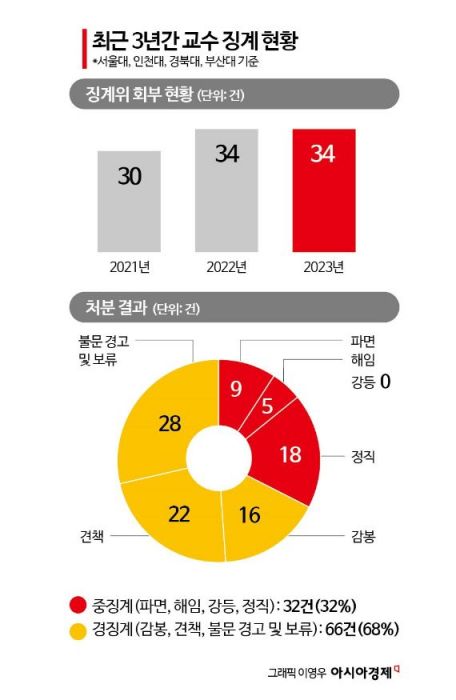
According to the 'Recent 3-Year Disciplinary Status of Faculty at National Universities (Seoul National University, Incheon National University, Kyungpook National University, Pusan National University)' obtained by Asia Economy on the 10th through the office of Assemblyman Kang Deuk-gu of the National Assembly Education Committee, the disciplinary committees held from January to November last year totaled 34 cases, which is similar to or slightly increased compared to 30 cases in 2021 and 34 cases in 2022. Considering that last year's statistics were counted only until November, the actual number of cases may be higher.
The most common reasons for disciplinary action were 'abuse of power and human rights violations' (14.3%), followed by 'drunk driving' (14.2%), 'sexual crimes' (10.3%), 'embezzlement' (10.2%), and 'research misconduct' (6.1%). Other reasons classified as 'others' (44.9%) included 'improper handling of admissions tasks,' 'injury and assault,' 'property damage,' 'violation of farmland laws,' and 'fraud.'
Although the number and reasons for disciplinary cases involving university professors are gradually increasing and diversifying, most penalties remain minor. Analyzing the disciplinary outcomes during the same period, severe penalties such as dismissal (9 cases), discharge (5 cases), demotion (0 cases), and suspension (18 cases) totaled 32 cases, accounting for only 32% of the total. On the other hand, minor penalties such as salary reduction (16 cases), reprimand (22 cases), and warnings or deferrals without further action (28 cases) totaled 66 cases, making up 68% of the total.
Park, a graduate student at a university in Seoul, said, "Looking at the students around me, even when unpleasant incidents occur on campus, most do not try to resolve them through internal procedures and do not have high expectations either," adding, "Professors who caused controversies mostly return to work after about a month of leave, so concerns about secondary harm are even greater."
Experts emphasize the need for an official procedure in which the university transparently discloses the composition of the disciplinary committee and the reasons for disciplinary outcomes to the public. Currently, there is no detailed explanation process for disciplinary decisions to the outside, and even if one disagrees with the outcome, there is practically no way to appeal.
Professor Gu Jeong-woo of the Department of Sociology at Sungkyunkwan University said, "Sometimes disciplinary committees at universities produce results that are not reasonably acceptable, and in such cases, it is important for the school to provide detailed explanations to students and parents about why such decisions were made," adding, "However, since such procedures are not currently in place, the gap between internal and external parties continues to widen."
Voices criticizing the fairness of disciplinary committees also emerged. A university professor who requested anonymity said, "Even though universities form committees according to their internal regulations, considering the closed nature of university spaces, it is impossible to rule out the possibility that minor personal relationships influence disciplinary outcomes," adding, "Since university professors are educators who are socially required to uphold higher moral standards, I agree that the level of disciplinary measures should be stricter than it currently is."
© The Asia Business Daily(www.asiae.co.kr). All rights reserved.
![Clutching a Stolen Dior Bag, Saying "I Hate Being Poor but Real"... The Grotesque Con of a "Human Knockoff" [Slate]](https://cwcontent.asiae.co.kr/asiaresize/183/2026021902243444107_1771435474.jpg)

















