FOMC Holds Base Interest Rate Steady
Rate Cut Discussions Premature
Inflation Growth Expected to Slow This Year
Target Level Approached Only by Q4
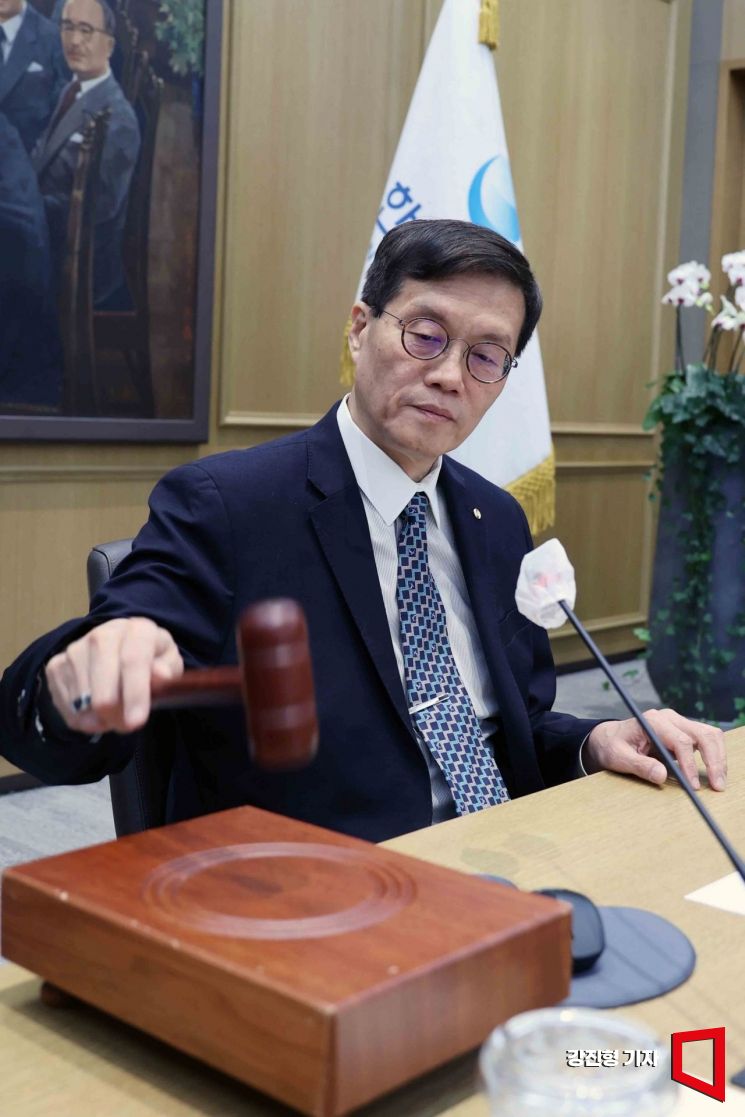 Lee Chang-yong, Governor of the Bank of Korea, is attending the first Monetary Policy Committee plenary meeting of the new year held at the Bank of Korea in Jung-gu, Seoul, on the morning of the 11th, and is striking the gavel. Photo by Joint Press Corps
Lee Chang-yong, Governor of the Bank of Korea, stated that the necessity for an additional base rate hike has decreased compared to before. However, he explained that discussions about rate cuts are premature.
Governor Lee made these remarks during a press conference held after the Monetary Policy Committee decided to keep the base rate unchanged on the morning of the 11th.
He explained, "The trend of slowing inflation continues, and overseas risks such as international oil prices and the Middle East situation have eased," adding, "At this point, the Monetary Policy Committee members agreed that the necessity for an additional base rate hike has decreased."
He continued, "Last month, among the six committee members, four said the rate should be opened up to 3.75% over the next three months, and the remaining two suggested maintaining it at 3.50%, but this time all five members agreed to maintain it at 3.50%."
However, he emphasized that this does not mean the base rate should be cut immediately. Governor Lee stated, "Under the current circumstances, it will be difficult to cut the base rate for at least six months."
He added, as a personal opinion, "We need to observe the Federal Reserve's rate decisions based on inflation changes, the stability of oil prices, whether consumption will follow economic forecasts, and above all, whether the inflation path will proceed as expected."
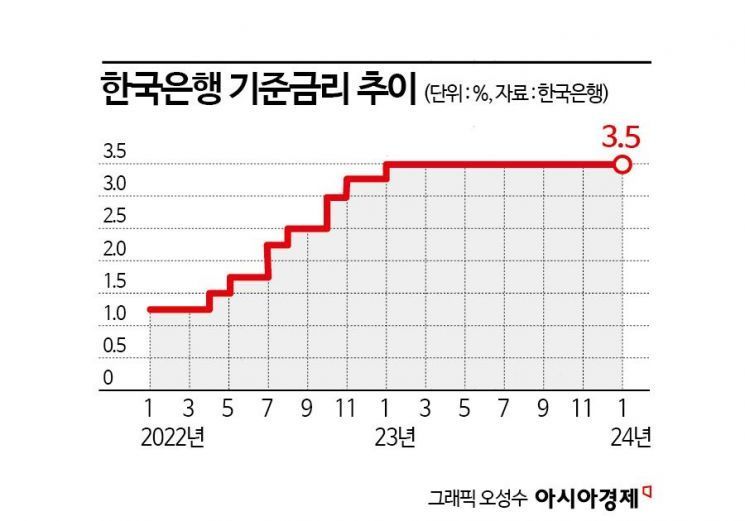
The Bank of Korea's Monetary Policy Committee kept the base rate at 3.50% per annum for the eighth consecutive time on this day. The committee has maintained the base rate unchanged for eight consecutive times since February last year, marking a full year.
The reason the Bank of Korea has kept the base rate unchanged for a year is that the consumer price inflation rate still records in the 3% range, falling short of the Bank's target of 2%. The consumer price inflation rate has remained in the 3% range for five consecutive months from August last year (3.4%) through December (3.2%).
The Bank of Korea stated that it will change its tightening stance only when the inflation trend is clearly controlled.
The Bank expects the inflation rate to continue slowing this year but to fall to the target level only after the fourth quarter. It judges that geopolitical risks in the Middle East and Europe have not yet ended, and risks such as climate change remain high, leaving inflationary uncertainties.
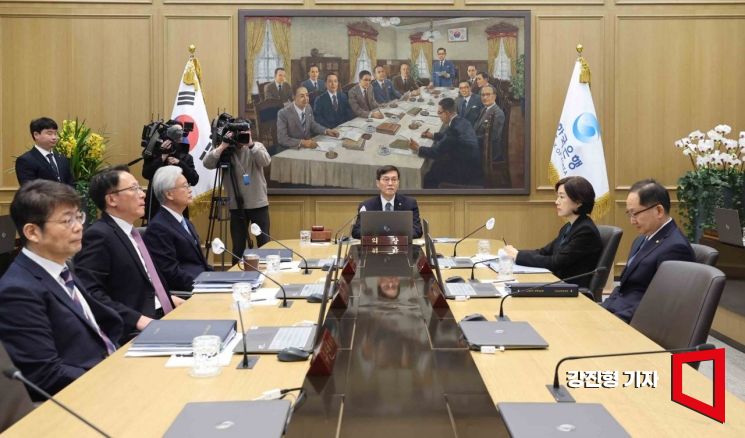 Lee Chang-yong, Governor of the Bank of Korea (third from the right), is presiding over the Monetary Policy Committee meeting held on the 11th at the Bank of Korea in Jung-gu, Seoul. Photo by Joint Press Corps
Governor Lee said, "Domestic inflation will continue its slowing trend, but the pace will be gradual due to the ripple effects of accumulated cost pressures," adding, "The consumer price inflation rate is expected to fluctuate around 3% for the time being and gradually decrease, with the annual inflation rate projected to be around 2.6%, as forecasted in November last year."
The high level of household debt is also a factor that sustains the tightening policy. According to the Bank of Korea, total household loans across all financial sectors increased by 10.1 trillion won compared to a year ago. The household debt-to-GDP ratio reached 100.8%.
The outstanding household loans in the banking sector reached a record high of 1,095 trillion won as of the end of last year. Although the increase in household debt slowed as the Bank of Korea raised the base rate, there is a possibility that debt will resume its upward trend due to the government's continued easing of real estate regulations.
Experts believe that whether South Korea will cut its base rate depends on inflation stability and the timing of the U.S. Federal Reserve's rate cuts. Currently, market interest rates have fallen to levels partially reflecting expectations of a rate cut. However, it is pointed out that it will be difficult for the Bank of Korea to cut the base rate hastily because inflation is unlikely to fall to the desired level in the first half of the year, and the timing of the Fed's rate cuts must also be considered.
© The Asia Business Daily(www.asiae.co.kr). All rights reserved.
![Clutching a Stolen Dior Bag, Saying "I Hate Being Poor but Real"... The Grotesque Con of a "Human Knockoff" [Slate]](https://cwcontent.asiae.co.kr/asiaresize/183/2026021902243444107_1771435474.jpg)


















