Review of Application to Last Year's Sales
Industry Impacted by COVID-19
Comprehensive Consideration of Chinese Tourist Influx
Industry Expects "Generous Relief"
Relief Rate Likely to Be Adjusted
The government is considering applying the 'duty-free shop license fee reduction' implemented in response to the COVID-19 pandemic to last year's sales as well. This is in consideration of the continued sluggish business conditions even after the endemic phase. However, it is expected that the 50% reduction rate applied over the past three years will be adjusted.
According to the Ministry of Economy and Finance on the 11th, the government is discussing a plan to apply the license fee, which was reduced by 50% over the past three years, to last year's sales as well. While there is some consensus that the reduction will be extended, it is widely known that maintaining the 50% reduction rate will be difficult.
The Ministry of Economy and Finance is considering the difficulties faced by the duty-free shop industry, but plans to make a decision after comprehensively reviewing the situation, including the influx of Chinese tourists as daily life recovery accelerated last year. In the '2024 Economic Policy Direction' announced on the 4th, the government stated, "Considering that the duty-free shop business conditions are still sluggish after the COVID-19 period, we will review measures to reduce license fees for 2023 sales."
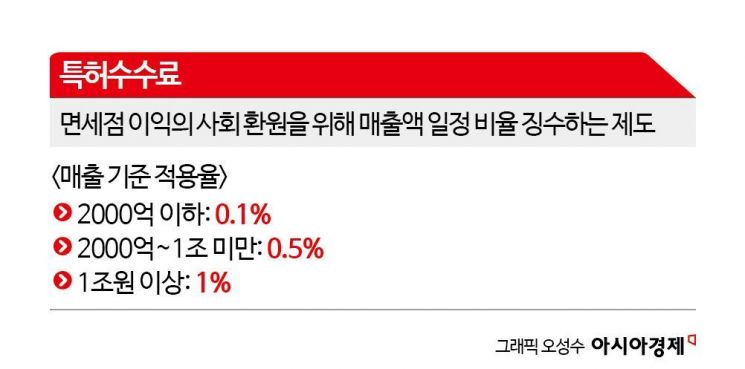
The license fee is a system that collects a certain percentage of sales to return profits from duty-free shops to society. According to the 2017 revision of the Customs Act, nationwide duty-free shops are required to pay a license fee of up to 1% based on their annual sales. The fee rate varies depending on the sales scale. Duty-free shops with annual sales of 200 billion KRW or less pay 0.1%, those with sales between 200 billion and less than 1 trillion KRW pay 0.5%, and those with sales of 1 trillion KRW or more pay 1%. Duty-free shops operated by medium-sized and small businesses pay 0.01%. Based on the previous year's sales, duty-free shops pay the applicable license fee every April.
The reason the government cut the license fee by half over the past three years was due to the severe impact on business conditions caused by COVID-19. With overseas travel routes blocked and a sharp decline in foreign tourists, losses continued.
However, the industry is hopeful for a 'generous reduction' as the sluggish business conditions persisted last year as well. According to the Korea Duty Free Shop Association, total domestic duty-free shop sales in November last year were 1.1553 trillion KRW, a 20.3% decrease compared to the same month the previous year. According to the National Statistical Portal (KOSIS) of Statistics Korea, the duty-free shop retail sales index (constant index) in November last year was 78.5 (2020=100), down 21.0% compared to the same month the previous year. This marks the 13th consecutive month of decline since November 2022 (-26.9%). This is the longest period of decline since related statistics began being compiled in 2010.
© The Asia Business Daily(www.asiae.co.kr). All rights reserved.
![From Bar Hostess to Organ Seller to High Society... The Grotesque Con of a "Human Counterfeit" [Slate]](https://cwcontent.asiae.co.kr/asiaresize/183/2026021902243444107_1771435474.jpg)
















