Employment Rate Hits All-Time High but Declines Among 20s and 40s
Rising Elderly Population... "Large Population and Increasing Care Demand"
"Inability of 20s and 40s to Work Causes Productivity Loss"
In an era of employment downturn, statistics showing a record-high employment rate with over 300,000 new jobs added last year were announced on the 10th. However, there are interpretations that it is difficult to view this as a sign of strong employment. This is because the figures rely on increased employment among the elderly. Voices are emerging calling for more proactive job policies, expressing concern over the decline in employment among the youth, who represent the future generation, and people in their 40s, the backbone of the economy.
According to the 'December 2023 and Annual Employment Trends' released by Statistics Korea, the annual number of employed persons last year was 28,416,000, an increase of 327,000 (1.2%) compared to the previous year. This is a positive figure that exceeded government expectations. In December 2022, the government predicted in the '2023 Economic Policy Direction' that the increase in employment would be only 100,000, but on the 4th, in the '2024 Economic Policy Direction,' it raised the target to 320,000.
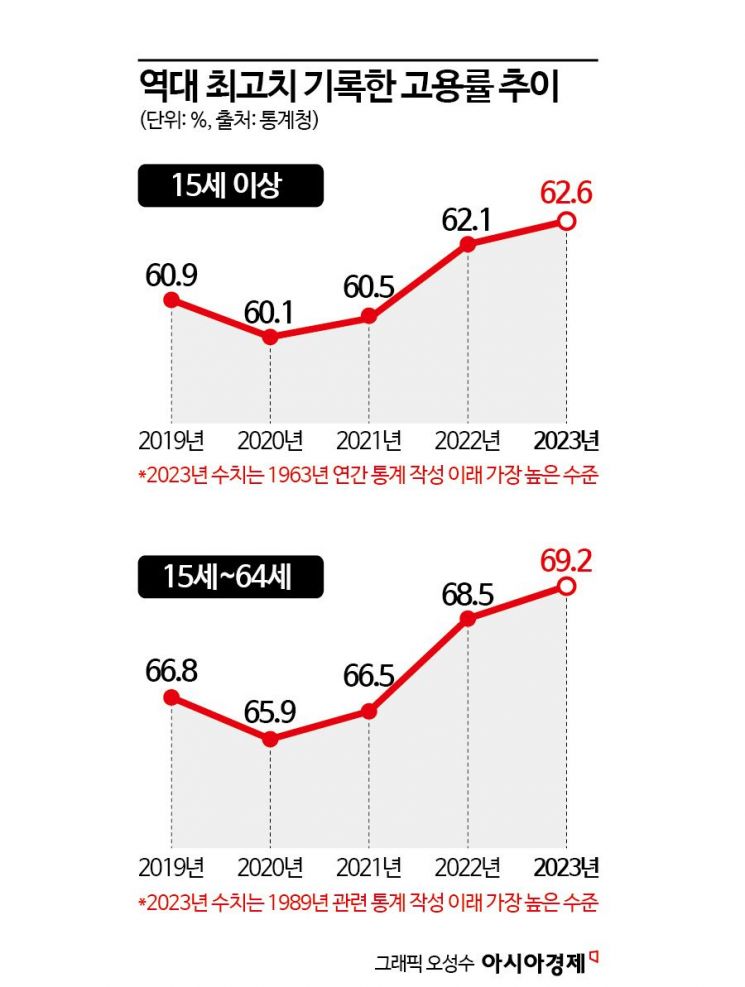
The overall employment rate (aged 15 and over) last year was 62.6%, up 0.5 percentage points from the previous year. This is the highest level since annual employment rate statistics began in 1963. The employment rate for the working-age population (15?64 years), based on the OECD standard, was also a record high at 69.2%, up 0.7 percentage points from the previous year, the highest since statistics began in 1989.
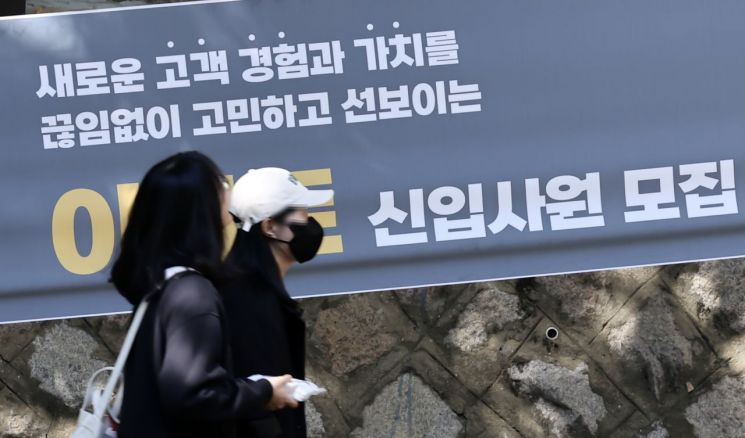 A banner related to employment hung at a university in Seoul on October 22. [Image source=Yonhap News]
However, there are some questionable points before celebrating. The increase in the employment rate is largely due to the elderly population. Breaking down the increase of 327,000 employed persons by age group shows that those aged 60 and over increased by 366,000, those in their 50s by 59,000, and those in their 30s by 54,000. In contrast, the number of employed persons in their 20s (aged 15?29) decreased by 98,000, and those in their 40s decreased by 54,000.
While there was strong employment growth among the elderly that exceeded the total increase in employed persons, employment among those in their 20s and 40s declined. Statistics Korea attributes the significant increase in elderly employment to the large elderly population and the growing demand for care labor in which they are engaged. From the perspective of responding to an aging society, the re-entry of the elderly into the labor market can be seen as encouraging. However, the decline in employment among people in their 20s, who are starting their economic activities, and those in their 40s, known as the 'economic backbone,' raises concerns.
Of course, the decrease in employment among the youth can also be seen as a result of a declining youth population. Seo Woon-ju, Director of the Social Statistics Bureau at Statistics Korea, responded to a question about the decline in youth employment rate during a briefing, saying, "The youth population is decreasing significantly, so the number of employed persons also decreases," and added, "There is also a tendency for youth to transition to non-economic activities such as continuing their studies."
It is noteworthy that the number of 'inactive' individuals who do not engage in job-seeking activities and thus are not counted in employment or unemployment statistics is increasing among the youth. According to the 'Supplementary Survey on Non-Wage Workers and Non-Economic Activity Population' released by Statistics Korea in November last year, the 'inactive' population increased by 83,000 from the previous year to 2,322,000. 'Inactive' refers to those in the non-economic activity population who do not have serious illnesses or disabilities but are not entering the labor market.
However, a professor at Yonsei University Business School pointed out, "It is a loss in terms of national productivity that people in their 20s and 40s, who are at prime working ages, are unable to work," adding, "Especially for young people in their 20s, failing to secure a job at a young age greatly increases the likelihood of losing value throughout their lifetime." The professor also noted, "After the collapse of Japan's bubble economy, young people who could not find jobs became hikikomori (social recluses), which became a social issue," warning, "If this happens, our society may end up bearing a significant burden of support costs for them."
To increase the employment rate among the youth, the government needs to prepare policy measures to reduce the employment burden on companies. The professor argued, "Companies feel burdened when hiring people in their 20s as regular employees because they tend to stay until retirement, whereas for those aged 60 and over, most jobs are low-wage, part-time work such as government elderly job programs," and emphasized, "Flexible employment and labor policies are necessary."
© The Asia Business Daily(www.asiae.co.kr). All rights reserved.
![Clutching a Stolen Dior Bag, Saying "I Hate Being Poor but Real"... The Grotesque Con of a "Human Knockoff" [Slate]](https://cwcontent.asiae.co.kr/asiaresize/183/2026021902243444107_1771435474.jpg)

















