Lee Seok-bae, Director of Quantum Energy Research Institute, Appears at First Public Event After LK-99 Controversy
Promotes Research and Verification Using Yonsei University's Quantum Computer
Claims China and Others Are Developing Similar New Materials, Emphasizes Need for National Support
Apologizes for Controversy but Does Not Disclose Verification Data
"What we have developed is indeed a superconductor. We will proceed with the process of objective verification through third-party domestic and international experts following legal procedures for commercialization as soon as the related preparations are completed."
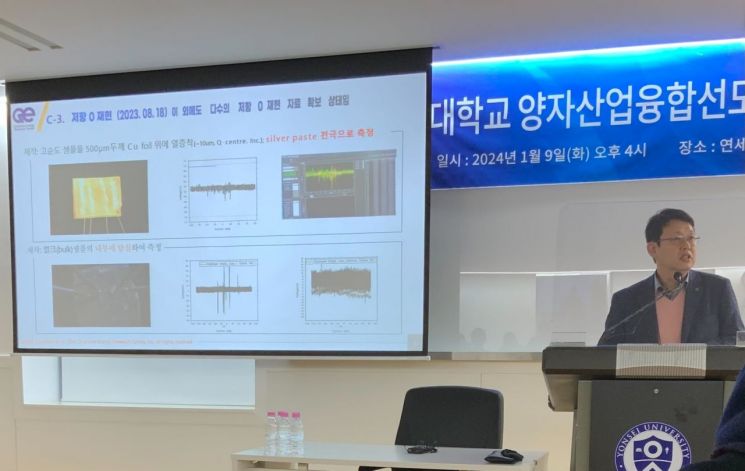 Lee Seok-bae, Director of the Quantum Energy Research Institute, is speaking at the Vision Declaration Ceremony of the Yonsei University Quantum Industry Convergence Leading Group held at Yonsei University on the 9th. Photo by Baek Jong-min
Lee Seok-bae, director of the Quantum Energy Research Institute who studied LK-99, which claims to be a room-temperature and ambient-pressure superconductor, stated that he will accelerate research and verification of room-temperature superconductors using quantum computers in collaboration with Yonsei University's Quantum Industry Convergence Leading Group. This stance directly challenges the scientific community's evaluation that LK-99 developed by the Quantum Energy Research Institute is not a room-temperature and ambient-pressure superconductor.
Director Lee appeared on the 9th at the vision declaration ceremony of Yonsei University's open Quantum Industry Convergence Leading Group (Director Lee Hak-bae, hereafter QILI). This is the first time Director Lee has appeared before the media since the LK-99 controversy last year.
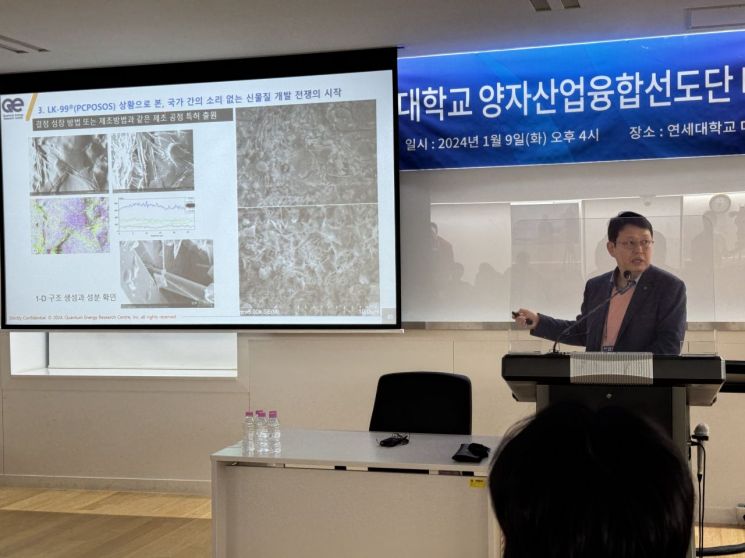 Lee Seok-bae, Director of the Quantum Energy Research Institute, is speaking at the Vision Declaration Ceremony of the Yonsei University Quantum Industry Convergence Leading Group held at Yonsei University on the 9th. Photo by Baek Jong-min
He claimed, "The material 'LK-99 (PCPOSOS)' possessing the unique characteristics of a superconductor, which the Quantum Energy Research Institute owns and researches, is indeed a superconductor," adding, "Instead of LK-99, we developed a material called 'PCPOSOS' with sulfur added, and confirmed that its resistance exhibits superconducting properties."
Director Lee said, "On August 18 last year, we created and confirmed a material that reproduced this, and we have secured numerous reproduction data showing zero resistance." He also introduced that Professor Kim Hyun-tak from William & Mary University in the U.S., who is conducting joint research, plans to present at a conference in March. Director Lee emphasized that the Quantum Energy Research Institute created this material based on the liquid state equation theory of the late Professor Choi Dong-sik from Korea University, highlighting that it is the result of over 20 years of effort and revealed the roots of the research.
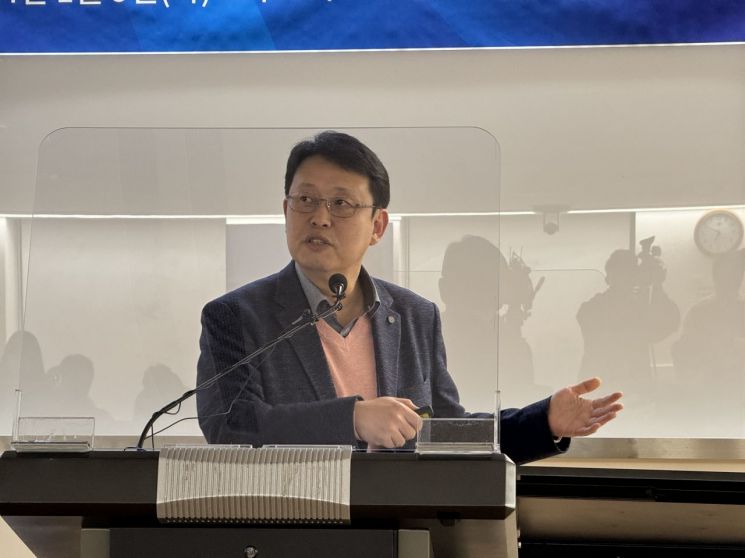 Lee Seok-bae, Director of the Quantum Energy Research Institute, is speaking at the Vision Declaration Ceremony of the Yonsei University Quantum Industry Convergence Leading Group held at Yonsei University on the 9th. Photo by Baek Jong-min
Director Lee said regarding the process of the LK-99 paper being released on a preprint site in July last year and the subsequent confusion, "The paper was posted during cross-verification, and I apologize for the problematic parts." He claimed that after the LK-99 release, numerous questions were answered and peer review is ongoing. The Quantum Energy Research Institute also announced that it will actively communicate in the future by distributing press releases after the event.
Director Lee also introduced, "After the LK-99 release, patent applications for manufacturing processes such as crystal growth methods or production methods are being filed in China. A silent new material development war between countries has begun." He explained that China is actively utilizing supercomputers for research and emphasized the reason for using quantum computers in research. Yonsei University will start operating a quantum computer at its Songdo Global Campus from June.
Lee Hak-bae, director of QILI, said, "Yonsei University has already gained extensive experience using IBM's quantum computer via cloud services. The quantum computer installed at Yonsei University will play a significant role in LK-99 research." This forecasted that the school will focus on providing computing power support for LK-99 during the initial phase of quantum computer adoption. Director Lee added, "Research on materials and drugs will be fully launched using Yonsei University's quantum computer, and I understand that cooperation with IBM research labs on material research is also being pursued in some areas."
Meanwhile, when asked to disclose information that could dispel doubts about LK-99, Director Lee responded on behalf of Director Lee Seok-bae, saying, "Coca-Cola does not disclose its intellectual property (IP), and Tesla also does not release its IP." Director Lee Seok-bae also explained the reason for not separately disclosing samples or resistance measurement data, stating, "As a company, it is difficult to disclose due to patent and other issues."
© The Asia Business Daily(www.asiae.co.kr). All rights reserved.
![Clutching a Stolen Dior Bag, Saying "I Hate Being Poor but Real"... The Grotesque Con of a "Human Knockoff" [Slate]](https://cwcontent.asiae.co.kr/asiaresize/183/2026021902243444107_1771435474.jpg)


















