Short-term Impact of Geopolitical Risks
The World Bank (WB) forecasted that the global economic growth rate will slow down for the third consecutive year in 2024 due to high interest rates, high inflation, and weakness in China. It diagnosed that the world is set to experience the 'worst five years' in 30 years. In particular, it expressed concern that escalating geopolitical risks in Ukraine, the Middle East, and other regions could act as new short-term risks to the global economy this year.
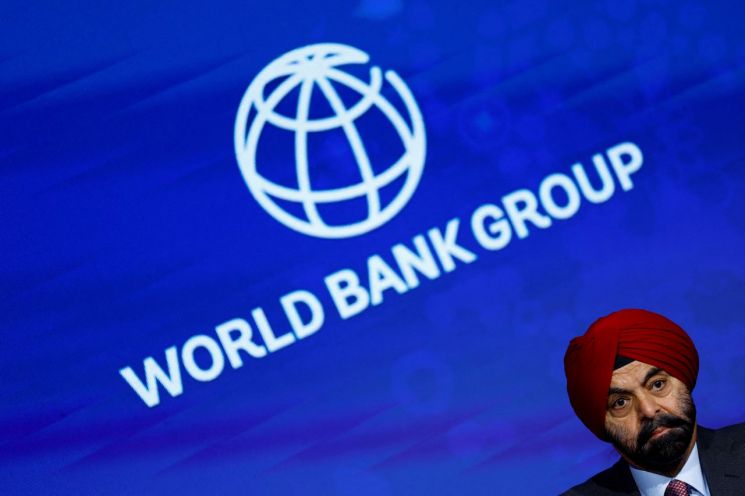
In its "Global Economic Prospects" report released on the 9th (local time), the WB projected the global economic growth rate for 2024 at 2.4%. This is the same as the growth forecast for this year presented in the June report last year. However, it is expected to fall below last year's growth rate (estimated at 2.6%), continuing a decline for the third consecutive year. The WB pointed out that this level is about 0.75 percentage points lower compared to the average of the 2010s.
The WB stated, "The world economy is going through the weakest five years in 30 years," diagnosing that "tight monetary policies, restrictive financial conditions, and fragile global trade are continuously weakening global economic activity." It also warned, "Following the pandemic and Russia's invasion of Ukraine, recent conflicts in the Middle East have heightened geopolitical risks and increased uncertainty in commodity markets, which could negatively impact global growth." The global economic growth rate is expected to rebound to 2.7% in 2025, but this is still 0.3 percentage points lower than the forecast presented in June last year.
In this report, the WB pointed out that escalating geopolitical tensions could become a new short-term risk to the global economy. If the war in the Middle East expands, it could lead to sharp rises in energy and raw material prices, broadly affecting global economic activity and inflation. Other risks include high real interest rates and financial stress, persistent inflation, weaker-than-expected growth in China, trade fragmentation, and disasters related to climate change. In particular, the growth rate of global trade is expected to remain at about half the average of the decade before the pandemic, which is anticipated to adversely affect developing countries and others.

Specifically, advanced economies such as the United States, the European Union (EU), and Japan are projected to grow by 1.2% throughout this year. This is the same as the forecast presented in June last year. However, it is 0.3 percentage points lower compared to last year's estimated growth rate. The U.S. economy is expected to grow by 1.6% this year. Although slower than last year's 2.5%, this is 0.8 percentage points higher than the previous forecast, supported by robust consumer spending. Japan's growth forecast for this year was also raised by 0.2 percentage points to 0.9%. On the other hand, the EU region's growth forecast for this year (0.7%) was revised downward by 0.6 percentage points compared to the previous forecast.
China's economic growth rate is expected to slow from the 5% range last year to 4.5% this year. The WB stated, "This is the slowest pace in 30 years since the pandemic. Growth slowdown will continue due to lukewarm consumer sentiment and persistent real estate downturn," adding, "If China falls short of expectations by 1 percentage point, it could cause a negative spillover effect, reducing overall global growth by 0.2%."
This slowdown in China's growth is inevitably expected to impact developing countries. The growth rates for emerging economies and developing countries were presented as 4.0% last year and 3.9% this year. The WB noted, "With growth slowing in most major economies, weak global trade, and the tightest financial conditions in decades, the medium-term outlook for many developing countries has darkened," emphasizing that "the 3.9% growth forecast for developing countries is more than 1 percentage point lower than the average of the past decade."
Indermit Gill, Chief Economist of the WB Group, warned, "Short-term growth will remain weak, and many developing countries, especially the poorest, will fall into traps," adding, "Without a major course correction, the 2020s will be recorded as a decade of missed opportunities." Meanwhile, the report did not include a forecast for South Korea.
© The Asia Business Daily(www.asiae.co.kr). All rights reserved.
![Clutching a Stolen Dior Bag, Saying "I Hate Being Poor but Real"... The Grotesque Con of a "Human Knockoff" [Slate]](https://cwcontent.asiae.co.kr/asiaresize/183/2026021902243444107_1771435474.jpg)












