'Ban on Dog Meat Consumption' Passed by Bipartisan Agreement
Dog Breeders Association Demands 2 Million Won Support Per Dog
Animal Rights Groups Welcome as "A New Chapter in History"
With the passage of the 'Special Act on the Prohibition of Dog Meat Consumption' through the National Assembly, the breeding, slaughter, and distribution of dogs will be completely banned starting in 2027.
However, support measures for the dog meat industry have yet to be established, and some critics argue that this represents excessive regulation of traditional food culture. Although the bill was passed through bipartisan agreement, social challenges remain to be addressed.
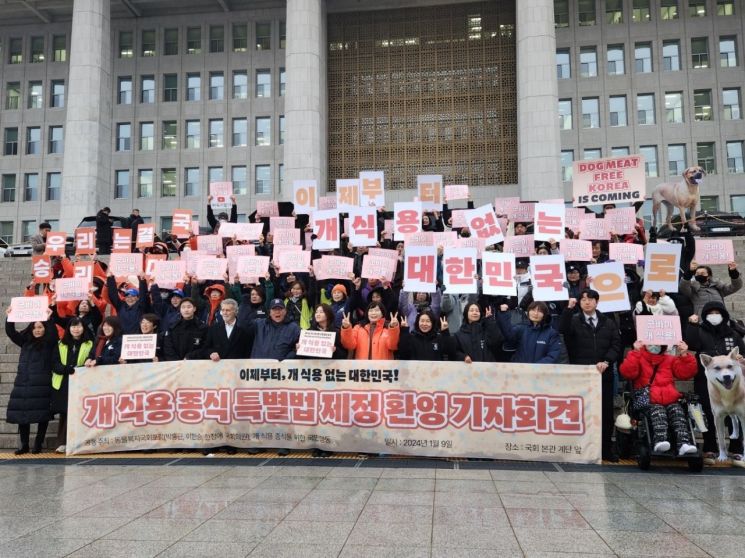 On the afternoon of the 9th, the "National Action to End Dog Meat Consumption" held a press conference in front of the National Assembly Main Building to welcome the passage of the Special Act to End Dog Meat Consumption.
 [Photo by Im Chunhan]
Compensation Expected to Reach Up to 4 Trillion Won... Government Reluctant
A Ministry of Agriculture, Food and Rural Affairs official said in a phone interview with Asia Economy on the 10th, “The dog meat industry is requesting compensation for five years of losses, but we cannot support all of it,” adding, “We plan to provide support within a reasonable range through discussions with related ministries and organizations. No details have been finalized yet.”
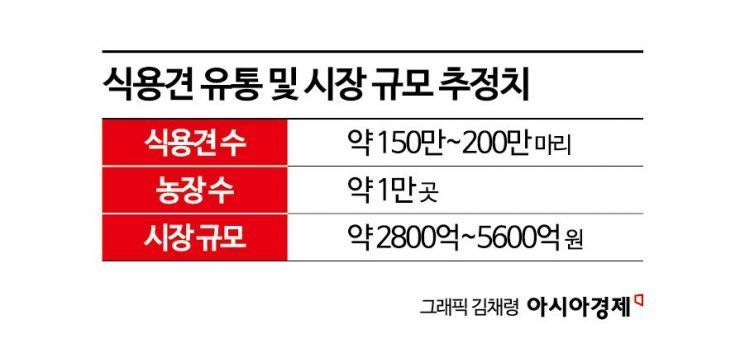
According to the related industry, approximately 1.5 to 2 million dogs are distributed annually for consumption in South Korea, with around 10,000 dog meat farms. The dog meat market size is estimated to be between 280 billion and 560 billion won. The Korea Dog Meat Association demands compensation of 2 million won over five years, calculating annual income per dog at 400,000 won. In this case, government compensation for business closures alone could cost up to 4 trillion won, and additional budgets will be needed considering support for career changes.
The Dog Meat Association stated, “Whether to consume dog meat is a matter of the people's food sovereignty and fundamental rights. Unilaterally legislating a ban on dog meat consumption without gathering opinions from the parties involved or the public is an abuse of power by the government and legislature,” and insisted, “Permanent compensation and support measures corresponding to the complete closure of the entire industry must precede.”
The 'Special Act on Ending the Breeding, Slaughter, and Distribution of Dogs for Consumption,' approved at the National Assembly plenary session on the 9th, prohibits breeding or increasing the number of dogs for consumption purposes, slaughtering them, and distributing or selling foods cooked or processed using dogs as raw materials. Violations are punishable by imprisonment of up to three years or a fine of up to 30 million won, and breeding, increasing, or distributing dogs is punishable by imprisonment of up to two years or a fine of up to 20 million won.
The law also includes provisions to support the closure and career changes of dog breeders, dog meat-related slaughter and distribution merchants, and dog meat-related food service businesses. The ruling party and government officially announced the push for the enactment of the special law in November last year, and the Democratic Party adopted the bill as a party policy.
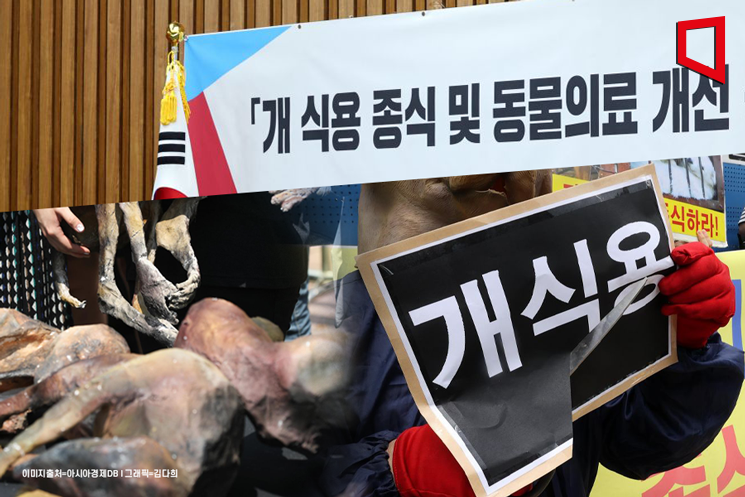
'Animal Rights vs. Food Culture' Debate Continues
Animal rights groups welcomed the bill’s passage, saying, “South Korea has opened a new chapter in respecting life.” The 'People’s Action to End Dog Meat Consumption' held a press conference at the National Assembly on the afternoon of the 9th, emphasizing, “The government should promptly carry out procedures to end dog meat consumption while finding ways to minimize the sacrifice of dogs,” and “It must encourage the rapid closure or conversion of dog meat facilities and never allow animals to be used as tools for compensation during this process.”
However, there is also a significant public opinion opposing the legislation even among those who do not support dog meat consumption.
Office worker Kim (31) said, “I don’t deliberately seek out dog meat, but I consider it a type of food,” and criticized, “It’s a bit strange to ban only dogs when it doesn’t negatively affect public health.” Housewife Baek (62) said, “I don’t eat dog meat, but I have friends who like it,” and added, “I’m not sure if it’s that different from eating beef, pork, or chicken.”
© The Asia Business Daily(www.asiae.co.kr). All rights reserved.
![Clutching a Stolen Dior Bag, Saying "I Hate Being Poor but Real"... The Grotesque Con of a "Human Knockoff" [Slate]](https://cwcontent.asiae.co.kr/asiaresize/183/2026021902243444107_1771435474.jpg)


















