US Expected to Issue $4 Trillion in Treasury Bonds This Year
Fiscal Deficit Ratio to GDP Projected at 6.5-8% Over 4 Years
Fiscal Expansion Promises Increase Ahead of Election
As borrowing costs surge due to high interest rates, governments around the world are expected to significantly increase government bond issuance again this year. With major elections scheduled in key countries including the United States, candidates are making excessive promises to increase fiscal spending, raising concerns that already risky global public debt could surge further. The likelihood of warning signs being triggered for fiscal deficits and national credit ratings has increased not only for developing countries but also for advanced economies.
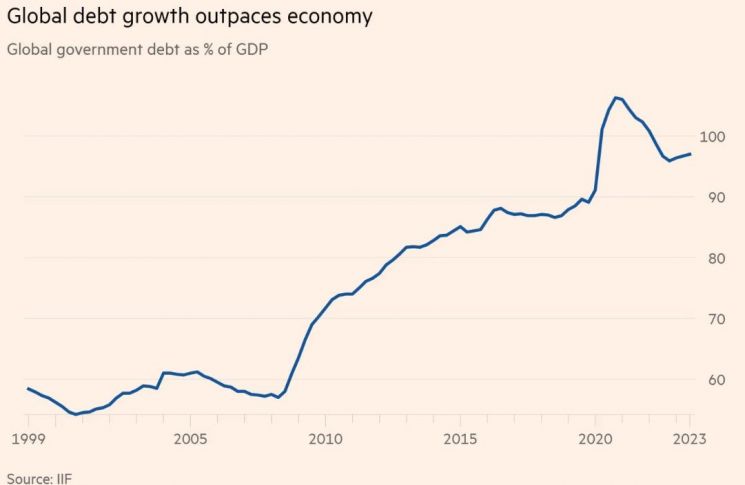
According to major foreign media on the 8th (local time), the scale of government bond issuance by the US and UK governments this year is expected to be the largest ever, excluding the COVID-19 pandemic period.
Apollo Global Management estimated that the US Treasury will issue about $4 trillion worth of 20- to 30-year government bonds this year, a significant increase from $3 trillion last year. RBC Capital Markets projected that the net issuance of US government bonds, considering the Federal Reserve's bond purchases and maturing existing bonds from the end of August last year to the end of September this year, will reach $1.6 trillion, the second highest level ever. Excluding the pandemic period when governments and central banks injected money to prevent the economic shock caused by COVID-19, this would be the largest volume of government bond issuance in history. There are also expectations that the US net issuance of government bonds will surpass pandemic levels in 2024-2025.
The UK is also expected to see government bond issuance reach its highest level since the pandemic year of 2020. The net issuance volume is anticipated to be about three times the average of the past decade.
The net issuance of government bonds in the 10 major European Union (EU) countries is also estimated to increase by 18% compared to a year ago, reaching 640 billion euros.
Not only advanced countries but also emerging markets are expected to significantly increase government bond issuance. According to the Institute of International Finance (IIF), the government debt-to-GDP ratio of emerging markets reached a record high of 68.2% last year, and this ratio is expected to rise further this year.
Accordingly, the global debt-to-GDP ratio is believed by the IIF to have surged from 334% at the beginning of 2023 to over 337% by the end of 2023. According to IIF estimates, global debt reached a record high of $307 trillion in the first half of last year.
The main reasons for governments significantly increasing government bond issuance are the rapid monetary tightening by central banks over the past two years and the resulting surge in borrowing costs. Although the Federal Reserve and other major central banks are expected to start cutting interest rates this year, rates are still projected to remain high compared to pre-tightening levels. Expansion of government fiscal spending is also one of the causes of rising debt. For example, the Biden administration in the US has greatly increased government spending by strengthening climate response and industrial policies through the Inflation Reduction Act (IRA) and the CHIPS and Science Act (CSA).

In particular, concerns are growing that debt levels could increase further this year as major countries such as the US and UK hold elections. Presidential candidates in various countries may excessively promise increased government spending to win voters' support. Ahead of the US presidential election in November, former President Donald Trump has introduced tax cut proposals. UK Prime Minister Rishi Sunak has also announced plans to consider tax cuts such as abolishing the 40% inheritance tax ahead of the expected general election in the second half of this year.
David Zahn, Head of European Bonds at asset management firm Franklin Templeton, warned, "The two frontrunners, President Biden and former President Trump, will likely maintain high levels of government spending even after the election, which will ultimately cause significant problems for the US."
In fact, the US has already fallen into a vicious cycle of expanding fiscal deficits by indiscriminately increasing government bond issuance. According to the International Monetary Fund (IMF), the US fiscal deficit as a percentage of GDP is expected to reach 6.5-8% over the next four years, sharply rising from below 4% in 2022. As the US fiscal situation deteriorated, global credit rating agency Fitch downgraded the US sovereign credit rating in August last year. Moody's also lowered the US rating outlook three months later.
The IIF stated, "If the upcoming elections lead to populist policies, government borrowing will increase further, and the fiscal restraint stance may be further relaxed. If government spending suddenly rises after this global election season, the burden on many countries already facing high interest costs could become even heavier."
© The Asia Business Daily(www.asiae.co.kr). All rights reserved.


















