UNIST Professor Jang Sung-yeon’s Team Develops 'Solar Cell' with Specially Designed Anode Intermediate Layer
Also Applied to Green Hydrogen Production Technology, Published in Advanced Energy Materials
A technology to improve the stability of perovskite solar cells has been developed. With high efficiency and long-term operation capability, it is expected to commercialize perovskite solar cells and impact green hydrogen production technology.
UNIST (President Yong-Hoon Lee) announced on the 9th that a research team led by Professors Sung-Yeon Jang, Jung-Ki Ryu, and Ji-Wook Jang from the Department of Energy and Chemical Engineering, together with Professor Sang-Kyu Kwak’s team from Korea University, developed a tin-lead halide perovskite solar cell with high stability and efficiency.
According to the research team, a specially designed cathode interlayer was inserted between the tin-lead halide perovskite active layer and the metal electrode. This is a groundbreaking technology that simultaneously improves the stability and efficiency of the solar cell device.
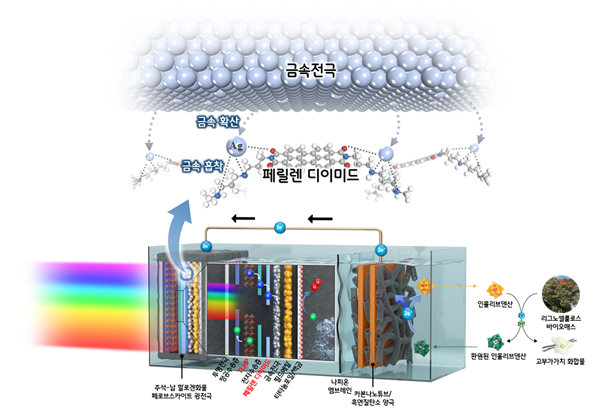 A schematic diagram of a photoelectrochemical device with enhanced stability using perylene diimide molecules that act as a chemical barrier to metal ion diffusion.
Professor Sung-Yeon Jang explained, “We proposed a new structure of a photoelectrochemical device that can produce high-efficiency green hydrogen by utilizing the developed solar cell as a photoelectrode.”
Metal halide perovskites have excellent ‘photoelectron’ properties that emit electrons when exposed to light energy, making them promising materials in solar energy applications.
In particular, mixed tin-lead halide perovskites (TLHP) can absorb sunlight from the visible to near-infrared regions, making them important materials for developing high-efficiency solar cells.
However, TLHP has lower atmospheric stability than lead-based perovskites, making it difficult to utilize the material’s advantages.
The research team introduced aliphatic amine-functionalized perylene diimide as a cathode interlayer that can chemically protect TLHP. Perylene diimide is inserted into the upper layer of the perovskite, the photoactive layer that produces electricity upon light absorption.
It not only efficiently transports electrons but also acts as a chemical barrier, significantly enhancing stability.
Devices applying perylene diimide showed a high photoelectric conversion efficiency (23.21%) and maintained over 81% of the initial efficiency after operating for 750 hours at 60 degrees Celsius, demonstrating high stability.
 UNIST ID photos, top row from left: Professor Jeongki Ryu, Professor Jiuk Jang, Professor Seongyeon Jang; bottom row (all first authors) from left: Research Assistant Professor Yuri Choi, Researcher Muhibullah Al Mubarok, Researcher Rashmi Mehrotra.

The research team also utilized the developed technology as a photoelectrode for hydrogen production. They used TLHP-based photoelectrodes to harness electrons generated during the decomposition of lignocellulosic biomass such as agricultural waste.
Without external power, it showed a record solar hydrogen production rate of approximately 33.0 mA/cm2 (~3.42×10⁻⁶ kg·s-1·m-2). This value exceeds the final target for solar hydrogen production under 1-sun conditions set by the U.S. Department of Energy.
Professor Sung-Yeon Jang of the Department of Energy and Chemical Engineering said, “Through this research, we have dramatically increased the long-term stability of tin-lead based perovskite solar cells, which was one of the major issues. Our ultimate goal is not only to convert light energy into electrical energy but also to advance to the stage where we can produce fundamental industrial chemicals such as hydrogen in an eco-friendly manner.”
The study involved first authors Muhibullah Al Mubarok, a combined MS-PhD course researcher at UNIST; Assistant Research Professor Yuri Choi; Rashmi Mehrotra, a combined MS-PhD course researcher; and Yujin Kim, a combined MS-PhD course researcher at Korea University.
The research results were published online on November 30 last year in Advanced Energy Materials. The research was supported by the National Research Foundation (NRF) of Korea under the Ministry of Science and ICT.
© The Asia Business Daily(www.asiae.co.kr). All rights reserved.
![Clutching a Stolen Dior Bag, Saying "I Hate Being Poor but Real"... The Grotesque Con of a "Human Knockoff" [Slate]](https://cwcontent.asiae.co.kr/asiaresize/183/2026021902243444107_1771435474.jpg)


















