A research team led by Professor Jimmyeong Guk from the Department of Astronomy and Space Science at Yonsei University announced on the 8th that they have succeeded for the first time in the world in detecting dark matter filaments shaped like spiderweb structures that form the cosmic skeleton by utilizing gravitational lensing phenomena.
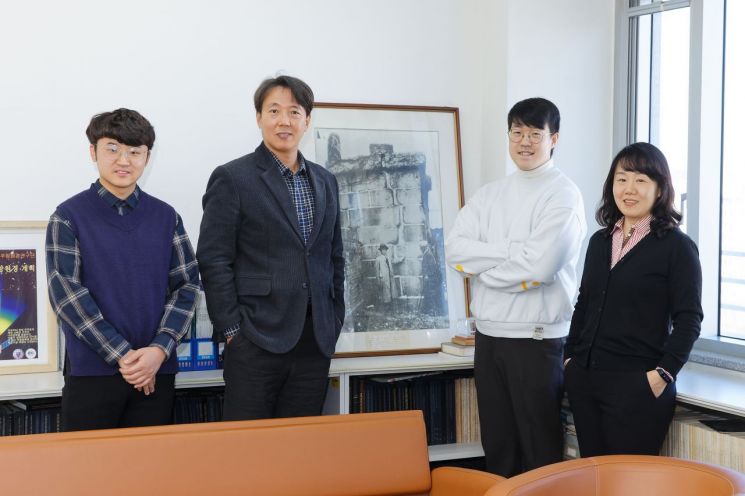 Researcher Cha Sang-jun, Professor Ji Myung-guk, Researcher Kim Hyung-han, Research Professor Cho Hye-jeon at Yonsei University (from left).
[Photo by Yonsei University]
By analyzing observational data obtained through gravitational lensing, the research team detected dark matter filaments extending from the Coma Cluster located 320 million light-years away from Earth.
Dark matter is estimated to account for about 25% of the universe, but it emits no light and neither absorbs nor reflects external light, so it can only be detected through its gravitational effects.
The research team used the gravitational lensing data from the Subaru Telescope at the Mauna Kea Observatory in Hawaii. By utilizing gravitational lensing phenomena, it is possible to measure the degree to which light from background objects is bent by the gravity of foreground objects, allowing the mass of the foreground to be determined. This takes advantage of the property that dark matter in the foreground, which has gravity but is invisible, can bend light.
The team reportedly analyzed the observational data using advanced optical image processing technology and big data statistical analysis techniques.
Professor Ji said, “This research result directly observes and verifies the evolution process of the large-scale structure of the universe, which previously existed only as a theory. It is expected to play a significant role not only in understanding the origin and evolution of the universe but also in verifying the standard cosmology.”
The research findings were published on the 5th (local time) in 'Nature Astronomy' (IF 14.1), a top-tier academic journal in the field of astronomy.
© The Asia Business Daily(www.asiae.co.kr). All rights reserved.

















