Changes in Real Estate Regulations in 2024
Up to 60 Payments Recognized for Minor Subscription Savings
Broker Information Must Be Included in Lease Reporting
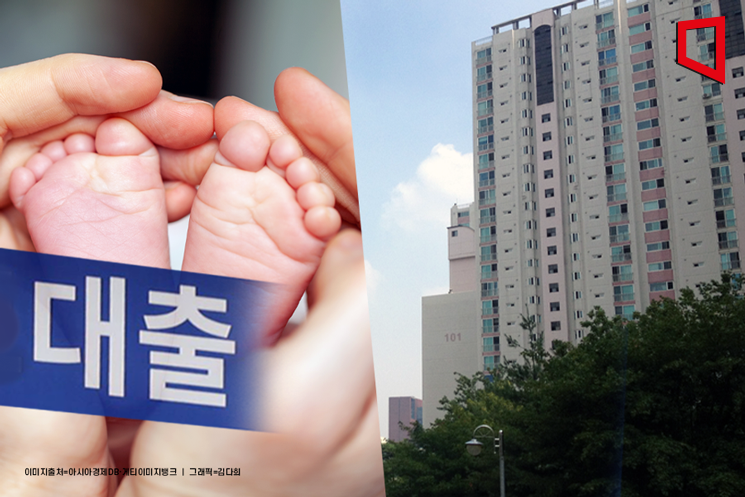
The two main pillars of the real estate system changing from this year are support policies for newlyweds who marry and have children, and deregulation of redevelopment projects.
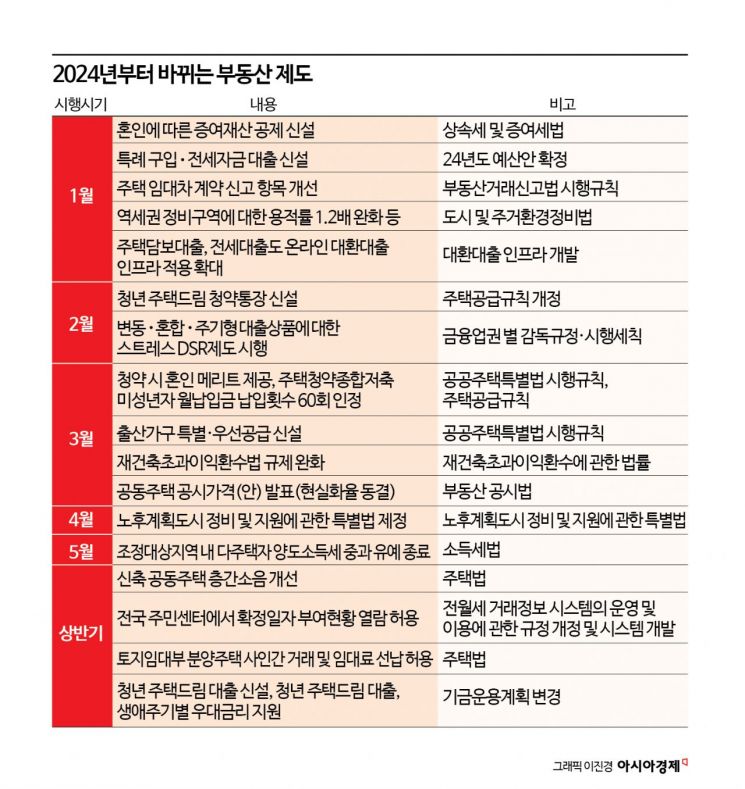
On the 8th, Zigbang summarized and announced the real estate-related systems changing from 2024. In January, the marriage gift property deduction and the special housing purchase and jeonse loan system for newborns will be implemented, and from March, a special and priority supply system for households with children will be introduced.
Special Newborn Loans from January, Priority Supply for Childbearing Households from March
The special purchase and jeonse loans with low interest rates for households with newborns will be implemented from this month. For home purchase funds, households without a home who have given birth within 2 years from the loan application date (from children born in 2023) and meet income requirements can borrow up to 500 million KRW when purchasing a home priced at 900 million KRW or less. A special interest rate of 1.6% to 3.3% will be applied for 5 years, and if additional children are born after the special loan, the interest rate will be further reduced by 0.2 percentage points per newborn and the special period extended.
Special supply benefits for childbearing households will also be newly established. From March, about 70,000 units per year will be specially and preferentially supplied to households with children aged 2 or under (including fetuses) as of the announcement date of tenant recruitment. This includes public sale New:Home newborn special supply (sharing type 35%, selective type 30%, general type 20%), private sale newborn priority supply (20% of first-time buyers and newlywed special supply), and public rental newborn priority supply (10%).
From March, the subscription system will also change to favor marriage and childbirth. Currently, if both spouses apply separately for subscriptions announced on the same day (public/private, general/special supply) and both win, all are invalidated. Going forward, if there are duplicate wins, the first application will be considered valid. Couples will be able to apply individually for the same complex. For private sale general supply point-based subscriptions, the subscription savings period of both the applicant and spouse (50% of the spouse's period, up to 3 points) can be combined, making it more advantageous than for singles.
Changes to enhance the effectiveness of the Housing Subscription Savings account are also notable. Previously, only up to 24 monthly payments of housing subscription savings by minors were recognized when selecting tenants in general supply, but this will be expanded to 60 payments. For private housing general supply, the point system only recognized up to 2 years of subscription period for minors, but this will be extended to 5 years. When point scores are equal, those with longer subscription periods will be prioritized. These changes will be implemented from March 25 through amendments to the Housing Supply Regulations.
Youth Housing Dream Subscription Launching in February... Up to 80% of Sale Price Supported if Selected
The 'Youth Housing Dream Subscription Account' to help young people build assets will also be launched in February. If selected through this account, low-interest loans up to 80% of the sale price can be supported through the 'Youth Housing Dream Loan' established in December. Eligible applicants are non-homeowners aged 39 or younger, with income limits of 70 million KRW or less for singles and 100 million KRW or less for married couples. After being enrolled in the Youth Housing Dream Subscription Account for more than one year and paying in at least 10 million KRW, applicants purchasing homes priced at 600 million KRW or less with exclusive area under 85㎡ can borrow up to 40 years at a minimum interest rate of 2.2%. Additional preferential interest rates will be provided for marriage and childbirth after winning the subscription.
With the rise of jeonse fraud issues, the reporting items for housing lease contracts have also been expanded. This is to resolve difficulties in investigation and enforcement caused by the absence of licensed real estate agent information in the reporting items when disputes arise in jeonse or monthly rent contracts. The government amended the 'Real Estate Transaction Reporting Act Enforcement Rules (Article 6-2, Paragraph 1)' in January to add the office location, representative name, registration number of the licensed real estate agent who mediated the lease contract, as well as the names and contact information of affiliated licensed agents. From as early as the first half of the year, residents will be able to view the status of confirmed dates granted at local community centers nationwide. If tenants have been granted a confirmed date, the inconvenience of having to visit the community center of the relevant location without a contract to view moving-in households will be resolved.

Considering high interest rates and inflation, the market reflection rate of the official property price, which serves as the tax base for property holding tax in 2024, will be kept the same as in 2023. The market reflection rate applied to the 2024 official property price has been frozen at the 2020 level before the plan was established. The average market reflection rates for 2024 are 69% for apartment complexes, 53.6% for detached houses, and 65.5% for land.
Raising the Threshold for Exemption of Reconstruction Excess Profits and Relaxing Floor Area Ratio in Station Area Redevelopment Zones
The regulation on the Reconstruction Excess Profit Recoupment Act has been eased. The excess profit exemption amount, which exempts reconstruction charges, has been raised from the current 30 million KRW to 80 million KRW, and the unit of the charge rate determination range has been expanded from 20 million KRW to 50 million KRW. The starting point for calculating excess profits, which determines the charge basis, has been adjusted from the approval date of the promotion committee to the date of association establishment approval. This system is scheduled to be implemented from March.
To expand urban housing supply, the floor area ratio in redevelopment zones located in station areas can be relaxed up to 1.2 times, and part of the supply can be allocated as New:Home (public sale). Residents wishing to carry out redevelopment projects can request the relevant local government to draft redevelopment plans. The amended Urban and Residential Environment Redevelopment Act will be applied from the 19th.
Regulations on the supply of land lease-type sale housing will also be improved. Currently, land lease-type sale housing can only be publicly repurchased by the Korea Land and Housing Corporation (LH), but going forward, a resale restriction period within 10 years will be set, and after this period, free trading will be possible. If repurchased by the public during the resale restriction period, the public will buy at the 'current sale price + average interest of 1-year term deposit,' but in the future, the purchase price will be differentiated according to the holding period. The public repurchase entity will also be adjusted from the current Korea Land and Housing Corporation to the actual public housing project operator who supplied the housing.
The 'Special Act on Aging Planned Cities' integrating reconstruction of first-generation new towns will be implemented from April. The applicable targets are sites over 1 million square meters where land development projects were completed more than 20 years ago. Through integrated redevelopment, various regulatory special cases such as easing or exemption of safety inspections, floor area ratio increases, and integrated reviews can be granted to special redevelopment zones to facilitate smooth redevelopment projects.
Ham Young-jin, head of Zigbang Big Data Lab, said, "The operation of various real estate asset products is accompanied by variables such as taxes and changes in real estate policies and systems. Subscription, mortgage loan incentives vary depending on marriage, childbirth, household size, and age group, and tax policies such as property holding tax and income tax are constantly evolving. It is necessary to familiarize oneself with the changing systems in advance and actively utilize them for asset management that suits oneself."
© The Asia Business Daily(www.asiae.co.kr). All rights reserved.
![Clutching a Stolen Dior Bag, Saying "I Hate Being Poor but Real"... The Grotesque Con of a "Human Knockoff" [Slate]](https://cwcontent.asiae.co.kr/asiaresize/183/2026021902243444107_1771435474.jpg)


















