"Lee Jae-myung Leaves a Very Bad Precedent" Flood of Criticism
Busan Medical Association: "Ignoring Local Medical Community"
Claims of Confusion Arising in Medical Field
Lee Jae-myung, leader of the Democratic Party of Korea, was stabbed with a weapon in Busan on the 2nd and was transferred by 119 helicopter from the Regional Trauma Center at Busan National University Hospital to Seoul National University Hospital, sparking ongoing controversy in the medical community. The consensus among medical professionals is that the decision to transfer Lee to Seoul National University Hospital bypassed local medical care by utilizing various privileges. Medical staff at Busan National University Hospital had already prepared for surgery, and it is reported that there was some resistance at the time of the transfer.
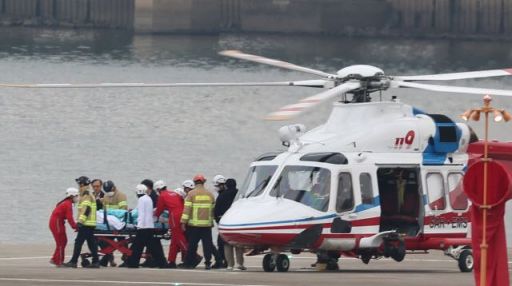 During his visit to Busan, Lee Jae-myung, leader of the Democratic Party of Korea, who was stabbed with a weapon, is being transported from the Noryangjin Helicopter Pad in Yongsan-gu, Seoul, to Seoul National University Hospital on the 2nd.
 [Photo by Yonhap News]
On the 5th, Yeo Han-seul, head of the Emergency Medicine Department at Sokcho Medical Center, stated on his social media (SNS), "If a patient with a stab wound around the neck comes to Sokcho Medical Center where I work, regardless of medical protocol hierarchy, we would not initially admit the patient. It is appropriate to transfer the patient quickly to a higher-level general hospital capable of surgical treatment. To clarify the facts, Lee visited the Regional Trauma Center at Busan National University Hospital, one of the top trauma hospitals in Korea. On the other hand, we cannot dare to criticize the professor and medical staff who performed the surgery at Seoul National University Hospital," he said.
However, Dr. Yeo added, "I write this with anxiety, hoping such incidents do not occur. When patients who cannot be treated here need to be transferred to other hospitals, some refuse to ride private ambulances that cost money and request 119 ambulances, which are free," expressing concern. "I am just a doctor working in a local area who absolutely does not want to see the collapse of Korea's emergency medical system," he said.
Lee Kyung-won, Public Relations Director of the Korean Society of Emergency Medicine (Yongin Severance Hospital), pointed out, "If surgery was not possible at Busan National University Hospital, the first step should have been to contact other hospitals in the Busan area capable of surgery and request transfer. If that was not possible, they should have checked the possibility of transfer to nearby Daegu. How can the transfer request to Seoul National University Hospital, ignoring this procedure, be considered as following the emergency medical system protocol?"
Director Lee continued, "It is common for patients to be transferred to hospitals in their desired regions. However, in cases of severe emergency diseases or severe trauma patients, when a hospital with sufficient treatment capability is preparing for surgery and admission, how can we explain to patients or families who request transfer by helicopter to Seoul National University Hospital, which is 'better'?" He warned, "If cardiac arrest occurs, it could lead to the tragic loss of precious lives."
He added, "Please do not let politics ruin the emergency medical system. This area should not be influenced by political or factional logic," emphasizing, "Ignoring and shaking the regional emergency medical system and transferring patients according to the wishes of guardians will prevent the emergency medical system from being properly maintained, and the general public will suffer the most as a result."
Im Hyun-taek, representative of the Doctors for the Future group and president of the Korean Pediatric Society, said, "There are many good hospitals in the provinces. If lawmakers advocating for the regional doctor system and the establishment of regional medical schools do not set an example by visiting those hospitals themselves, who else will?" He criticized, "Lawmakers try to receive treatment at Big 5 hospitals when they or their families are sick, while telling their constituents to be treated at newly established, lower-level regional medical schools."
He continued, "Lawmakers ignore local and public medical care when they use medical services themselves. How can they prevent patients from flocking from the provinces to Seoul Station or Suseo Station?" He criticized, "The biggest problem ahead is that when problems arise in the provinces, other patients will also try to call helicopters. What justification is there to stop this?"
Busan Medical Association: "We must strongly condemn the Democratic Party for ignoring local medical communities and trampling on the medical delivery system"
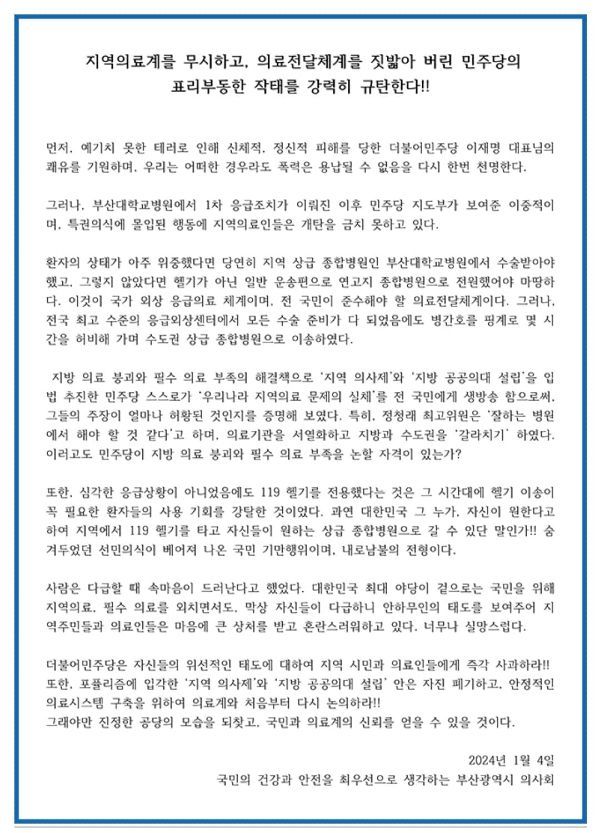 Statement from the Busan Medical Association condemning the Democratic Party of Korea for ignoring the local medical community and trampling on the medical delivery system.
 [Photo by Busan Medical Association]
The Busan Medical Association issued a statement titled "Strongly condemning the Democratic Party's hypocritical behavior that ignores the local medical community and tramples on the medical delivery system," wishing for Lee's speedy recovery while criticizing, "After the first emergency treatment was performed at Busan National University Hospital, the double-faced and privilege-obsessed behavior shown by the Democratic Party leadership has left local medical professionals deeply disappointed."
They added, "If the patient's condition was very critical, surgery should have been performed at Busan National University Hospital, the regional tertiary hospital. If not, the patient should have been transferred to a regional general hospital by regular transport, not by helicopter. This is the national trauma emergency medical system and the medical delivery system that all citizens must follow." They pointed out, "However, despite all surgical preparations being completed at the nation's top-level emergency trauma center, the patient was transferred to a metropolitan tertiary hospital, wasting several hours under the pretext of nursing care."
The Busan Medical Association stated, "The Democratic Party, which legislated the 'regional doctor system' and 'establishment of regional public medical schools' as solutions to the collapse of local medical care and shortage of essential medical services, has live-broadcasted the reality of Korea's regional medical problems to the entire nation, proving how hollow their claims are." They added, "Using a 119 helicopter when it was not a serious emergency deprived other patients who truly needed helicopter transport during that time."
The National Doctors' Association (Jeonui-chong) said in a statement, "The Democratic Party's response after Lee's stabbing was medically inappropriate," criticizing, "They transferred him to Seoul National University Hospital by emergency helicopter simply because the guardian requested it. This is a manifestation of the Democratic Party's hypocritical sense of privilege, pretending to care for local medical care. It was a dangerously risky decision that threatened Lee's life."
Jeonui-chong added, "Medicine is a science and a professional field trained to reach the same conclusion on the same issue. As professionals, we are dismayed that even medicine is being used as a political tool." They strongly criticized the Democratic Party for "manipulating and mocking medical facts to suit their agenda" and condemned their "hypocritical sense of privilege, insisting on metropolitan hospitals while pretending to care for local medical care."
Doctors: "It is difficult to persuade patients who ask for ambulances"
Claims have already emerged that confusion is occurring in the medical field. On an online community, a user who verified as a doctor, A, posted on the 4th a message titled "It is difficult to persuade patients who ask for ambulances saying they want to be transferred to Seoul like Lee Jae-myung."
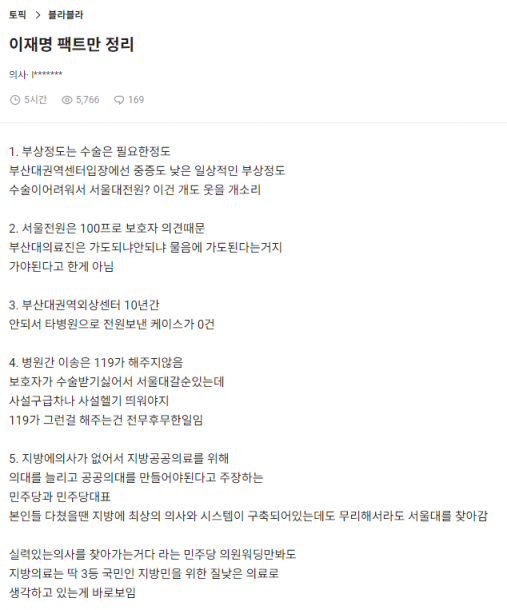 A post written by a netizen verified as a doctor on the anonymous workplace community 'Blind.'
 [Photo by online community 'Blind']
A said, "A patient undergoing surgery for acute cholecystitis wanted to go to a hospital in Seoul, so I wrote a transfer referral, but they asked me to call a 119 ambulance. I am exhausted trying to persuade them that it is not possible." He added, "They insist on why they cannot ride the ambulance. Lee Jae-myung left a very bad precedent, and just thinking about persuading people who want to be transferred to Seoul by 119 ambulance makes me sigh. Our hospital can perform the surgery, but persuading patients who refuse because it's in the provinces is also exhausting."
Another verified doctor, B, said, "119 does not provide hospital-to-hospital transfers. Guardians may refuse surgery and want to go to Seoul National University Hospital, but they must use private ambulances or private helicopters. 119 has never done such things." He criticized, "The Democratic Party and its leader, who advocate increasing medical schools and establishing public medical schools for local public medical care due to lack of doctors in the provinces, went to Seoul National University Hospital even though the best doctors and systems were established locally when they were injured." He added, "When the Democratic Party says 'they are going to skilled doctors,' it shows they consider local medical care as low-quality care for third-class citizens in the provinces."
Previously, Lee and the Democratic Party had raised their voices to fix the social problem of patients concentrating in large hospitals. They pointed out the medical gap between metropolitan and non-metropolitan areas, set the establishment of public medical schools in each region as a key task, and are promoting the introduction of a regional doctor system to have newly graduated doctors work in local areas for ten years. In this context, Lee's bypassing of Busan National University Hospital has been criticized as completely opposite to the existing policy line. This is because contradictory privileges were applied, contrary to the legislation pushed forward despite opposition from the medical community. The problem is considered greater because it occurred in an emergency situation rather than general treatment.
Meanwhile, on the morning of the 2nd, at around 10:27 a.m., Lee was stabbed in the left neck area by Kim (67) near Daehang Observatory in Gadeokdo, Gangseo-gu, Busan. After the attack, Lee was admitted to Busan National University Hospital and then transferred by helicopter to Seoul National University Hospital, where he underwent about two hours of venous vascular reconstruction surgery and is currently recovering.
© The Asia Business Daily(www.asiae.co.kr). All rights reserved.



















