Sejong Institute of Science and Technology (SAIST) announced on the 6th that it held an advanced new drug development seminar at the Daeyang AI Center of Sejong University.
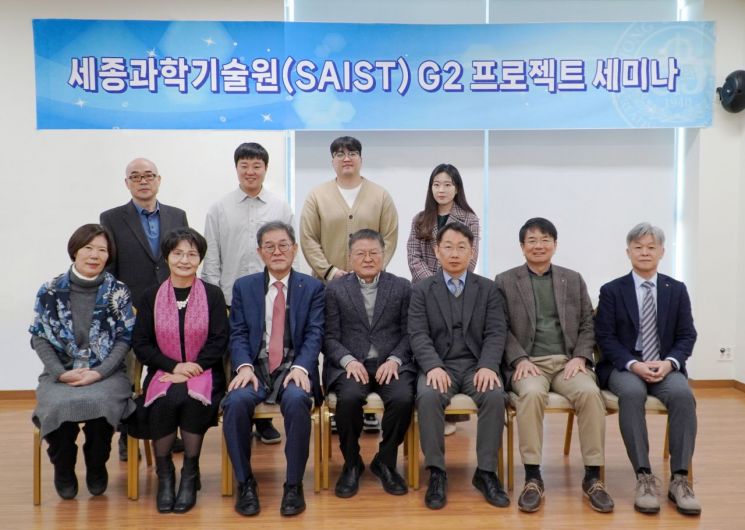 Attendees of the Sejong Institute of Science and Technology (SAIST) G2 Project (Advanced New Drug Development) seminar are taking a commemorative photo. Photo by Sejong University
The first topic discussed was "Development of Therapeutics for Intractable Diseases through Mitochondrial Metabolic Regulation." Professor Park Young-min of the Department of Smart Bio-Industry Convergence at Sejong University stated, "With rapid aging, the number of patients suffering from intractable diseases, especially degenerative neurological diseases including cancer and Alzheimer's dementia, is rapidly increasing," and emphasized, "We aim to maximize outcomes through collaborative research in related fields as a top priority."
Professor Yang Hyun-ok of the Department of Smart Bio-Industry Convergence at Sejong University presented on "Discovery of Natural Material Sources for the Prevention and Treatment of Intractable Diseases." Professor Yang said, "Natural materials are largely utilized in three categories: natural medicine, health functional foods, and functional cosmetics," adding, "It is particularly advantageous to discover materials for pharmaceuticals by utilizing traditional medical information, which allows for the prediction of possible side effects."
The final presentation was on "Development of Candidate Therapeutic Substances for Intractable Diseases Based on Artificial Intelligence." Professor Park Hwang-seo of the Department of Bio Convergence Engineering at Sejong University explained, "The efficacy and toxicity of new drug candidates are determined by three-dimensional interactions with biomolecules, whereas existing AI drug development techniques have limitations in representing candidate substances in one or two dimensions," and added, "We plan to develop a three-dimensional descriptor based purely on quantum mechanics and electromagnetics and introduce it into AI programs to build infrastructure capable of accurately predicting both the efficacy and various pharmacological properties of new drug candidates simultaneously."
© The Asia Business Daily(www.asiae.co.kr). All rights reserved.
![Clutching a Stolen Dior Bag, Saying "I Hate Being Poor but Real"... The Grotesque Con of a "Human Knockoff" [Slate]](https://cwcontent.asiae.co.kr/asiaresize/183/2026021902243444107_1771435474.jpg)
















