Korea Chamber of Commerce and Industry Survey
3.8 Employees Hired per Franchise Including Store Owners
The average startup cost for franchise stores was found to be 159 million KRW, with an average investment recovery period of 3.6 years.
On the 4th, the Korea Chamber of Commerce and Industry (hereinafter 'KCCI') announced the results of the 2023 Franchise Industry Survey conducted on 800 franchisors and 1,000 franchise stores. The survey showed that the average cost to start a new franchise store was 159 million KRW. By detailed industry, bakery had the highest cost at 263 million KRW, followed by eyeglasses at 223 million KRW, pizza and burger at 162 million KRW, Korean food at 156 million KRW, and coffee at 142 million KRW. Next were beauty and hair care at 121 million KRW, snack bars at 119 million KRW, convenience stores at 118 million KRW, and chicken at 104 million KRW, all requiring startup costs exceeding 100 million KRW.
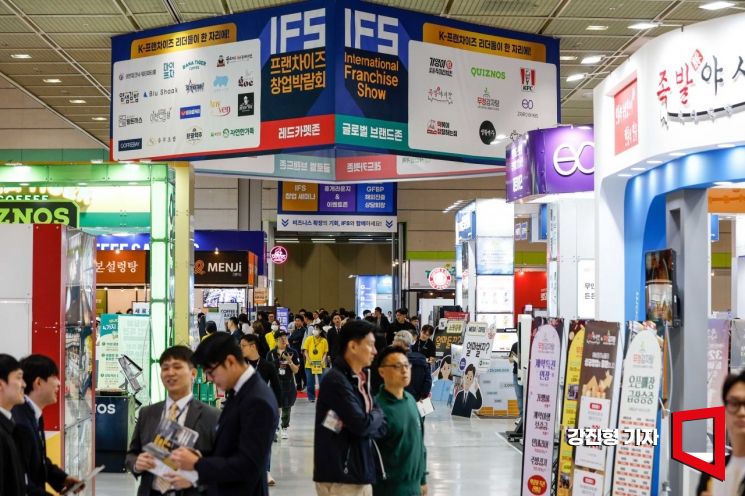 Last October, the 'Franchise Startup Expo' held at COEX in Gangnam-gu, Seoul, was bustling with prospective entrepreneurs. Photo by Jinhyung Kang aymsdream@
The average time to recover the investment cost was 3.6 years. By industry, wholesale and retail took the longest at 4.8 years, followed by bakery at 4.3 years, eyeglasses at 4.2 years, and pizza and burger at 3.7 years, all longer than the average. Korean food (3.3 years), coffee (3.2 years), beauty and hair care and convenience stores (each 3 years), chicken (2.6 years), and snack bars (2.5 years) had relatively shorter recovery periods.
Franchise stores created an average employment of 3.8 people per store, including the owner. By industry, food service employed 4.2 people, wholesale and retail 3.6 people, and service industry 3.4 people on average.
Among franchise stores, 8 out of 10 (79.7%) responded that the minimum wage increase negatively affected their management. In response, measures included expanding work by owners and family members (44.3%), reducing employee working hours (25.3%), and cutting costs other than labor (23.9%).
Among responding franchise owners, 47% said that franchising helped them overcome the COVID-19 pandemic crisis. This indicates that overcoming the crisis was somewhat easier for franchise stores than for individual self-employed businesses. KCCI analyzed that "franchises have high brand awareness and provide product development, advertising and promotion, and operational management, and during the COVID-19 period, they supported the introduction of external platform apps and kiosks, which helped franchisees." On the other hand, 8.4% responded that franchising did not help.
In fact, franchise owners’ satisfaction with franchise store operation was higher in terms of ease of store operation provided by the franchise system (63.8 points), protection of sales territory (63.4 points), and franchisor marketing (61.4 points) than in sales level (58.8 points) and owner working conditions (58.8 points). Also, when asked about the intention to renew the contract upon expiration, 8 out of 10 franchise owners (79.3%) said they intended to renew.
Franchisors owned an average of 77 franchise stores. By industry, wholesale and retail had the most with an average of 183 stores, followed by service industry with 104 stores, and food service with 52 stores. Additionally, about half (53%) of franchisors said they received royalties from franchise stores, an 11.1 percentage point increase from 41.9% in the 2021 survey.
© The Asia Business Daily(www.asiae.co.kr). All rights reserved.
!["The Woman Who Threw Herself into the Water Clutching a Stolen Dior Bag"...A Grotesque Success Story That Shakes the Korean Psyche [Slate]](https://cwcontent.asiae.co.kr/asiaresize/183/2026021902243444107_1771435474.jpg)
















