Largest-Ever Investment Activation Policy
Focus on Domestic Demand and Livelihood Revitalization
Legal Amendments Key for Major Policies
The 'Choi Sang-mok Goal' economic policy direction, which will lead the overall economy this year, was unveiled on the 4th. The plan aims to revitalize exports and investment through the largest-ever trade finance and facility investment funds, a one-year extension of the temporary investment tax credit, and an increase in the tax credit rate for additional research and development (R&D) expenditures. It also seeks to invigorate livelihoods by achieving early stabilization of inflation in the 2% range and activating domestic demand. However, it is not easy to avoid populism controversies ahead of the general election, and there remains the challenge of overcoming the 'minority government' National Assembly hurdle.
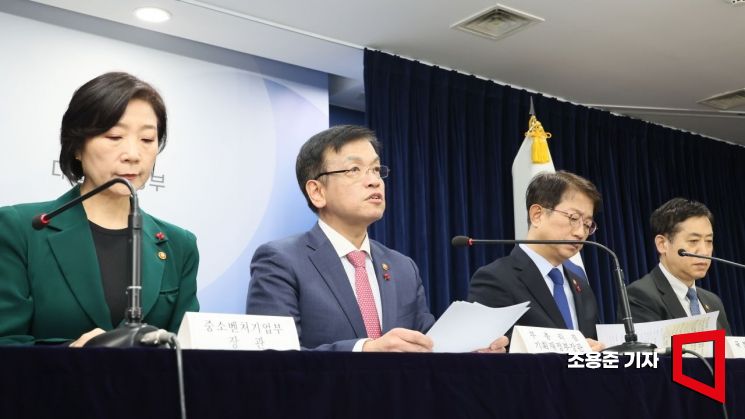 Choi Sang-mok, Deputy Prime Minister for Economy and Minister of Economy and Finance, is delivering opening remarks at the joint briefing on the 2024 Economic Policy Direction held at the Government Seoul Office in Jongno-gu, Seoul, on the 4th. The briefing was attended by Park Sang-woo, Minister of Land, Infrastructure and Transport; Kim Ju-hyun, Chairman of the Financial Services Commission; Oh Young-joo, Minister of SMEs and Startups; and Jung Byung-guk, 1st Vice Minister of Culture, Sports and Tourism. Photo by Jo Yong-jun jun21@
On the 4th, the government held a 'Livelihood Discussion with the People' chaired by President Yoon Suk-yeol to finalize and announce this year's economic policy direction. The core is to increase exports and facility investment, lower living costs, activate domestic demand, and revitalize livelihoods. Choi Sang-mok, Deputy Prime Minister and Minister of Economy and Finance, stated at a briefing held at the Government Seoul Office, "The government will do its utmost to spread the warmth of economic recovery to every corner and enhance the dynamism of our economy to create a 'vibrant livelihood economy.'"
First, exports and investment will be revitalized by supplying the largest-ever trade finance (355 trillion won) and facility investment funds (52 trillion won). To stimulate early investment rebound, the temporary investment tax credit for facility investment will be extended for one year until the end of this year. The tax credit rate for increased R&D investment will also be temporarily raised by 10 percentage points until the end of this year.
To activate domestic demand, the goal is to achieve early stabilization of inflation in the 2% range during the first half of the year. The burden of food expenses on households will be reduced through the largest-ever 21 types of fruits and processed fruit products subject to tariff quotas. In crisis areas experiencing population decline due to low birth rates and aging, if a one-household resident in the metropolitan area purchases one house, they will be considered as a one-household resident for tax purposes. To accelerate domestic demand recovery in the first half, a 20% additional income deduction will be supported for increased consumption, and a 'Small Business Support Triple Set' has been prepared, including 200,000 won support for electricity bills, loan interest refunds, and raising the threshold for simplified VAT taxpayers for small business owners.
To manage financial risks such as real estate project financing (PF), market stabilization measures will be promoted, and the household debt ratio relative to gross domestic product (GDP) will be managed stably. Meanwhile, to realize a dynamic economy, the three major location regulations?Greenbelt, farmland, and mountainous areas?will be improved. For the future, fiscal rules legislation and pension reform will be pursued unwaveringly, and a 'Future Generation Vision and Mid-to-Long-Term Strategy' will be prepared to address challenges such as population and climate.
This economic policy direction focused on 'reviving livelihoods,' so the distinctive color expected from Deputy Prime Minister Choi was not clearly revealed. Given that various livelihood support measures were released ahead of the general election, there were criticisms of populism. In response to the question of whether this was an election-oriented policy, Deputy Prime Minister Choi drew a line, saying, "Looking at the economic indicators, the first half will be difficult in terms of livelihood perception. I judged this solely based on economic trends, regardless of the political schedule."
The extension of the temporary investment tax credit, the tax credit for increased R&D expenditures, the 20% additional income deduction for consumption in the first half, the one-household resident status for homebuyers in population crisis areas, and the improvement of the three major location regulations are legislative matters, so the implementation of these policies may depend on the general election results. Regarding this, Deputy Prime Minister Choi said, "Although there are considerable legal amendments, most are for the sake of livelihoods, so I expect cooperation regardless of party lines."
© The Asia Business Daily(www.asiae.co.kr). All rights reserved.
!["The Woman Who Threw Herself into the Water Clutching a Stolen Dior Bag"...A Grotesque Success Story That Shakes the Korean Psyche [Slate]](https://cwcontent.asiae.co.kr/asiaresize/183/2026021902243444107_1771435474.jpg)
















