Long-Settled Controversy Over Japanese Line
Various Seafood Companies Also Provide Detailed Explanations to Customers
Similar to Photos of Noryangjin Market's 'Daegae Controversy'
At the end of last year, a controversy arose when blackened snow crabs appeared at the Noryangjin Fisheries Market, but a fishery expert corrected the misunderstanding by stating that it was a "blackening phenomenon, not decay." The blackening of crabs is unfamiliar even to seafood merchants in Korea, but it is reportedly well-known in Japan. One seafood company’s website even provides detailed information about the characteristics of this blackening phenomenon for customers.
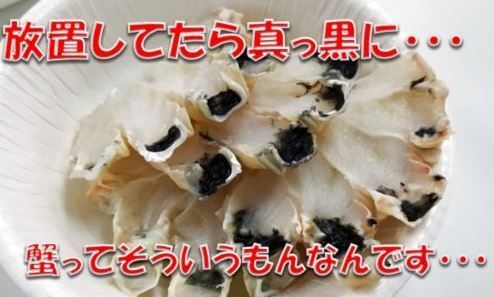 A photo of blackened snow crab posted by the Japanese seafood handling company 'Jangin Bonjeom.' It is very similar to the controversial 'blackened snow crab' photo from Noryangjin Fish Market. [Image source=Jangin Bonjeom website]
‘Takumi Honten,’ a high-end seafood company located in Osaka, Japan, described the blackening phenomenon of snow crabs in detail on its website. In the notice, the company stated, "As a company that sells crabs, the 'blackening of crabs' is an inseparable issue," and explained, "Some customers ask, 'The crab has turned black. Is it rotten?' To clarify from the start, it is not rotten."
They continued, "Live snow crabs naturally exhibit this. The blackening occurs due to the oxidation of tyrosine, a type of amino acid in the crab, through interaction with oxidase enzymes," adding, "The blackened parts contain melanin, a black pigment, which is not harmful and does not affect the taste, so it is safe to eat as is." The company further noted, "A similar phenomenon is the blackening of banana peels. Just as you peel and eat bananas even if the peel turns black, the same applies to crabs, so blackening is completely harmless."
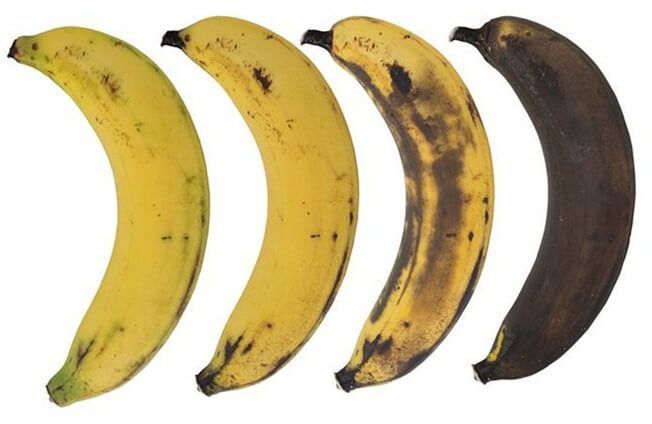
They also provided detailed methods to prevent blackening. The company explained, "To prevent blackening, crabs can be steamed at high temperatures, frozen to inhibit enzyme activity, or treated with antioxidants," emphasizing, "If you want to prevent blackening, do not leave thawed crabs at room temperature. Please absolutely avoid doing that."
Earlier last year, a post on a domestic online community sparked public outrage when a son reportedly bought a "rotten snow crab" from Noryangjin Fisheries Market. The poster shared photos of a crab with legs that appeared blackened as if mold had spread. Due to the controversy, the seafood vendor who sold the crab to the son reportedly suspended operations and was investigated by the merchant disciplinary committee.
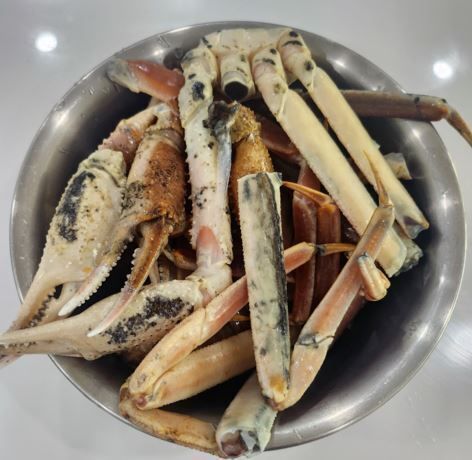
However, fish columnist Kim Ji-min explained in a video posted on the YouTube channel ‘Memories of Fishing’ on the 2nd that the crab was not rotten but exhibited the blackening phenomenon.
Kim added that the blackening phenomenon might be unfamiliar to domestic merchants. He said, "Snow crabs are sold alive in tanks about 95% of the time. Since they are taken out of the tank and steamed immediately when customers request, blackening rarely occurs." However, the controversial crab was a "cut snow crab," and since the buyer used public transportation, the blackening may have occurred quickly. He emphasized, "The blackening phenomenon does not indicate freshness issues. It just looks bad externally," and "At least the blackened parts are not rotten but are due to the blackening phenomenon."
© The Asia Business Daily(www.asiae.co.kr). All rights reserved.
![An "Human Knockoff" Clutching a Stolen Dior Bag... A Bizarre Con That Shakes Your Sanity [Slate]](https://cwcontent.asiae.co.kr/asiaresize/183/2026021902243444107_1771435474.jpg)


















