There are increasing observations that this year could be hotter than 2023, which is set to be recorded as the hottest year ever.
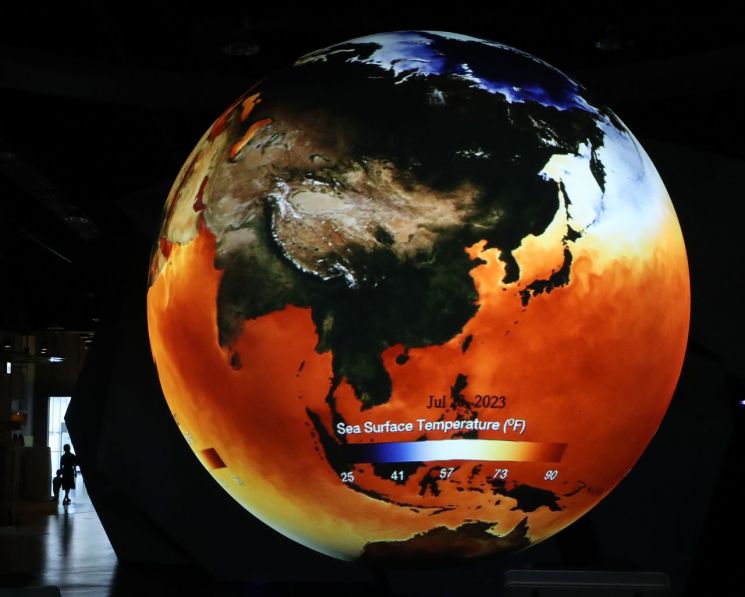 Citizens visiting the indoor exhibition hall of the National Daegu Science Museum are observing the SOS system that represents the El Ni?o phenomenon amid the climate crisis. / Photo by Yonhap News
On the 2nd (local time), the American daily newspaper The Washington Post reported, citing major meteorological observation agencies and experts, that temperatures this year could be higher than last year due to El Ni?o.
El Ni?o refers to the phenomenon where sea surface temperatures in the eastern equatorial Pacific Ocean abnormally rise. It raises global temperatures and causes weather anomalies such as storms and droughts.
Although the official December temperatures have not yet been announced, last year's annual average temperature is predicted to surpass 2016, the hottest year on record.
The Copernicus Climate Change Service (C3S), the European Union's (EU) climate change monitoring agency, previously announced the temperature analysis results from January to October, stating that 2023 will effectively be the hottest year since the last interglacial period. The UK Met Office forecasted on the 8th of last month that "the global average temperature could rise more than 1.5 degrees Celsius above pre-industrial levels for the first time."
Since the El Ni?o phenomenon, one of the causes that raised global temperatures last year, is continuing, some meteorologists predict that this year will be even hotter, The Washington Post reported. In fact, both 2016, the hottest year on record, and 2023, which is expected to surpass it, experienced El Ni?o.
The current El Ni?o, which began in June last year, is expected to be as strong as the El Ni?o of 2015?2016 and is anticipated to further accelerate global temperature rise this year.
El Ni?o generally lasts about a year, peaking in winter and gradually fading from spring. It is known that the warming effect becomes greater in the later stages than in the early stages.
Considering this pattern, this El Ni?o is expected to peak within the next few weeks to months. There are forecasts that it will reach its peak around February. In this case, the first half of this year could be hotter than the previous six months.
The period after El Ni?o ends is also problematic. Whether temperatures will continue to rise throughout this year depends on the situation after El Ni?o, but it is still unknown whether La Ni?a (a phenomenon where sea surface temperatures in the eastern equatorial Pacific Ocean drop) will return six months later or if a neutral state will prevail.
Carlos Buontempo, director of C3S, said, "We are in uncharted territory and essentially do not know what will happen next."
© The Asia Business Daily(www.asiae.co.kr). All rights reserved.

















