Christopher Pyserise, Professor at London School of Economics
"The More AI Advances, the More STEM Majors' Jobs Are Threatened"
Christopher Pissarides, Nobel laureate in Economics and professor at the London School of Economics (LSE), warned that the 'STEM (Science, Technology, Engineering, Mathematics) major concentration' phenomenon, which surged after the generative artificial intelligence (AI) boom, could threaten jobs for STEM majors by excessively accelerating AI technology development.
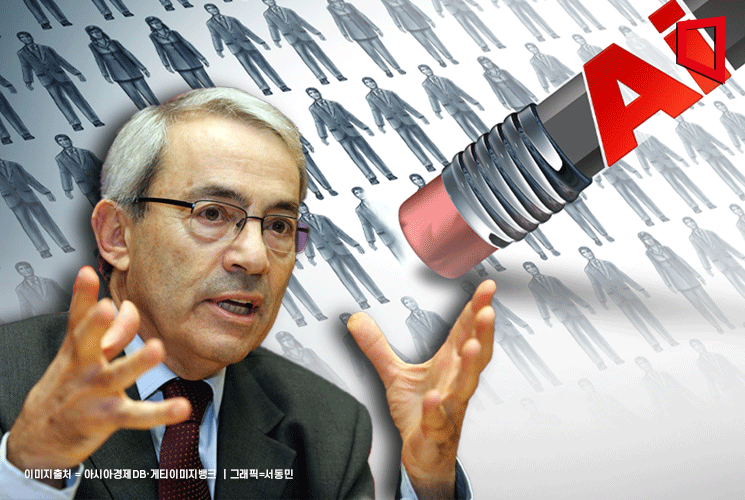
In an interview with foreign media on the 2nd (local time), Professor Pissarides stated, "Certain IT workers risk sowing the 'seeds of self-destruction' by developing AI that will eventually take over their own jobs in the future." He is an authority in the labor field who won the Nobel Prize in Economics in 2010.
As employment opportunities for STEM majors such as computer engineering have recently expanded, making these majors popular, Professor Pissarides observed that the faster AI develops, the more quickly it can replace jobs held by related majors. He particularly expressed concern that the demand for STEM majors has surged even more after the OpenAI 'ChatGPT craze,' warning that this field could become "obsolete." STEM majors may fall into a trap by contributing to AI development and excessively automating their own jobs.
Professor Pissarides predicted, "The skills currently required for data collection, analysis, development, and AI technology development will soon become useless because these technologies will (work) by themselves." He added, "Despite the growth of the AI market, there are not enough jobs for all STEM majors to be employed."
However, he viewed the overall impact of AI on the job market optimistically. He expected that as AI automates many jobs, the value of empathy and creative skills, which are difficult for AI to replace, will increase. He also anticipated that the importance of face-to-face jobs that are hard to replace with AI, such as communication, customer service, and healthcare, will grow.
He said, "Jobs related to personal care, communication, and positive social relationships will become mainstream," and "People will realize that these are the jobs we should expect in the future." He emphasized, "We must not ignore these jobs," and added, "They will be much better than the jobs people have done after graduating from school."
With the rapid development of the AI industry due to the ChatGPT craze, concerns about AI's future impact on the job market are increasing. Earlier, the U.S. investment bank Goldman Sachs predicted in a report in March last year that AI would replace 300 million full-time jobs in 10 years. However, it forecasted that the global real gross domestic product (GDP) would increase by 7% over 10 years if companies worldwide adopt AI. Elon Musk, CEO of Tesla, also predicted the arrival of a universal high-income era where "there will come a time when no jobs are needed," with AI doing the work and people receiving a basic income.
© The Asia Business Daily(www.asiae.co.kr). All rights reserved.
![Clutching a Stolen Dior Bag, Saying "I Hate Being Poor but Real"... The Grotesque Con of a "Human Knockoff" [Slate]](https://cwcontent.asiae.co.kr/asiaresize/183/2026021902243444107_1771435474.jpg)
















