The Supreme Court has ruled that the corporate liability provision under the Unfair Competition Prevention Act applies only when an employee or executive of the corporation actually commits an act such as acquiring, disclosing, or improperly using trade secrets, and does not apply if the act remains an attempt.
According to the legal community on the 3rd, the Supreme Court's Third Division (Presiding Justice No Jeong-hee) overturned the original ruling that sentenced Intercos Korea, the Korean subsidiary of the Italian cosmetics company Intercos, to a fine of 10 million KRW in the appeal trial concerning charges of violating the Unfair Competition Prevention Act (disclosure and improper use of trade secrets) against former executive A and Intercos Korea. The case was remanded to the Suwon District Court. The original ruling sentencing A to 10 months in prison was upheld.
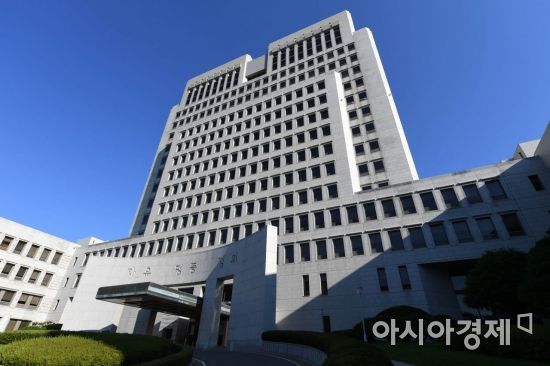
The court stated, "The corporate liability provision cannot be applied to punish the defendant company for the charge that employee A attempted but failed to improperly use the victim's trade secrets," and added, "Nevertheless, the original ruling that found Intercos Korea guilty of attempted improper use of trade secrets misapplied the legal principles regarding the scope of application of Article 19’s corporate liability provision under the Unfair Competition Prevention Act, which affected the judgment," explaining the reason for overturning and remanding.
A, who worked at Kolmar Korea, a mid-sized domestic cosmetics company, from 2008 to 2017 and served as director of the Color Research Institute’s Basic Research Team overseeing cosmetics R&D, was indicted on charges of stealing core technology of sunscreen developed by Kolmar Korea to produce or attempt to produce products after moving to Intercos Korea in 2018.
From July 2017 to May 2018, he was accused of leaking information about Kolmar Korea’s manufacturing technologies for cosmetics such as sunscreen, masks, and lipstick by storing it on the cloud, taking photos, and sending texts, as well as failing to return such information upon resignation (violations of the Unfair Competition Prevention Act and breach of trust).
In the second trial, the prosecution added a preliminary charge that A attempted to develop new products based on the stolen information after moving to Intercos Korea but failed.
The first and second trials sentenced A to 10 months in prison. Another former executive B of Intercos Korea, also from Kolmar Korea and involved in the crime, received a 6-month prison sentence with a 2-year probation in both trials.
Both argued that the leaked information did not constitute important business assets protected under the Unfair Competition Prevention Act, but this was rejected.
The court also found that A’s act of taking and not returning company trade secrets despite being aware of the obligation to return such information, as evidenced by signing a confidentiality agreement upon resignation, constituted breach of trust.
However, the appellate court recognized only attempted offenses for the charge of improper use of trade secrets, stating that it was not sufficiently proven whether A actually used the leaked materials in developing Intercos Korea’s cosmetics.
A appealed, but the Supreme Court found no issue with the second trial’s judgment.
However, the Supreme Court overturned the second trial’s ruling that imposed a 10 million KRW fine on Intercos Korea, reasoning that the corporate liability provision cannot hold the corporation responsible for an employee’s attempted offense.
The court explained, "Article 19 of the Unfair Competition Prevention Act stipulates that if a representative, agent, employee, or other worker of a corporation or individual commits any violation under Article 18, paragraphs 1 to 4, related to the corporation’s or individual’s business, the corporation or individual shall be fined in addition to punishing the offender."
It continued, "Accordingly, the corporate liability provision applies only when employees commit violations under Article 18, paragraphs 1 to 4, concerning acquisition and improper use of trade secrets, and does not apply to violations under Article 18-2, which punishes attempts to improperly use trade secrets."
The Unfair Competition Prevention Act’s Article 18 (Penalties) Paragraph 1 punishes acts such as acquiring, using, or disclosing trade secrets abroad or knowing they will be used abroad for unfair gain or to harm the trade secret holder; unauthorized leakage; deletion or refusal to return; acquisition through theft, deception, or threats; and improper use of trade secrets.
Paragraph 2 punishes such acts committed without the intent to use abroad; Paragraph 3 punishes unfair competition acts; and Paragraph 4 punishes disclosure of secrets in the course of duties.
Article 18-2 (Attempt) punishes attempts under Paragraphs 1 and 2 of Article 18.
Article 19 (Corporate Liability) stipulates that when an employee commits a violation of the Unfair Competition Prevention Act, the corporation shall also be punished, but limits the applicable crimes to those under Article 18, Paragraphs 1 to 4.
The Supreme Court concluded that since the law explicitly excludes the attempt provision (Article 18-2) from the scope of the corporate liability provision, corporations cannot be punished when their employees only attempt the offense.
© The Asia Business Daily(www.asiae.co.kr). All rights reserved.
![User Who Sold Erroneously Deposited Bitcoins to Repay Debt and Fund Entertainment... What Did the Supreme Court Decide in 2021? [Legal Issue Check]](https://cwcontent.asiae.co.kr/asiaresize/183/2026020910431234020_1770601391.png)
















