President Yoon "Pursuing Market Regulation Reform and Abolishing Financial Investment Tax"
Following Short Selling Ban and Capital Gains Tax Relief, Stock Market Stimulus Measures
Experts "Abolition Expectations Already Reflected in Market"
Challenges Include National Assembly Approval and Securing Tax Revenue
President Yoon Suk-yeol's declaration to abolish the Financial Investment Income Tax (금투세) is expected to trigger serious discussions on the matter this year. However, since revising the 금투세 requires legislative changes, reaching an agreement with the Democratic Party of Korea, which opposes the move citing tax cuts for the wealthy, is essential, meaning it will likely take time before actual abolition occurs. Following a significant shortfall in tax revenue last year and concerns about revenue deficits this year, the government is also faced with the challenge of securing alternative tax revenue if the originally planned 금투세-related tax items are removed. Moreover, the capital market remains skeptical about whether abolishing the 금투세 can resolve the stock market undervaluation, known as the Korea Discount, as the market has already factored in expectations of abolition.
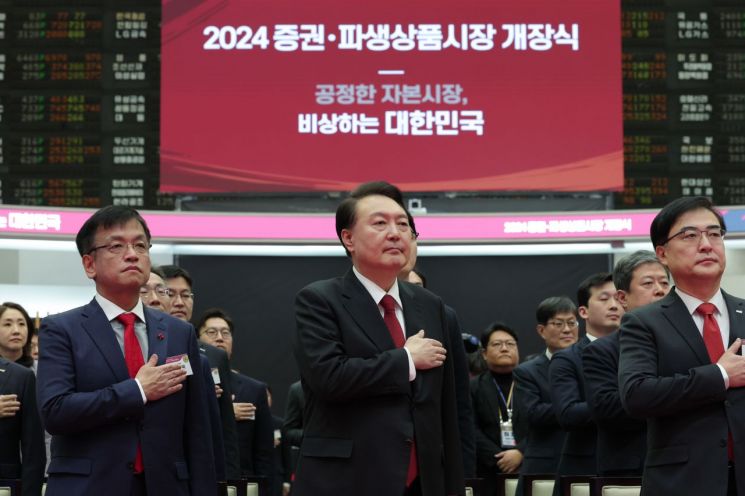 President Yoon Suk-yeol is saluting the national flag at the opening ceremony of the 2024 Securities and Derivatives Market held at the Korea Exchange in Yeouido, Yeongdeungpo-gu, Seoul, on the morning of the 2nd.
 [Image source=Yonhap News]
On the 2nd, President Yoon Suk-yeol attended the stock market opening ceremony held at the Korea Exchange and stated, "We will thoroughly prepare reform measures for short selling and push forward with the abolition of the Financial Investment Income Tax." This reaffirmed his commitment to abolishing the 금투세, a key national agenda, interpreted as a move to support the domestic stock market's vitality in line with changes in U.S. monetary policy.
The Financial Investment Income Tax (금투세) is a system that taxes capital gains exceeding a certain amount from financial investments such as stocks, bonds, funds, and derivatives at rates between 20% and 25%. It was introduced by the Moon Jae-in administration in 2020 as part of the 'Capital Market Advancement Plan.' The system revised the existing tax law that imposed capital gains tax on stocks, eliminated the major shareholder threshold, and instead taxed investors earning over 50 million KRW annually in financial investment income. Considering a smooth transition to the new tax system and allowing individual investors to adapt, implementation was scheduled for 2023. However, in May 2022, President Yoon mentioned abolishing the 금투세, effectively resetting the introduction of the tax. At that time, the KOSPI, which had repeatedly risen enough to offset declines thanks to abundant liquidity post-COVID-19, was entering a correction phase influenced by U.S. interest rate hikes. After the Yoon administration took office, the Ministry of Economy and Finance decided in July 2022, through the '2022 Tax Reform Plan,' to postpone the implementation of the 금투세 from 2023 to 2025.
The background behind President Yoon's push to abolish the 금투세 lies in resolving the Korea Discount. On that day, President Yoon said, "South Korea has many world-class companies with global competitiveness, but the stock market is significantly undervalued," adding, "During my term, I will eliminate the Korea Discount through deregulation of the capital market."
The intention is to revise factors that could burden the domestic stock market, such as banning illegal short selling, easing capital gains tax on major shareholders, and abolishing the 금투세, thereby creating a stable investment environment for investors. This aims to establish a virtuous cycle leading from reduced tax burdens on companies and individuals → smoother corporate financing and increased asset values → to expanded tax revenue.
However, experts believe President Yoon's remarks on abolishing the 금투세 will have limited impact on the stock market. Kim Hak-kyun, head of research at Shin Young Securities, said, "The abolition of the 금투세 is a campaign promise and a national agenda of President Yoon, so expectations for its implementation have already been reflected in the market," adding, "This statement will likely only reaffirm the president's commitment to abolishing the 금투세."
There are many hurdles to overcome before abolishing the 금투세. The ruling party must first persuade the opposition. Since abolishing the 금투세 requires amending the law, approval from the National Assembly is necessary. The opposition party, which holds a majority in the Assembly, maintains its opposition to abolishing the 금투세, citing it as a tax cut for the wealthy.
Jang Hye-young, a member of the National Assembly's Planning and Finance Committee, criticized, "It is inappropriate for the president to unilaterally decide to abolish a system that was originally agreed upon by both ruling and opposition parties in the National Assembly," adding, "This decision benefits a very small number of wealthy stockholders and greatly contradicts tax justice principles that tax should be levied where income exists."
Initially skeptical about abolishing or postponing the 금투세, financial authorities now intend to proceed according to government policy. However, if the government moves forward with easing capital gains tax on stocks and abolishing the 금투세, concerns about securing tax revenue will deepen. According to the Ministry of Economy and Finance's report on national tax revenue, tax revenue from January to November this year was 324.2 trillion KRW, a decrease of 49.4 trillion KRW compared to the same period last year. Although the 금투세 has not yet been collected, it was expected to be imposed after the grace period ends, so the Ministry of Economy and Finance, responsible for the national budget, must devise ways to compensate for the shortfall. This is why there are talks about not only abolishing the 금투세 but also reviewing and adjusting taxes across the entire asset market.
A representative from the financial investment industry said, "It seems that a comprehensive review of taxes on asset markets, including the virtual asset market, will be conducted, not just discussions about the 금투세."
© The Asia Business Daily(www.asiae.co.kr). All rights reserved.
![Clutching a Stolen Dior Bag, Saying "I Hate Being Poor but Real"... The Grotesque Con of a "Human Knockoff" [Slate]](https://cwcontent.asiae.co.kr/asiaresize/183/2026021902243444107_1771435474.jpg)











