CEO Lee Attacked During Visit to 'Gadeokdo New Airport' Site
Approximately 1cm Laceration on Neck...Reported to Be in Severe Bleeding Condition
On the 2nd, Lee Jae-myung, the leader of the Democratic Party of Korea, was attacked with a sharp weapon by an unidentified man disguised as a supporter during a site visit to the 'Gadeokdo New Airport' location. Lee, who was stabbed, sustained a laceration about 1 cm in size on his neck and was reported to be in a state of severe bleeding.
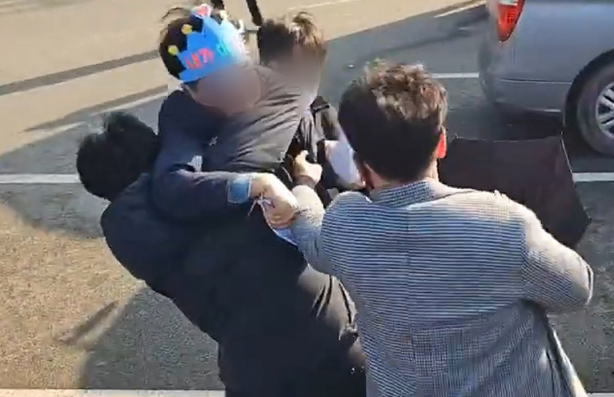 On the 2nd, the suspect who attacked Lee Jae-myung, the leader of the Democratic Party of Korea, with a weapon at the site of the new Busan Gadeokdo Airport was arrested by the police at the scene.
 [Photo by YouTube 'BareunSori TV'] [Image source=Yonhap News]
Lee, who was stabbed, sustained a laceration about 1 cm in size on his neck. Although he did not lose consciousness, he was reported to be in a state of severe bleeding. After collapsing while bleeding, Lee was transported by ambulance about 10 minutes after the attack and received emergency treatment at the Regional Trauma Center of Busan National University Hospital. Around 1 p.m., he was airlifted by helicopter to Seoul National University Hospital. Democratic Party Chief Spokesperson Kwon Chil-seung explained that Lee is suspected to have damage to his jugular vein, raising concerns about potential massive bleeding.
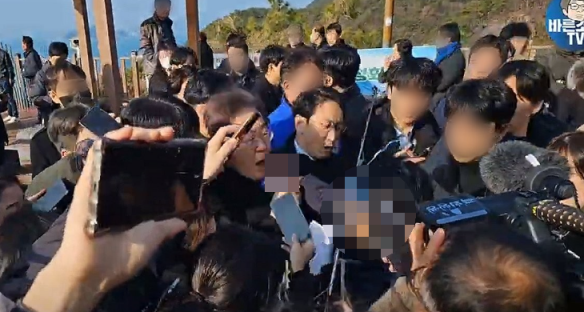 Democratic Party of Korea leader Lee Jae-myung was attacked by a man while moving after inspecting the site of the new Busan Gadukdo Airport on the 2nd and holding a Q&A session with reporters.
 [Photo by YouTube 'BareunSoriTV']
Wounds are classified according to their cause into categories such as ▲incision ▲burn ▲abrasion ▲puncture ▲laceration ▲pressure sore ▲contusion, and are further divided into infected and non-infected wounds depending on the presence of infection. There are also sprains or dislocations caused by joint injuries, and symptoms related to wounds include ▲pain ▲bleeding ▲functional impairment.
Among these, a laceration is a wound caused by tearing of the skin, often with irregular, jagged edges. The damaged area results in a loss of the skin’s protective function for the body.
An incision refers to a wound where the skin is cut by a sharp object (such as a knife or glass shard). Wounds caused by knives or sharp objects generally have a lower risk of infection.
A puncture wound occurs when the skin is pierced by a sharp object (such as a nail or spear). Although there is usually not much bleeding, deep wounds can cause internal bleeding. Disinfection is difficult, increasing the risk of bacterial infection or dust intrusion. When wounds are caused by contaminated objects, there is a risk of tetanus due to bacterial infection, so caution is necessary.
○ Health Information Related to Lacerations
- Lacerations are treated by performing suturing.
- Most lacerations are small in size and can be healed with simple suturing.
- Suturing keeps the torn and separated skin edges as close as possible to prevent bleeding and infection, preserve tissue function and appearance, and promote faster wound healing.
- Suturing yields better results when done early, so it is recommended to perform it as soon as possible, and it must be done by a qualified person using sterilized instruments and materials at a hospital.
- Previously, suturing was mainly done with thread, but for shallow wounds, staples, tape, or adhesive glue are now also used outside of thread sutures.
■Materials Used for Suturing Lacerations
- The suturing process varies depending on the degree of wound contamination.
- Primary closure, where a clean and minimally contaminated wound is sutured immediately, is generally well performed. However, if the wound is dirty and heavily contaminated, secondary closure is performed by leaving the wound open to heal naturally.
- There is also tertiary closure, where contaminated wounds are initially treated with debridement and antibiotics for several days before suturing later.
■Removal of Sutures
- The timing for suture removal is not fixed and is decided by the doctor based on the wound’s healing progress.
- Wound healing is influenced by how much the area around the wound moves, as well as factors such as the patient’s age, nutritional status, presence of infection, use of steroids, radiation therapy, and chemotherapy.
© The Asia Business Daily(www.asiae.co.kr). All rights reserved.


















