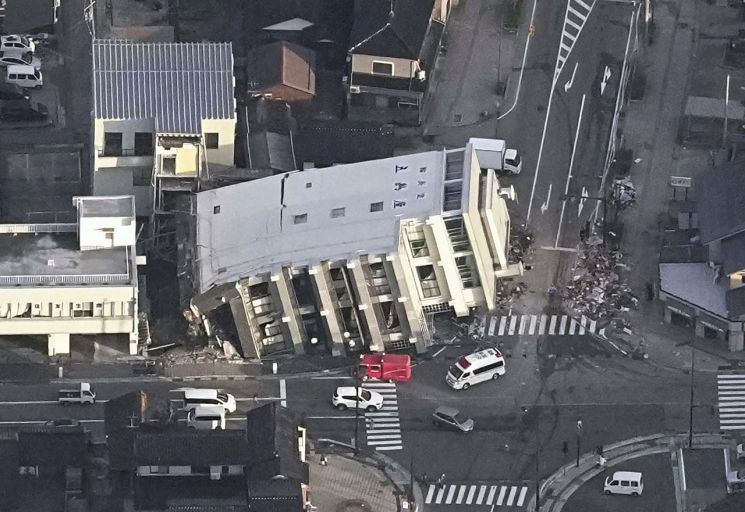
 On the 1st (local time), a massive earthquake measuring 7.6 struck central Honshu, Ishikawa Prefecture, Japan. One side of a large building in Wajima city has sunk underground. [Image source=Yonhap News]
The earthquake that occurred in Ishikawa Prefecture, Japan, has been identified as the strongest since the 2011 Great East Japan Earthquake, raising concerns not only about casualties but also about economic damage.
According to the Japan Meteorological Agency on the 2nd, a strong earthquake with a magnitude of 7.6 struck the Noto Peninsula in central Honshu, Ishikawa Prefecture, at around 4:10 PM the previous day. This is the strongest earthquake since the magnitude 9 Great East Japan Earthquake in 2011.
The Japan Meteorological Agency issued a "major tsunami warning" for the Noto Peninsula area of Ishikawa Prefecture, anticipating a tsunami with a maximum height of 5 meters. This is the first major tsunami warning issued since the Great East Japan Earthquake in March 2011. The tsunami warning has since been lifted.
Casualties are also mounting. According to Japan's public broadcaster NHK, at least 13 people have been confirmed dead in Ishikawa Prefecture so far, with dozens seriously injured, and power has been cut off to 32,400 households.
Economic damage is also a concern. JR East, a railway company, decided to suspend operations on the sections between Nagano Station and Kanazawa Station, and between Echigo-Yuzawa Station and Niigata Station, on the morning of the day for inspection of the Shinkansen high-speed train facilities. Noto Airport is currently unable to operate flights due to cracks over 10 meters long found in various parts of the runway.
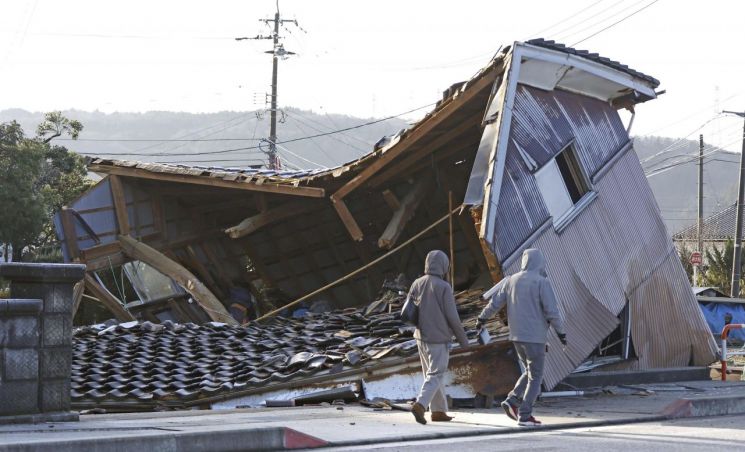 On the 2nd, people are passing by a building collapsed due to an earthquake in Shikamachi, Ishikawa Prefecture, Japan. [Image source=Yonhap News]
The large magnitude of this earthquake has led to comparisons with the 2011 Great East Japan Earthquake.
The scale of damage Japan suffered during the 2011 Great East Japan Earthquake was astronomical. According to the Japanese government, the earthquake and tsunami at that time caused approximately 28,000 casualties, including deaths, injuries, and missing persons, and damaged 1.14 million households. Subsequently, the Fukushima nuclear power plant accident caused by the tsunami resulted in 470,000 displaced persons.
The economic damage exceeded 20 trillion yen (183 trillion won), which was about 0.5% of Japan's GDP at the time. Due to the earthquake damage, Japan's economic growth rate in 2011 was only -0.9%.
Indirect damage was also significant. After the Great East Japan Earthquake, Japanese companies increased overseas investments, and the number of tourists visiting Japan decreased, impacting the tourism industry. The government's fiscal soundness also deteriorated due to disaster recovery costs.
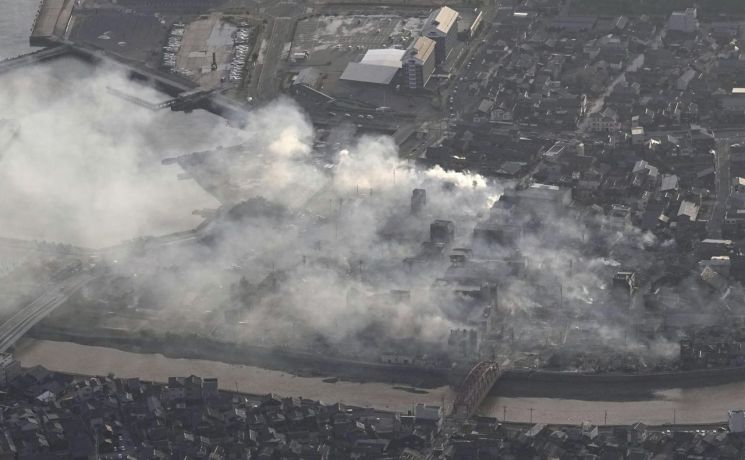 A magnitude 7.6 earthquake struck on the 1st in Wajima City, Ishikawa Prefecture, central Honshu, Japan, causing fires in several buildings.
 [Image source=Yonhap News]
There is also analysis that South Korea gained economic benefits indirectly. According to the Hyundai Research Institute, South Korea's export growth rate to Japan in 2011 was 40.8%, a significant increase from 29.4% in 2010. Meanwhile, the import growth rate decreased, reducing the trade deficit by 7.5 billion dollars.
Additionally, Japanese companies increased their investments in South Korea, and many foreigners who had planned to visit Japan changed their destination to South Korea due to concerns about radiation damage, improving the tourism balance deficit. The Korea Economic Research Institute also predicted at the time that South Korea's economic growth rate would increase by 0.25 percentage points (p) due to the indirect benefits from the Japanese earthquake.
Although the damage from this earthquake is expected to be less than that of the 2011 Great East Japan Earthquake, warnings have been issued not to be complacent. There is a possibility of additional earthquakes occurring on the Noto Peninsula where the earthquake happened.
Professor Fumihiko Imamura of Tohoku University said in an interview with the Asahi Shimbun, "I hope people do not think that the earthquake and tsunami have ended with this," noting that during the 1983 Central Sea of Japan earthquake, locally a tsunami over 10 meters high also occurred.
Professor Takuya Nishimura of Kyoto University's Disaster Prevention Research Institute also said, "Because faults are distributed complexly on the Sea of Japan side, if one moves, the surrounding faults are likely to move as well, making activity more active."
© The Asia Business Daily(www.asiae.co.kr). All rights reserved.



















