Parental Allowance of 1 Million Won per Month · Infertility Support Regardless of Income
0.68. This is the total fertility rate in South Korea projected by Statistics Korea for 2024. The total fertility rate refers to the expected number of children a woman will have in her lifetime. After the previously considered minimum threshold of 0.8 was broken (estimated 0.70 in 2021), the total fertility rate has been declining more steeply. It is expected to plummet to 0.65 by 2025.
Accordingly, this year the Ministry of Health and Welfare's childbirth policy has also changed. The focus is on the 'low birthrate crisis.' While Statistics Korea expects the total fertility rate to hit bottom the year after next and rebound to the 0.7 range by 2027, reaching 1.08 by 2050, attention is on whether the Ministry's policy changes will lay the foundation for a rebound in the birthrate.
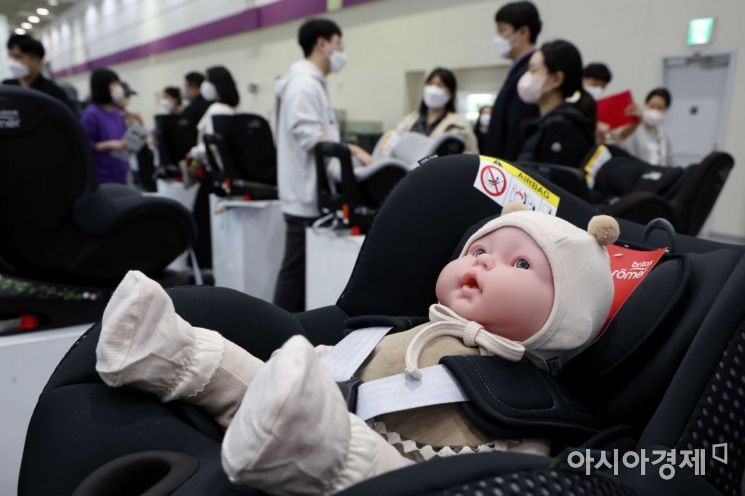 On the 14th, citizens are browsing booths at the Kobe Baby Fair held at COEX in Gangnam-gu, Seoul. This exhibition, where you can see everything from maternity products to early childhood education at once, will continue until the 17th. Photo by Moon Honam munonam@
'Parent Allowance' 500,000 to 1,000,000 KRW per month... First Meeting Voucher up to 3,000,000 KRW
First, the 'parent allowance' paid to parents of children under one year old will be significantly increased. The parent allowance for parents of zero-year-old children will be raised from the existing 700,000 KRW to 1,000,000 KRW this year. For parents of one-year-old children, the payment will increase from 350,000 KRW to 500,000 KRW this year.
Support for multi-child families will also be expanded. The 'First Meeting Voucher' which was paid 2,000,000 KRW to all newborns will now be provided differentially by birth order: 2,000,000 KRW for the first child and 3,000,000 KRW from the second child onward.
Infertility treatment costs can be supported regardless of income. Until last year, support for infertility treatment costs and high-risk pregnancy medical expenses applied only to those with 'less than 180% of median income.' This criterion will be removed starting this year.
Additionally, fertility (pregnancy ability) examination costs will be supported for couples hoping to conceive. The purpose is to detect high-risk factors for pregnancy and childbirth early. For women, this includes ovarian function tests (AMH) and ultrasounds; for men, semen analysis. Assisted reproductive technology using frozen eggs will also be supported up to twice (up to 1,000,000 KRW per session). Medical expenses for premature infants and congenital anomalies, as well as congenital hearing loss tests and hearing aid support, will be available regardless of income.
Expansion of Livelihood Benefit Support... 1,830,000 KRW per month for a 4-person household
The Basic Livelihood Security System, which guarantees minimum living standards, will be strengthened. With the increase in median income and livelihood benefit eligibility criteria, a single-person household with less than 32% of median income will receive up to 710,000 KRW per month, and a four-person household up to 1,830,000 KRW per month.
The criteria for converting automobile assets and income for households with six or more members and those with three or more children will also be relaxed. Until now, the asset conversion rate (4.17%) applied only to passenger cars under 1600cc (over 10 years old or valued under 2,000,000 KRW). This will be relaxed to include cars under 2500cc.
The government views the next 10 years as a golden time to prevent the low birthrate crisis and plans to take a more proactive approach to measures for reversing the total fertility rate decline.
Kim Young-mi, Vice Chair of the Presidential Committee on Ageing Society and Population Policy, said the day before, "The next 10 years until those born in the 1990s and 2000s reach their 30s can be called the golden time to maintain the total fertility rate and number of births," adding, "What we hope for during President Yoon Seok-yeol's term is to create a turning point for the birthrate, which has been declining for eight consecutive years."
Vice Chair Kim said, "The urgent task is to create an environment where people can raise children while working, receive seamless care, and resolve youth employment and income insecurity," and expressed hope that "when these things come together, the birthrate can naturally rise without artificially setting targets."
© The Asia Business Daily(www.asiae.co.kr). All rights reserved.

















