Export and Import Trends for December 2023 and the Entire Year
Last year, exports decreased by more than 7%. However, semiconductor exports showed signs of recovery, leading the rebound that began in October last year. The government expects the upward trend in exports to become more solid in the new year.
According to the Ministry of Trade, Industry and Energy on the 1st, exports in 2023 recorded $632.69 billion, down 7.4% from the previous year. Imports decreased by 12.1% to $642.67 billion, resulting in a trade deficit of $9.97 billion.
An official from the Ministry of Trade, Industry and Energy said, "Despite difficult external conditions such as the global high-interest rate trend and delayed economic recovery in China, exports in 2023 showed continued strength in automobile exports, a positive turnaround in general machinery and ship exports after the second quarter, and gradual recovery in semiconductor exports. After hitting a low in the first quarter, the improvement trend continued, turning positive in October. The trade balance turned to a surplus in June due to gradual improvement in exports and a decrease in imports caused by energy price stabilization. In the second half of the year, a total surplus of $16.3 billion was recorded, significantly reducing the 2023 trade deficit to $9.97 billion compared to the previous year's deficit of $47.8 billion."
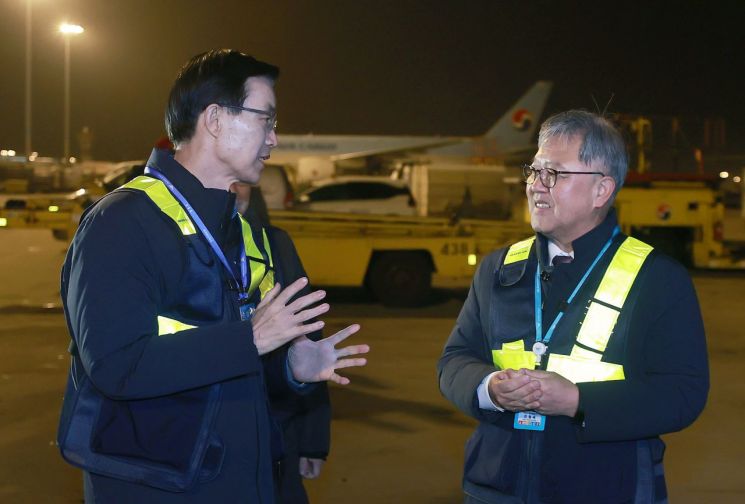 Visiting Minister of Trade, Industry and Energy Bang Moon-kyu (left) visited Korean Air's Cargo Terminal 1 at Incheon Airport on the 1st to encourage on-site workers as the first export site of the new year 2024.
In 2023, exports of three major items?automobiles, general machinery, and ships?increased. Automobile exports reached $70.9 billion, surpassing the previous record set in 2022 ($54.1 billion) by more than 30%, driven by strong sales of high-value vehicles such as electric cars and SUVs. General machinery exports increased by 4.6% year-on-year, and ship exports rose by 20.9%. Semiconductor exports, Korea's largest export item, continued their improvement trend after hitting a low in the first quarter and increased for two consecutive months following a positive turnaround in November.
Among the nine major export markets last year, exports increased in four markets (the United States, the EU, the Middle East, and the CIS). Notably, exports to the United States reached a record high of $115.7 billion, reclaiming its position as the second-largest export market after ASEAN for the first time in 18 years since 2005. The export share gap between China and the United States, Korea's two largest export markets, narrowed to 1.5 percentage points, the smallest since 2003. Exports to the EU also achieved record highs, supported by strong exports of automobiles and general machinery.
Exports to China decreased by 19.9% due to a slowdown in China's economy and a reduction in global imports, mainly affecting intermediate goods exports to China. Exports to ASEAN declined by 12.5%, mainly in IT parts including semiconductors, due to a downturn in the global IT industry. However, exports to China exceeded $10 billion for five consecutive months since August, showing signs of improvement, and exports to ASEAN increased for three consecutive months following a positive turnaround in October.
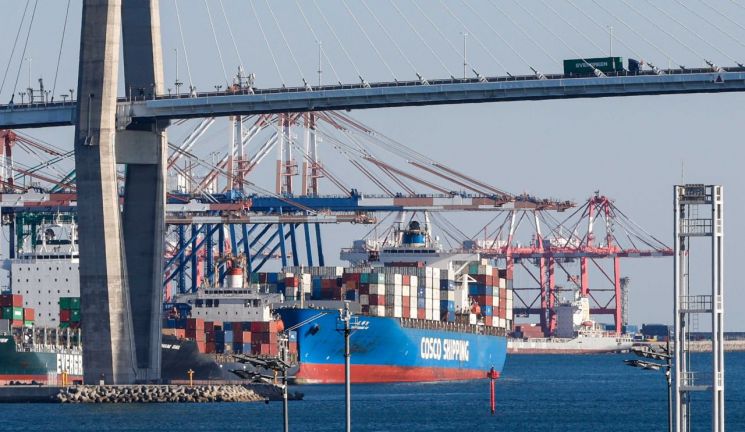 Export containers are being loaded onto a ship at Busan North Port. Photo by Jinhyung Kang aymsdream@
Exports to Poland (+14.8%), the UAE (+11.9%), and Saudi Arabia (+9.4%), key countries visited by President Yoon Suk-yeol, increased significantly. Poland recorded its highest-ever export performance in 2023, driven by steady growth in its largest export item, cathode materials, and strong K-defense exports, rising to become the second-largest export country within the EU after Germany. The UAE achieved exports exceeding $4 billion for the first time in five years since 2018, centered on automobiles, car parts, and general machinery exports. Saudi Arabia's exports recovered to the $5 billion level for the first time in six years since 2017, supported by strong automobile exports and increased exports of general machinery and steel linked to large-scale construction project contracts.
Minister of Trade, Industry and Energy Bang Moon-kyu said, "Despite difficult conditions, 2023 was a year in which exports turned positive and the trade balance achieved a surplus simultaneously in October, overcoming the export crisis earlier than East Asian competitors. The trade deficit was significantly reduced, and the export volume in the second half of the year exceeded that of the first half, demonstrating a growth pattern of 'low at the start, high at the end.' We will make every effort to ensure that our exports continue to follow an upward curve in 2024, firmly establishing an upward trend and becoming a key driver of our economic growth."
© The Asia Business Daily(www.asiae.co.kr). All rights reserved.


















