The Ministry of Justice has decided not to appeal a court ruling that deemed the two-month suspension disciplinary action against President Yoon Seok-yeol, taken while he was Prosecutor General, unlawful.
On the 29th, the Ministry of Justice stated, "Regarding the two-month suspension disciplinary action against the former Prosecutor General, we have decided today not to appeal the cancellation ruling issued by the Seoul High Court on the 19th."
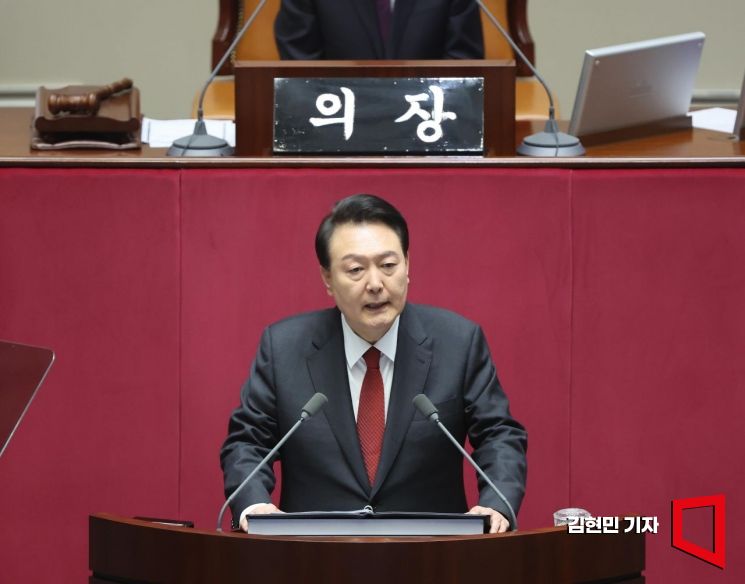
The Ministry of Justice explained the background, saying, "After reviewing the appellate court ruling, which examined all claims and evidence submitted by both plaintiff and defendant during the first and second trials and canceled the disciplinary action, we found no grounds for appeal such as violations of the Constitution, laws, orders, or regulations, and thus decided not to appeal."
The Ministry of Justice reiterated the issues pointed out by the second trial court, stating, "The appellate court ruled that the disciplinary procedure against the former Prosecutor General violated the constitutional principle of due process and related laws such as the Prosecutor Disciplinary Act, and therefore the disciplinary action was unlawful and canceled."
The Ministry of Justice explained, "The second trial ruling found that ▲ the Minister of Justice, who as the disciplinary requester should not have been substantially involved in the disciplinary review, arbitrarily changed the review schedule, excluded the pre-designated alternate members to ensure fairness, newly appointed disciplinary committee members, and designated one as acting chairperson, thereby arbitrarily altering the composition of the disciplinary committee and interfering with case review ▲ despite a legitimate recusal request by the disciplinary subject, the recused members participated in related procedures, resulting in deliberation and resolution with less than the legally required quorum ▲ the disciplinary committee denied the disciplinary subject's lawful request for cross-examination of witnesses unfavorable to them, infringing on their right to defense. These actions violated the constitutional principle of due process and related laws such as the Prosecutor Disciplinary Act, rendering the disciplinary action unlawful."
Earlier, the Seoul High Court Administrative Division 1-1 (Presiding Judges Shim Jun-bo, Kim Jong-ho, Lee Seung-han) overturned the lower court's ruling that had dismissed President Yoon's appeal against the Ministry of Justice's disciplinary action and ruled in favor of the plaintiff on the 19th.
At that time, the court stated, "The Minister of Justice's involvement in the disciplinary procedure violates the disqualification provisions under the Prosecutor Disciplinary Act and the principle of due process, making it unlawful," and added, "The principle of due process is a fundamental constitutional principle applicable not only to criminal procedures but also to legislative, judicial, and administrative actions, and must be observed in disciplinary procedures against prosecutors."
Furthermore, the court noted, "There were defects in the quorum requirements for decisions on recusal requests and disciplinary resolutions," and judged, "It is unlawful for disciplinary committee members who received recusal requests to participate in disciplinary resolutions without a decision on the legitimacy of the recusal."
Additionally, the court found that the Ministry of Justice infringed on President Yoon's right to defense during the disciplinary resolution process. The court stated, "The committee admitted the statement written by Prosecutor Shim Jae-cheol as key evidence for recognizing the disciplinary reasons but unreasonably rejected the plaintiff's request to cross-examine witnesses to impeach it and did not provide alternative means for impeachment, thereby failing to guarantee the plaintiff's right to defense, which violates the principle of due process."
Previously, former Minister of Justice Choo Mi-ae excluded President Yoon from his duties as Prosecutor General in November 2020 and held a disciplinary committee in December of the same year, imposing a two-month suspension.
The disciplinary reasons cited by the Ministry of Justice at that time were ▲ drafting and distributing documents alleging surveillance of major case trial panels ▲ obstructing inspection and investigation related to the 'Channel A case' ▲ damaging the dignity and reputation of prosecutors by undermining political neutrality.
President Yoon's side argued that these disciplinary reasons were either untrue or not problematic and demanded the cancellation of both the exclusion from duty and the disciplinary action. They also applied for a suspension of execution (stay of effect) of the exclusion and disciplinary action, which the court approved within a week, allowing him to return to duty.
The Ministry of Justice stated, "We take the appellate court ruling, which found significant procedural violations and infringements on the right to defense in the disciplinary process against the Prosecutor General who commands and supervises prosecutors and oversees prosecutorial affairs as a quasi-judicial institution, very seriously. We will ensure that due process and the right to defense are guaranteed in all future inspections and disciplinary processes and will strive to protect the neutrality of the prosecution and the independence of prosecutorial investigations."
© The Asia Business Daily(www.asiae.co.kr). All rights reserved.
![Clutching a Stolen Dior Bag, Saying "I Hate Being Poor but Real"... The Grotesque Con of a "Human Knockoff" [Slate]](https://cwcontent.asiae.co.kr/asiaresize/183/2026021902243444107_1771435474.jpg)
















