Foreign Net Purchases in Chinese Stock Market at 30.7 Billion Yuan
Lowest in 8 Years Since 2015
Over 200 Billion Yuan Outflow Since August
Impact of Biguiyuan Default and Others
This year, the scale of foreign investors' investment in the Chinese stock market recorded the lowest level in eight years. Foreign investors withdrew 200 billion yuan, accounting for 90% of the 235 billion yuan they invested in the Chinese stock market this year. The exodus of foreign investors from the Chinese stock market continued as the risk of economic recession increased due to the Chinese real estate crisis and sluggish domestic demand, coupled with escalating geopolitical tensions from the US-China conflict.
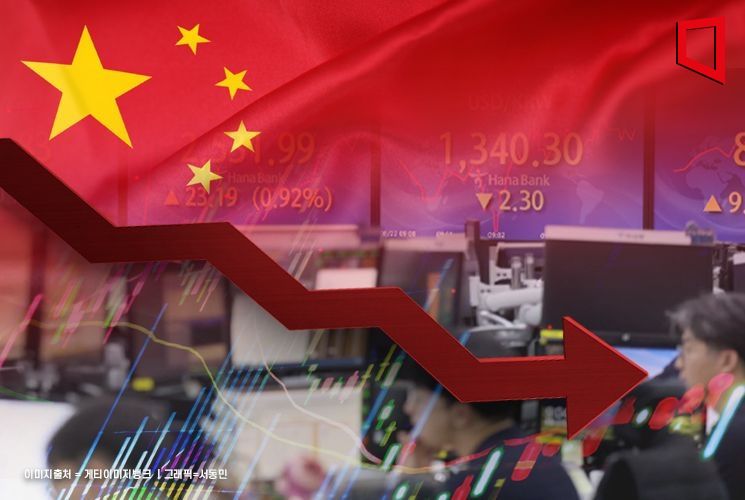
On the 28th (local time), major foreign media analyzed cross-trading data between the Chinese mainland stock market and the Hong Kong stock market this year and found that the net purchase amount by foreign investors in Chinese listed stocks was 30.7 billion yuan as of the 27th of this month. This is the lowest level since the implementation of the Shanghai-Hong Kong Stock Connect (Hushangtong) in 2015.
Foreign investors invested 235 billion yuan in the Chinese stock market as recently as August. However, within just four months, 87% of that amount was withdrawn, shrinking the net inflow of foreign investment this year to about 30 billion yuan.
The trigger was the default news of Country Garden (Biguiyuan), China's largest private real estate developer. Foreign investors began net selling Chinese stocks from August, when the Country Garden default occurred, and have continued to sell steadily on a monthly basis since then. Concerns spread that an economic crisis could occur as defaults among Chinese real estate companies spread like dominoes. In addition, sluggish domestic demand in China, the impact of export slowdowns due to global economic contraction, and escalating US-China tensions further intensified foreign investors' aversion to investing in the Chinese stock market.
Accordingly, unlike global stock markets, the Chinese stock market continued its downward trend this year. While the US S&P 500 index rose 24.6% this year due to a tech stock rally, the Chinese CSI 300 index fell 11.8% during the same period. This contrasting movement has continued this month as well. The US S&P 500 index rose 4.7% this month, while the CSI 300 index fell more than 3%.
Market analysts suggest that pessimism about the Chinese economy is pressuring the stock market, and that selling begets more selling, with market fear weighing heavily on the stock market.
Kay Hian, Chief Investment Officer (CIO) of asset management at UOB Hong Kong, a Singapore-based investment bank (IB), said, "Real estate is a major issue, but beyond the real estate problem, it is a psychological issue," adding, "Both domestic and foreign investors are mentioning consumer sentiment, corporate sentiment, and investment sentiment."
Alicia Garcia Herrero, Asia-Pacific economist at French IB Natixis, said, "Indicators are gradually improving and the overall conditions are quite positive for Chinese stocks," and added, "Honestly, apart from investors basically giving up on the market and saying 'there is no visible upside potential,' there is no other reason to explain the stock market decline."
The Chinese stock market is expected to continue its weakness going forward. According to a survey conducted by Bank of America (BofA) targeting Asian fund managers, most respondents said they are reducing the proportion of Chinese stocks in their investment portfolios.
© The Asia Business Daily(www.asiae.co.kr). All rights reserved.

















