The construction industry is experiencing a growing sense of crisis following the workout application by Taeyoung Construction, ranked 16th in construction capability. This is due to a considerable number of construction companies facing issues such as real estate project financing (PF) defaults and unsold units amid the economic downturn. Furthermore, the possibility of instability in the capital procurement market is also causing tension within the industry.
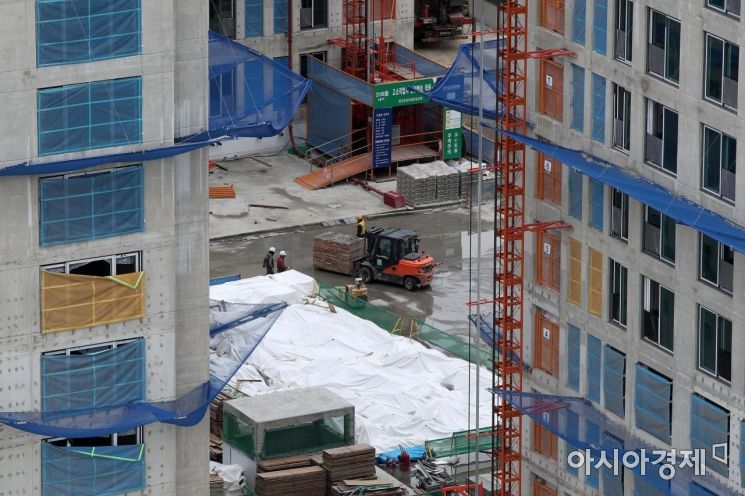
According to financial and construction industry sources on the 29th, companies like Shinsegae Construction and Kolon Global are facing potential liquidity crises due to contingent liabilities from PF. Contingent liabilities refer to debts that may arise in the future but are not yet confirmed. Typically, in relation to real estate PF, this means the construction company has guaranteed loans taken by the project developer. With the high-interest rate environment and poor business conditions, the expanded scale of contingent liabilities is expected to act as a trigger.
Korea Ratings changed Shinsegae Construction's unsecured bond credit rating outlook to 'negative' last month. This was due to the cumulative cost of sales ratio reaching 99.2% as of the end of September this year, and the recognition of bad debts beginning in projects with low sales rates such as Villiv Radice (19.6 billion KRW), Villiv Lucent (11.4 billion KRW), and Villiv Heritage (5.5 billion KRW) located in Daegu. These complexes are reported to have sales rates in the low 20% range. As a result, Shinsegae Construction recorded an operating loss of 90.3 billion KRW in the third quarter of this year.
Shinsegae Construction's debt ratio (467.9%) is also classified as 'high risk.' In the construction industry, a debt ratio exceeding 200% is considered risky, and over 300% is regarded as high risk. Taeyoung Construction, which recently applied for a workout, had a debt ratio of 478.8%.
Kolon Global, ranked 19th in construction capability, also has a high debt ratio of 313% as of the end of September. Additionally, as of the end of August, its contingent liabilities from unstarted PF projects amounted to 612.1 billion KRW, which is about three times its cash and cash equivalents of 237.7 billion KRW during the same period. This has led to analyses suggesting that if the construction and real estate markets cool further and PF risks materialize, it will be difficult to respond using internal cash reserves.
If the PF-related crisis spreads, partner companies will also face liquidity pressures, potentially leading to a contraction in the real economy. The problem is that the construction market outlook for next year is not favorable. To make matters worse, construction companies are expected to face increased difficulties in raising funds. Financial institutions may reduce liquidity supply to construction companies or demand credit enhancements.
In a recent report, Samsung Securities stated, "There is a high possibility that the short-term funding market will become unstable. While risks have so far been raised mainly among small and medium-sized construction companies, credit rating downgrades among large or mid-sized construction companies within the top 30 in construction capability are causing PF risks to spread to construction companies." It added, "Project delays and accumulating financial costs on PF mean that construction companies' PF guarantees are not easily reduced. The difficulties in the PF market are expected to be prolonged."
According to the Financial Services Commission, as of the end of September this year, the outstanding balance of domestic PF loans was 134.3 trillion KRW, an increase of about 42 trillion KRW (45%) compared to 92.5 trillion KRW at the end of 2020, over three years ago. The PF loan delinquency rate rose from 1.19% at the end of last year to 2.42% at the end of September this year.
© The Asia Business Daily(www.asiae.co.kr). All rights reserved.

















