Seoul's Total Dining Sales Slightly Increase Compared to Last Year Before Indoor Mask Mandate
The commercial district that experienced the warmest winter compared to the previous year in Seoul was found to be the area near Gwanghwamun.
Korea Credit Data (KCD) announced on the 28th the results of an analysis of sales data from about 200,000 dining establishments in Seoul using the management service 'Cash Note.'
According to the survey results, the average sales of dining establishments in Seoul from the first to the third week of December increased by 3% compared to the same period last year. Considering that indoor mask-wearing was mandatory in December last year, there was no significant sales increase as expected. In particular, while daytime sales increased by 5% compared to the previous year, nighttime sales only rose by 2%. This suggests that although COVID-19 restrictions have been lifted, the culture of company dinners has not returned.
The commercial district in Seoul with the highest sales increase compared to the previous year was Gwanghwamun. From the first to the third week of December, sales increased by 12-20% compared to the same period last year. Nighttime sales also rose by 11-16%. This is interpreted as the business conditions of nearby commercial districts improving as more companies returned from remote work to commuting.
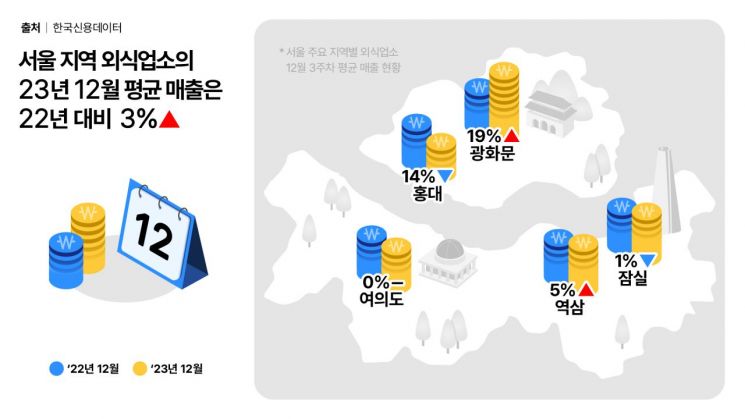
The Yeoksam-dong area, an office district in Gangnam, also showed a sales increase of about 2-5% compared to the same period last year. The Yeouido area, known as a financial district, showed different trends between day and night. Daytime sales were similar to last year or decreased by about 1-2%, but nighttime sales increased by about 3-6% compared to the previous year.
The economy near Hongdae, a representative university district, was cold. Sales decreased every week from the first to the third week of December. In the third week of December, which included Christmas, nighttime sales dropped by as much as 13% compared to the same period last year. Daytime sales also decreased by 9%.
Sales on Christmas Eve also varied by region. On the 24th, Gwanghwamun and Yeoksam recorded sales increases of 59% and 16% respectively compared to the previous year. However, Jamsil and Hongdae areas saw sales decreases of 10% and 16% respectively.
Gang Ye-won, Director of Data Strategy at Korea Credit Data, said, "The continuous rise in labor and material costs has significantly changed consumption patterns," adding, "The dispersion of consumption toward overseas travel continuing through the year-end with the endemic is also having a considerable impact on the recovery of sales in the dining industry."
© The Asia Business Daily(www.asiae.co.kr). All rights reserved.
![Clutching a Stolen Dior Bag, Saying "I Hate Being Poor but Real"... The Grotesque Con of a "Human Knockoff" [Slate]](https://cwcontent.asiae.co.kr/asiaresize/183/2026021902243444107_1771435474.jpg)
















