‘Brave Rifles’ Brigade Rotational Deployment
Early next year, the ‘Brave Rifles’ brigade under the U.S. Army III Armored Corps, which was deployed in the Middle East, will be stationed in Korea. The Brave Rifles was a unit also deployed to the Middle East in 2018-2019 for the war against the Islamic extremist armed group ‘Islamic State’ (ISIS).
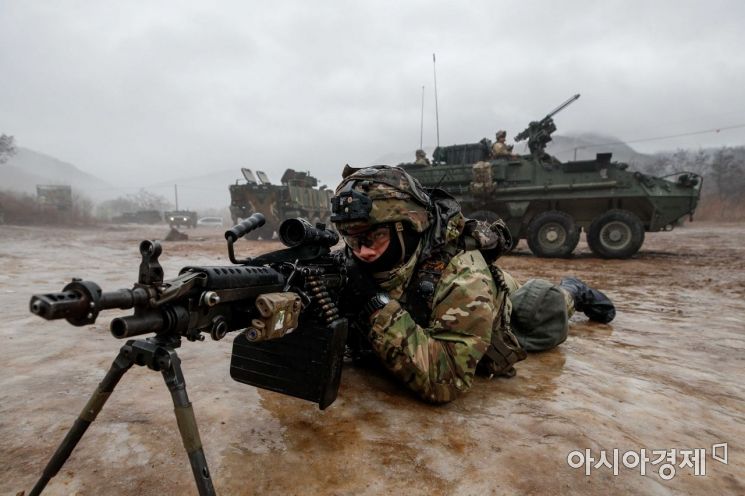 On the 13th, the Army's Amitiger Demonstration Brigade and the U.S. 2nd Infantry Division Stryker Brigade conducted a battalion-level joint exercise at the Mugeon-ri Training Ground in Paju, Gyeonggi Province. Approximately 800 South Korean and U.S. soldiers participated in this exercise, which involved various weapon systems including the K808 wheeled armored vehicle, U.S. Stryker armored vehicles, reconnaissance drones, unmanned aerial vehicles (UAVs), and anti-tank missiles (Hyeongung). Photo by Jinhyung Kang aymsdream@
According to the U.S. Forces Korea on the 28th, as part of a regular rotational deployment, it was decided to deploy the Brave Rifles brigade under the U.S. Army III Armored Corps from Fort Cavazos, Texas, to Korea. The unit designated as a rotational force in Korea will serve for nine months. During its two-year deployment in the Middle East, over 60 members of the Brave Rifles received medals.
With the deployment of the Brave Rifles brigade, the U.S. Army 4th Infantry Division’s 2nd Stryker Brigade Combat Team (SBCT), currently stationed with the U.S. Army 2nd Infantry Division and the ROK-U.S. Combined Division in Korea, will complete its mission and return to the United States. The SBCT is also known as the ‘Lancer Brigade.’ It was the first U.S. Stryker brigade deployed to U.S. Forces Korea in October last year.
The SBCT is organized with M1126 Stryker armored vehicles. The M1126 Stryker can carry up to nine armed personnel and can reach a maximum speed of about 100 km/h (on roads). However, its armor and armament are weaker compared to tanks and infantry fighting vehicles. Instead, it boasts excellent mobility and can be quickly transported anywhere in the world by airlift. Although the U.S. SBCT’s own firepower is limited compared to armored brigades, its high mobility and ability to operate effectively in various terrains and climatic conditions make it one of the benchmarks for the future-type combat units that the ROK military aims to develop.
In addition, the United States aims to enhance the strategic flexibility of U.S. Forces Korea. Strategic flexibility refers to the concept of moving U.S. Forces Korea away from being a fixed unit on the Korean Peninsula to rapidly deploying them to conflict zones in Northeast Asia in case of emergency. Regarding the rotational unit reorganization, the U.S. Army evaluated that it "provides commanders with improved mobility and strategic flexibility."
Meanwhile, Burwell Bell, former commander of U.S. Forces Korea (served from February 2006 to June 2008), recently stated in a New Year’s message sent to the Korea-U.S. Alliance Foundation that "2024 will pose the most serious threat to peace and stability on the Korean Peninsula since North Korea’s ‘Cheonan sinking’ in 2010," and urged that "the U.S. should deploy an additional tank battalion to the Korean Peninsula to reinforce the ‘Stryker’ brigade stationed in Korea in 2024."
© The Asia Business Daily(www.asiae.co.kr). All rights reserved.
![Clutching a Stolen Dior Bag, Saying "I Hate Being Poor but Real"... The Grotesque Con of a "Human Knockoff" [Slate]](https://cwcontent.asiae.co.kr/asiaresize/183/2026021902243444107_1771435474.jpg)
















