Sejong University announced on the 27th that it jointly hosted the Sejong Institute of Science and Technology (SAIST) G2 Project (National Land Remodeling Strategy IV) seminar at the Sejong University Daeyang AI Center, together with the Sejong University Industry-Academic Cooperation Foundation, Sejong Research Institute, and Water Economy Research Institute.
At the seminar held on the 20th, chaired by Jeong Myeong-chae, Chairman of the Water Economy Research Institute, Sejong University President Bae Deok-hyo stated, "The government is currently promoting the basic design for the construction of the new Gadeokdo Airport," adding, "Through this seminar, we hope to establish a new concept for the construction of the Gadeok New Airport to efficiently utilize the national land and promote the development of Busan and the Gyeongnam region."
In his keynote speech, Joo Myeong-geon, Honorary Chairman of Sejong University, said, "The National Land Remodeling Strategy is an essential element for our country to enter the G2 nation status," and particularly explained the necessity of "changing the runway of the currently planned east-west Gadeokdo New Airport to a north-south direction and constructing a breakwater connecting Gadeokdo and Jwiseom (Dadaepo)."
Chairman Joo stated, "By reclaiming a total area of 81㎢ (approximately 25 million pyeong), about 28 times the size of Yeouido, with dredged soil from the Nakdong River, it is possible to secure an additional 17% of the urban area of Busan Metropolitan City, which will greatly contribute to the urban and industrial development of Busan and the Gyeongnam region."
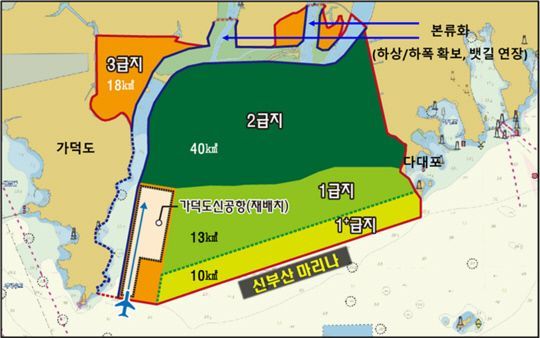
Professor Noh Joon-sung of the Department of Environmental Energy Convergence at Sejong University explained, "The coastal area connecting Gadeokdo and Dadaepo has a shallow depth within 20 meters, so by constructing a 12 km-long breakwater and reclaiming the inland part, a vast area can be secured." Professor Noh proposed a plan to "change the runway direction of the Gadeokdo New Airport currently planned by the government and move the waterway of the Nakdong River estuary toward Gadeokdo to develop the area around the breakwater into a 'New Busan Marina' region."
Professor Kwon Hyun-han of the Department of Civil and Environmental Engineering at Sejong University gave a presentation titled "Dredging and Utilization Plan for the Lower Nakdong River Basin." Professor Kwon stated, "Among the total water resources of 129.4 billion cubic meters in our country, 39.9 billion tons flow unused into the sea, which is similar to the reservoir capacity of China's Three Gorges Dam," and added, "By dredging the river, we can expand the water basin, which will not only help flood control but also secure water resources stably." Furthermore, he suggested, "Dredging the Nakdong River bed can yield about 2.7 billion cubic meters of dredged soil, of which aggregates can be sold to generate revenue, and the soil can be used for reclamation of the Gadeokdo New Airport site (about 270 million cubic meters)."
Professor Shin Nina of the Department of Business Administration at Sejong University analyzed the "Economic Feasibility of Utilizing Gadeokdo and Nakdong River Basin," explaining, "The land sale revenue from the reclaimed land around the Gadeokdo New Airport is estimated at 198 trillion won, and after deducting the costs of constructing the new airport, breakwater, and infrastructure amounting to 18 trillion won, a total profit of 180 trillion won can be generated." She projected that the economic ripple effect, including the creation of 2.2 million jobs, would amount to hundreds of trillions of won. Additionally, Professor Shin analyzed that "selling the dredged soil obtained through dredging the Nakdong River would generate an additional revenue of about 22 trillion won."
© The Asia Business Daily(www.asiae.co.kr). All rights reserved.

















