November Industrial Activity Trends
Industrial Production Up 0.5% · Consumption Up 1.0% · Facility Investment Down 2.6%
Domestic production rebounded last month as semiconductor production recovered. Retail sales also increased at the largest rate in nine months due to sales events concentrated in November. However, investment continued its sluggish trend, showing negative growth for two consecutive months.
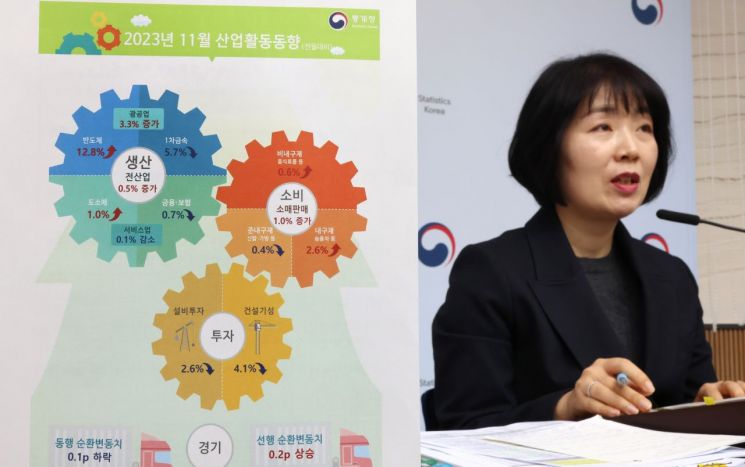 Kim Bo-kyung, Director of Economic Trend Statistics at the National Statistical Office, is announcing the November 2023 Industrial Activity Trends on the morning of the 28th at the Government Sejong Complex in Sejong City.
 [Photo by Yonhap News]
According to the 'November 2023 Industrial Activity Trends' released by Statistics Korea on the 28th, total industrial production (seasonally adjusted, excluding agriculture, forestry, and fisheries) increased by 0.5% last month. Production, which had maintained an increasing trend for two consecutive months in August (1.9%) and September (1.1%), rebounded after recording -1.8% in October.
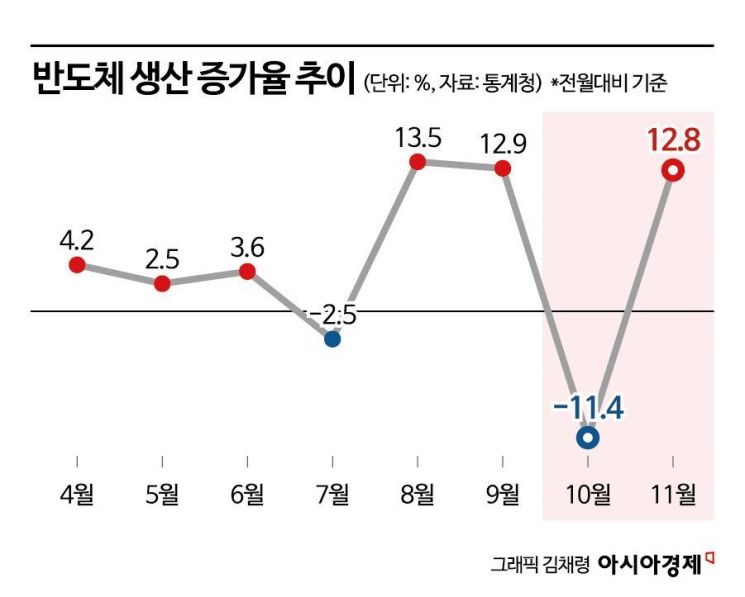
The recovery in production was largely influenced by the semiconductor sector. Semiconductor production, which had decreased by 11.4% in October due to base effects and a reduction in working days, increased by 12.8% last month as production of memory semiconductors such as DRAM and flash memory surged. This restored the growth trend seen in August (13.5%) and September (12.9%). Kim Bo-kyung, Economic Trend Statistics Officer at Statistics Korea, explained, “Semiconductor production tends to increase toward the end of the quarter,” adding, “Additionally, the expansion of demand for artificial intelligence (AI) servers has led to increased exports of high-capacity memory semiconductors, contributing to the recovery in production.”
Following the increase in semiconductor production, manufacturing production rose by 3.3%. The manufacturing production growth trend, which had increased consecutively in August (5.2%) and September (1.8%), had declined in October (-3.8%) but turned upward again. Machinery equipment also increased by 8.0% due to strong production of semiconductor-related wafer processing equipment and semiconductor assembly equipment. On a year-on-year basis, manufacturing production increased by 5.3%, continuing the growth trend for three consecutive months following September (3.0%) and October (0.9%). The Ministry of Economy and Finance evaluated that “the economic trend centered on manufacturing production and exports is recovering,” indicating “a manufacturing-centered economic recovery in the fourth quarter.” Manufacturing inventories decreased by 2.4% compared to the previous month. The average operating rate of manufacturing rose by 1.8 percentage points from the previous month to 71.9%.
However, service sector production decreased by 0.1% from the previous month. Production increased in wholesale and retail trade (1.0%) but declined in finance and insurance (-0.7%) and transportation and warehousing (-1.4%). Notably, finance and insurance production has been declining for three consecutive months, recording -0.1% in September and -1.2% in October. Officer Kim explained, “The reduction in interest income for banks and others reflects the narrowing interest rate spread due to high interest rates.”
Retail Sales Increase by 1.0%... Largest Growth in Nine Months
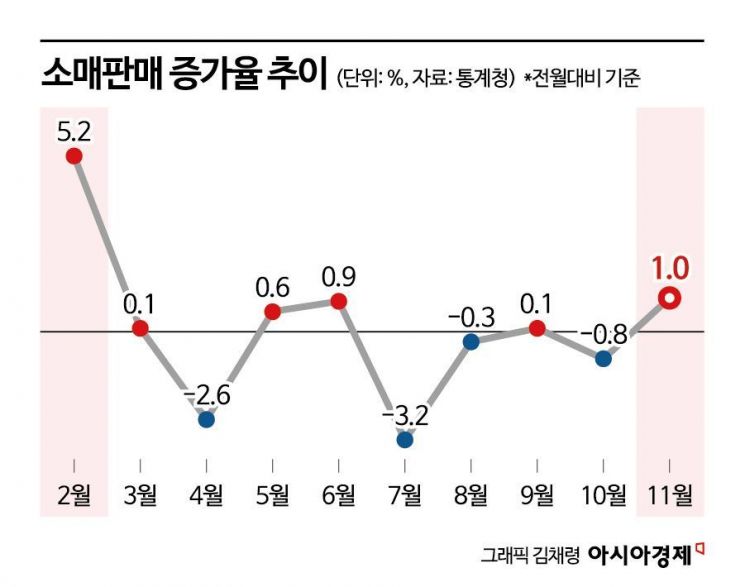
Retail sales, which indicate consumer trends, increased by 1.0% from the previous month, recovering from a decline of -0.8% in October and marking the largest increase in nine months since February (5.2%). Since March, retail sales had struggled to exceed 1.0%. In November, durable goods consumption increased by 2.6% as consumption rose in passenger cars and home appliances.
However, it seems difficult to be optimistic about a long-term recovery due to factors such as high inflation. Officer Kim analyzed, “In November, sales events like Black Friday led to increased sales of passenger cars and home appliances,” adding, “Recently, consumption in the goods sector has notably slowed down.” The Ministry of Economy and Finance also diagnosed, “Although signs of easing in the previously constrained domestic demand conditions are observed, such as improvements in retail sales, differences in recovery speed between sectors remain, so attention should be paid to the gap between indicators and the actual economic sentiment.”
Facility investment recorded negative growth for two consecutive months, following -3.6% in October. Both transportation equipment, including aircraft (-5.7%), and machinery (-1.5%) declined, resulting in a 2.6% decrease from the previous month. Construction output also fell by 4.1% due to poor performance in building (-3.0%) and civil engineering (-7.3%) works. The coincident index of economic indicators, which reflects the current economy, stood at 98.9, down 0.1 percentage points from the previous month. The leading index of economic indicators, which predicts future economic trends, rose by 0.2 points to 99.9.
© The Asia Business Daily(www.asiae.co.kr). All rights reserved.



















