Ministry of Culture, Sports and Tourism Releases Copyright Guide for Generative AI
Recommendations on Compensation for Training Data and Securing Copyright Holder Consent
The government has issued guidelines stating that AI businesses such as Naver and Kakao must provide appropriate compensation to copyright holders when using AI training data. While businesses are opposing this, claiming it makes rapid technological development difficult, the voices of copyright holders, including media companies that have long demanded payment for data usage, are expected to gain strength. Debates over the appropriateness of compensation and specific calculation methods are likely to begin.
First AI Copyright Guidelines Released... "Appropriate Compensation for Training Data Required"
According to the "Generative AI Copyright Guide" released by the Ministry of Culture, Sports and Tourism on the 27th, IT companies and other businesses must secure lawful usage rights by providing appropriate compensation to copyright holders when utilizing AI training data. It also pointed out that even works published on websites, blogs, or social networking services (SNS) cannot be used without the copyright holder's permission, so caution is necessary. This guideline serves as a manual containing important points that businesses, copyright holders, and service users should be aware of regarding AI copyright, and is regarded as the government's official stance on AI copyright.
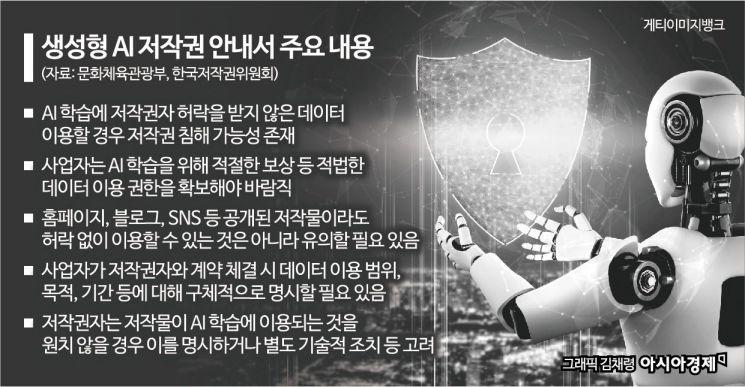
Although the guideline has no legal binding force, it is meaningful in that it presents a clear direction. Professor Lee Dae-hee of Korea University Law School, who participated in drafting the manual, explained, "Cases of paying fees for training data are emerging overseas, and in the long term, the trend will move toward compensation."
Emergency for Businesses like Naver and Kakao... Copyright Holders' Demands for Compensation Likely to Gain Strength
AI businesses, which need to collect vast amounts of data to create large language models (LLMs) that form the basis of generative AI, are facing an emergency. In Naver's case, there were rumors that it used 50 years' worth of articles from partner media companies. Since data that was previously used free of charge must now be purchased, the cost burden inevitably increases.
The Super Large AI Promotion Council under the Korea Software Industry Association immediately protested. They argued that rapid technological development would be impossible under the guidelines and requested the deletion of the phrase "recommend securing lawful rights for training data." Instead, they proposed revising the manual to clearly indicate prohibited actions. Ahn Hong-jun, head of industrial policy at the Korea Software Industry Association, expressed concern, saying, "It is interpreted to mean that the purpose, period, and compensation for data use must be negotiated case by case, but such procedures will inevitably cause us to fall behind in global competition."
An IT industry insider said, "Since compensation standards are not specific, we need to watch closely, but this will act as an invisible hurdle to data utilization," adding, "It is worrisome as it could influence future related legislation or court rulings." This criticism comes amid the pending Data Mining Act in the National Assembly, which allows free use of copyrighted works for AI training. The related bill includes provisions to classify AI training data as an exception under copyright law's 'fair use.'
On the other hand, the voices of data copyright holders are expected to gain strength. Currently, media companies are demanding compensation for AI training data. The Korea Newspaper Association recently submitted a statement to the Ministry of Culture, Sports and Tourism calling for mandatory payment for the learning and use of news by generative AI. The Korea Broadcasting Association also requested confirmation from Naver, Kakao, Google Korea, and others on whether broadcasting companies' copyrighted works are being used for AI training, expressing the opinion that separate compensation is necessary in such cases.
Overseas, lawsuits between AI businesses and media companies are ongoing. On the 27th (local time), The New York Times (NYT) filed a lawsuit against OpenAI, the developer of ChatGPT, and Microsoft (MS), claiming that its articles were used without permission for AI training. Previously, CNN and Reuters blocked ChatGPT from collecting their information.
Some big tech companies have begun negotiating fees for AI training content usage. Apple recently proposed contracts worth at least $50 million (approximately 65 billion KRW) to major media companies and publishers. OpenAI also signed news usage fee agreements with the Associated Press and the American Journalism Project. Kim Chan-dong, a member of the Ministry of Culture, Sports and Tourism's AI Copyright System Improvement Working Group and head of the Legal Research Team at the Korea Copyright Commission, said, "Detailed discussions are needed on compensation methods for data use and obtaining individual consent," adding, "We will monitor domestic and international trends to derive a reasonable direction."
© The Asia Business Daily(www.asiae.co.kr). All rights reserved.
![Clutching a Stolen Dior Bag, Saying "I Hate Being Poor but Real"... The Grotesque Con of a "Human Knockoff" [Slate]](https://cwcontent.asiae.co.kr/asiaresize/183/2026021902243444107_1771435474.jpg)











