As the likelihood of Taeyoung Construction entering workout increases, concerns about restructuring and project financing (PF) insolvency management are spreading throughout the construction industry. Construction companies that have been enduring by extending maturities are now reaching their limits due to rising PF loan balances and delinquency rates. If the impact grows, a chain reaction of insolvencies in the financial sector cannot be ruled out.
◆Taeyoung Construction to File for Workout... Application of New Corporate Restructuring Promotion Act
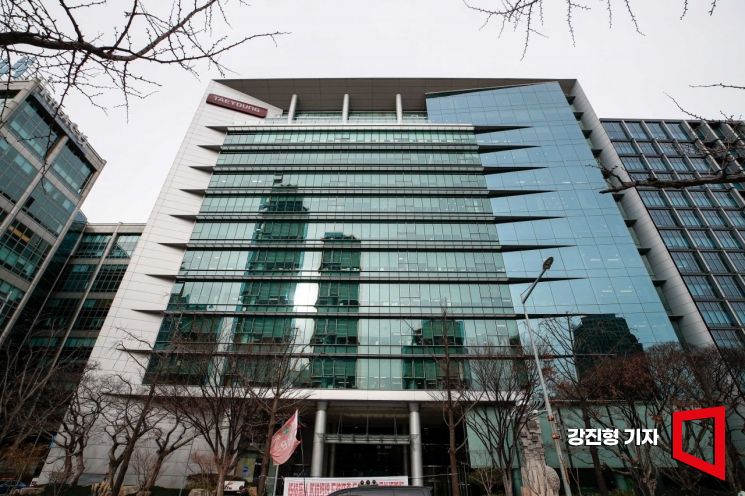
According to the construction industry on the 28th, Taeyoung Construction plans to hold a board meeting on the day to decide on filing for workout. Although it stated in response to the Korea Exchange's inquiry disclosure request about the workout rumors the previous day that "various measures for business normalization are currently under review, but nothing has been concretely decided," the industry analyzes that it has effectively entered the workout process.
A workout is a pre-bankruptcy stage requiring intense self-help efforts. If the creditors determine that a voluntary agreement for self-led restructuring is difficult, the company enters workout. In this case, restructuring is led by the creditors and proceeds faster than a voluntary agreement. However, management control transfers to the creditors, and the existing management may be dismissed.
If Taeyoung Construction files for workout, it will be the first case applying the newly enacted Corporate Restructuring Promotion Act (hereafter CRPA) established earlier this month. Originally, the workout system lost its effect on the 15th of last month due to the sunset of the CRPA. However, following industry concerns that this could burden the economy, the National Assembly re-enacted the CRPA. Under the new CRPA, companies experiencing temporary liquidity crises can receive loan maturity extensions and financial support if more than 75% of creditors agree.
According to Korea Ratings, as of the end of Q3 this year on a consolidated basis, Taeyoung Construction's net borrowings reached KRW 1.8176 trillion, and its debt ratio was 478.7%. The PF loan balance requiring refinancing, which is the core of the liquidity crisis excluding directly purchased PF securitization bonds, stands at KRW 2.3456 trillion. Excluding PF loans secured by collateral assets, contingent PF liabilities related to projects that are either not started or withdrawn amount to about KRW 1.2565 trillion.
Korea Ratings stated, "The scale of PF contingent liabilities with a high likelihood of risk realization is estimated at about KRW 1 trillion," adding, "Approximately KRW 190 billion will mature from this month through February next year." It further noted, "Considering monthly expected construction payments, short-term liquidity response is possible, but it is highly likely that the increased financial burden since the 2020 split will not be improved to match the current credit rating level," and "We will continue to review liquidity response and business management capabilities in this regard."
◆Fear Spreads in Construction Industry... Taeyoung Construction "Making Self-Help Efforts"
Taeyoung Construction emphasized that it is continuing self-help efforts to secure liquidity. Its holding company, TY Holdings, recently sold Taeyoung Industry, a logistics company considered a key business within the group, for KRW 240 billion. Taeyoung Construction also held a board meeting on the 22nd and decided to sell a 15.6% stake in the thermal power plant Pocheon Power for KRW 42 billion. The disposal date was disclosed as the 28th, coinciding with the maturity of a KRW 48 billion PF loan related to office development in Seongdong-gu, Seoul.
It is also known that they are seeking a joint management contractor for the military base relocation project site in Bucheon, Gyeonggi Province. A Taeyoung Construction official said, "Funds from the logistics company sale are expected to be received by the end of this month, and we are making efforts to overcome the liquidity crisis, including selling common shares of Pocheon Power."
However, the repercussions are serious. Subcontractors are an immediate concern. According to the Q3 report this year, Taeyoung Construction provided payment guarantees for subcontracting fees of KRW 51.9 billion to 10 subcontractors and KRW 231.3 billion to 9 sites. The industry believes that even if Taeyoung Construction enters workout, there are limits to claims on payment guarantees, and it will take time to pay fees, causing subcontractors to suffer liquidity pressure.
The impact of Taeyoung Construction's workout extends to the entire construction industry. So far, concerns about the deterioration of financial soundness of small and medium-sized construction companies have persisted due to PF losses from unsold units. However, with a relatively large company like Taeyoung Construction effectively entering workout, financial institutions must inevitably adjust for real estate PF insolvencies. Amid already poor business conditions due to high interest rates, rising construction costs, and economic recession, if financial institutions begin to resolve real estate PF insolvencies, a wave of bankruptcies in the construction industry could become a reality.
According to the Financial Services Commission, as of the end of September this year, domestic PF loan balances reached KRW 134.3 trillion, a sharp increase of about KRW 42 trillion (45%) compared to KRW 92.5 trillion at the end of 2020, about three years ago. The PF loan delinquency rate jumped from 1.19% at the end of last year to 2.42% at the end of September this year. For loan burdens to ease, the high-interest rate trend must subside, but the timing remains uncertain. The U.S. Federal Reserve's rate cuts are expected from the first half of next year, and the Bank of Korea's from the second half. Lee Hyuk-jun, head of financial evaluation at NICE Credit Rating, said, "The longer the high-interest rate situation continues, the 30-50% of real estate PF bridge loans will result in final losses."
The number of bankrupt companies has increased for two consecutive years. According to the Ministry of Land, Infrastructure and Transport, 21 construction companies went bankrupt this year, with the number of general construction companies rising from 1 in 2021 to 5 in 2022, and 9 this year. Representative examples include Daewoo Industrial Development ranked 75th in construction capability and Daechang Enterprise ranked 109th.
© The Asia Business Daily(www.asiae.co.kr). All rights reserved.


















