2028 University Entrance Exam Reform Plan
Abolish Elective Subjects like Korean, Math, Social Studies
Relative Evaluation System with 5 Grades for School Records
The '2028 University Entrance Examination System Reform Plan,' which eliminates elective subjects such as Korean, Mathematics, Social Studies, and Science and removes advantages and disadvantages based on elective subjects, has been finalized. All examinees will take the same exam questions regardless of their career paths, without taking 'Advanced Mathematics' (Calculus II and Geometry). Additionally, high school internal grades will shift from the current 9-grade relative evaluation system to a 5-grade relative evaluation system, excluding arts and physical education, science inquiry experiments, and social-science integrated elective subjects.
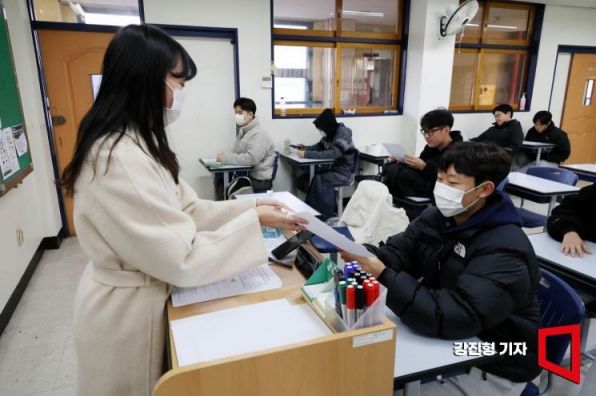 On the 8th, the distribution day of the 2024 College Scholastic Ability Test score reports, third-year students at Gyeongbok High School in Jongno-gu, Seoul, are checking their scores.
 [Photo by Joint Press Corps]
Elimination of Korean, Math, and Inquiry Elective Subjects and No Adoption of Advanced Mathematics
The Ministry of Education announced on the 27th that it has finalized the '2028 University Entrance Examination System Reform Plan' reflecting the resolution of the National Education Committee. The main point of the reform plan is the implementation of an integrated CSAT (College Scholastic Ability Test) that eliminates elective subjects in Korean, Mathematics, and Inquiry. Currently, the Korean and Mathematics sections operate under a 'common subject + elective subject' system, and in the inquiry section, students choose two subjects from 17 social and science subjects. However, starting with students currently in the second year of middle school, all will take the same subject exam in their chosen area.
The social and science inquiry sections will cover the integrated social studies and integrated science subjects from the current curriculum. Examinees will take both social studies and science. The Ministry of Education explained, "We aimed to resolve the advantages and disadvantages of elective subjects by reforming to an integrated and convergent CSAT subject system," adding, "We will abolish elective subjects in Korean, Mathematics, Social and Science Inquiry, and Vocational Inquiry areas and evaluate them based on the same standards and content."
Initially, the Ministry of Education considered including Advanced Mathematics (Calculus II and Geometry) as an elective subject in addition to the Mathematics section covering Algebra, Calculus I, and Probability and Statistics. However, based on the recommendation of the National Education Committee, it was decided not to include Advanced Mathematics in the CSAT. The Ministry explained, "There were concerns that introducing Advanced Mathematics would trigger private education and increase the burden on students and parents," and added, "Universities can sufficiently verify students' mathematical abilities and advanced learning through student records."
Other CSAT sections, evaluation and score provision methods, and the EBS linkage method will remain as they are.
High School Internal Grades to Use 5-Grade Relative Evaluation... Nine Integrated Social and Science Elective Subjects to Use Absolute Evaluation
High school internal grades will be reformed from the current 9-grade relative evaluation system to a 5-grade relative evaluation system, and absolute evaluation (A to E) and relative evaluation (grades 1 to 5) will be consistently recorded across all grades and subjects to establish safeguards against grade inflation.
Accordingly, starting from the 2025 academic year when current second-year middle school students enter high school, the top 10% will receive grade 1, up to 24% will receive grade 2, and up to 32% will receive grade 3. However, respecting the resolution of the National Education Committee, absolute evaluation will be conducted only for nine integrated social and science subjects among high school integrated elective subjects.
Furthermore, instead of knowledge memorization-based evaluation, 'essay and descriptive internal assessments' will be increased to evaluate future competencies such as critical thinking and problem-solving skills, and training to strengthen high school teachers' evaluation capabilities will be intensively conducted starting next year.
With the finalization of the 2028 university entrance examination reform plan, the Ministry of Education plans to support students, parents, high schools, education offices, and universities to prepare thoroughly for the reform and actively respond to fake news and anxiety marketing related to entrance exams.
Regulations related to the 2028 entrance exam reform, including the Higher Education Act, will be enacted and revised, and example questions for integrated social studies and integrated science according to the 2028 CSAT reform plan will be developed and disclosed within next year.
© The Asia Business Daily(www.asiae.co.kr). All rights reserved.
![Clutching a Stolen Dior Bag, Saying "I Hate Being Poor but Real"... The Grotesque Con of a "Human Knockoff" [Slate]](https://cwcontent.asiae.co.kr/asiaresize/183/2026021902243444107_1771435474.jpg)
















