Analysis Report on Changes in Trends of Chinese Tourists Visiting Korea
Notable Shift Towards Personalization, Small Groups, and Cultural Experiences
Shopping Proportion Decreased by 26.9% Compared to 2019
As trends among Chinese tourists visiting Korea rapidly change, it is estimated that the number of Chinese tourists visiting Korea this year will reach around 2 million. Chinese tourists have shown a rapid recovery centered on women, the MZ generation, and individual travel.
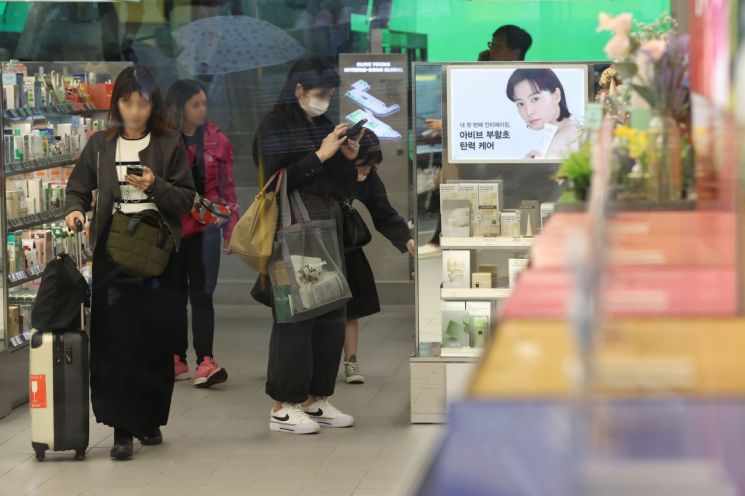 Group tours of Chinese tourists to Korea have resumed since last August, but the recovery of Chinese tourists appears to be slow. The industry analyzed that the sluggish recovery is partly due to the poor economic situation in mainland China and the shift from group travelers to individual travelers (Sanke) mainly from the MZ generation, making it difficult to expect a boom in Chinese tourists. The photo shows travelers visiting a cosmetics store in Seoul on the 6th. [Image source=Yonhap News]
The Ministry of Culture, Sports and Tourism and the Korea Culture and Tourism Institute introduced seven major trends in Chinese tourism to Korea in 2023, including these changes, in a report titled "Analysis of Changes in Chinese Tourism Trends to Korea after COVID-19," released on the 27th.
China resumed group tours to Korea in August after a hiatus of 6 years and 6 months. Quarantine for overseas arrivals also started relatively late, from January this year. The number of Chinese visitors to Korea this year is estimated to be around 2 million, an eightfold increase compared to last year (227,000). This figure is close to the government's target of 2 million announced in September for revitalizing Chinese tourism to Korea, and the number of visitors in the second half of the year nearly tripled compared to the first half (540,000), showing a rapid recovery.
Before COVID-19, in 2019, the number of Chinese visitors to Korea reached about 6 million. Considering that the outbound travel volume from Korea has not yet recovered to pre-COVID-19 levels since the quarantine for overseas arrivals was lifted in June 2022 (76.6% recovery from January to November 2023), the Ministry of Culture, Sports and Tourism and the Korea Culture and Tourism Institute expect the recovery of Chinese outbound travel to occur after 2024.
The Korea Culture and Tourism Institute identified seven major trends in Chinese tourism to Korea: ▲individualization and small group travel ▲female-led travel ▲focus on the 20s and 30s generation ▲shift from mass consumption to rational consumption ▲digital transformation of tourism information channels ▲longer stays ▲increased spending on cultural experiences. These trends were derived by analyzing the preliminary results of the "2023 Foreign Tourist Survey" for the first to third quarters.
This year, Chinese overseas travel showed a recovery starting from nearby Asian regions. The 2030 generation, numbering 370 million in China, led the trends of individualization and online travel. The main sending regions of tourists were concentrated in the top 10 cities with high income levels, such as Shanghai and Beijing. The average number of companions per visit to Korea decreased from 5.1 in 2019 to 2.1 this year, showing a trend toward individualization and smaller groups.
Looking at the composition of Chinese visitors to Korea, women accounted for 61.2%, and the 2030 generation made up 57.9%. The proportion of shopping in travel to Korea decreased from 95.1% in 2019 to 68.2% in 2023. The shopping locations for Chinese tourists also shifted from downtown duty-free shops (54.9%) and airport duty-free shops (40.5%) in 2019 to downtown duty-free shops (43%) and department stores (35.8%) in 2023. The use of social networking services (65.7%) and video sites (35.7%) as travel information channels increased noticeably among Chinese tourists.
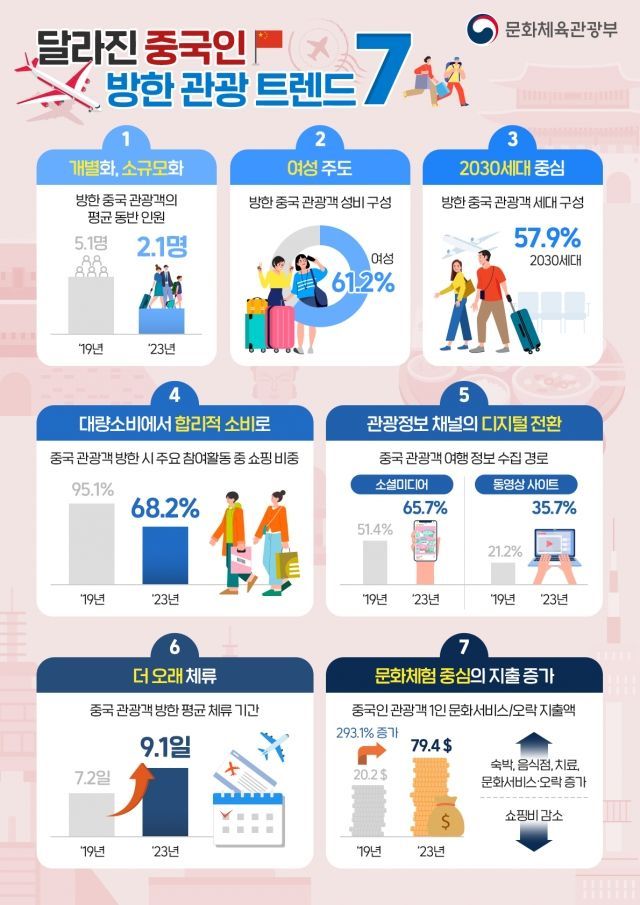 Infographic of the 'Analysis of Changes in Trends of Chinese Tourists Visiting Korea' report by the Ministry of Culture, Sports and Tourism and the Korea Culture and Tourism Institute. [Graphic = Ministry of Culture, Sports and Tourism]
The average length of stay increased from 7.2 days in 2019 to 9.1 days in 2023, an increase of about 1.9 days. Accordingly, the average expenditure per tourist also rose by 37.6%, from $1,632.6 in 2019 to $2,246.1 in 2023. The increase in length of stay is analyzed to be due to the phased recovery of the tourism market after COVID-19, with a relatively high proportion of economic activities, business, and study abroad in addition to tourism purposes.
In terms of tourist expenditure items, spending on shopping decreased, while spending on accommodation, restaurants, medical treatment, and cultural services and entertainment increased. In particular, spending on cultural services and entertainment increased about fourfold, from $20.2 in 2019 to $79.4 in 2023. The types of visits concentrated in Seoul and Jeju showed little change.
Chinese domestic credit card spending (January to November 2023) recovered to about 75.7% of the 2019 level. By category, tourism accommodation recovered to 78.8%, aviation to 115.4%, while duty-free shops remained at 44.9%.
The Ministry of Culture, Sports and Tourism plans to focus on specialized marketing for individual travel with the Korea Tourism Organization to recover Chinese tourism to Korea in line with the "2023-2024 Year of Visit Korea."
They will discover customized content by life cycle and interests and plan luxury travel products targeting the 2030 female demographic, a major pillar of Chinese consumption. Marketing targeting university students will also be actively promoted.
Strategies to attract group tour regions will continue. The "Korea Tourism Mega Roadshow," held in two regions this year, will be expanded next year to five regions including Shanghai, Guangzhou, Qingdao, Chengdu, and Dalian.
Additionally, using Chinese local social networking services and online travel platforms (OTA), they will intensively promote travel products targeting interests such as esports, famous dance academies, beauty and medical experiences, golf, marathons, and skiing. They will also actively promote easy payment merchants and immediate VAT refund services that allow the use of Chinese mobile payments directly in Korea.
The Ministry of Culture, Sports and Tourism and the Korea Tourism Organization will hold the "2024 Inbound Trend" event in Seoul on January 29 next year to share trends in high-value inbound markets such as China with the tourism industry and local governments. Representatives from China's leading online travel platforms (OTA) and social networking services (SNS) will participate as speakers to present the latest trends in the Chinese travel market after COVID-19.
© The Asia Business Daily(www.asiae.co.kr). All rights reserved.
![Clutching a Stolen Dior Bag, Saying "I Hate Being Poor but Real"... The Grotesque Con of a "Human Knockoff" [Slate]](https://cwcontent.asiae.co.kr/asiaresize/183/2026021902243444107_1771435474.jpg)

















