Launch of Joint T/F Team Specializing in Marine Weather to Proactively Prevent Accidents
The West Sea Regional Coast Guard Agency (hereinafter West Sea Agency) and the Gwangju Regional Meteorological Administration (hereinafter Gwangju Meteorological Administration) launched a joint task force (TF) last October to establish a collaborative system for preemptive preparation and response to hazardous marine weather, aiming to develop preventive measures against marine accidents caused by adverse weather conditions.
According to the West Sea Agency on the 27th, the joint TF has been promoting collaborative tasks to ensure public marine safety from three perspectives: △preemptive prediction methods for hazardous weather using 9-hour composite wave forecasts, △hazardous weather recognition methods utilizing real-time marine observation buoys, and △rapid hazardous weather information dissemination systems.
The Gwangju Meteorological Administration supported the establishment of a phased response system before hazardous weather by providing scenarios for wind and wave warnings, including the possibility of storm warnings, in advance.
Additionally, based on the wave prediction model (RWW3), they produced a ‘9-hour composite wave forecast’ by sequentially overlapping four forecast data sets at 3-hour intervals. This effort aimed to provide practical, prevention-centered information on worsening weather by supplementing the existing disaster prevention tasks with information on relatively safe marine areas for sheltering.
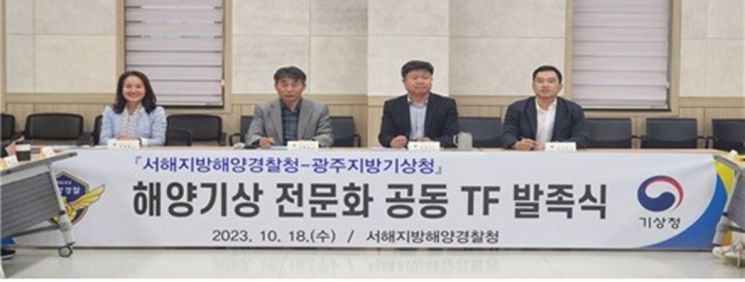 Last October, the West Sea Regional Maritime Police Agency and the Gwangju Regional Meteorological Administration launched a joint specialized task force team for marine weather.
 [Photo by West Sea Regional Maritime Police Agency]
Based on this, the West Sea Agency introduced alert stages for its own safety management preparation and response, setting the entire process from the issuance of advisories to the escalation to warnings into three alert levels (Alert 1 to 3) according to risk levels, thereby establishing a customized safety management response system reflecting local weather conditions.
This system holds great significance as it enables more accurate identification of the expected timing of weather advisories and the possibility of storm warnings, thereby preventing fishermen, who must operate for their livelihood, from encountering sudden severe weather at their fishing sites and facing danger.
Both agencies have devoted as much effort to ‘specialization in marine weather’ as to ‘establishing a rapid dissemination system.’
Through collaboration not only with Coast Guard forces such as patrol vessels, sub-stations, and the Vessel Traffic Service (VTS) but also with the Fishing Vessel Safety Operation Bureau, hazardous weather information is disseminated to fishing vessels using available communication means according to joint response procedures. Safety broadcasts, safe area relocation measures, and early sheltering are also implemented for safety management.
The captain of the Hanyangho, registered in Mokpo, said, “Since the Coast Guard and the Meteorological Administration help each other by providing detailed weather information to fishermen even before storm warnings are issued, the risk of suddenly getting into trouble while working will disappear. I can now fish with greater peace of mind than before.”
To stabilize the proactive joint safety management response system, the West Sea Coast Guard and Gwangju Meteorological Administration conducted a two-week pilot operation last October and also promoted internal training and coordination meetings with the Fishing Vessel Safety Operation Bureau.
Thanks to these efforts, despite several storm warnings being issued since November, no marine accidents caused by adverse weather have occurred to date,
and the number of marine accidents within the jurisdiction of the West Sea Coast Guard has decreased by more than 10% compared to the same period last year.
Furthermore, the West Sea Coast Guard and Gwangju Meteorological Administration are pursuing various collaborative tasks to establish a prevention-centered safety management system against hazardous winter weather. As these policies increasingly permeate the lives of marine workers, we look forward to a safe sea in the West and South Sea regions this winter.
© The Asia Business Daily(www.asiae.co.kr). All rights reserved.

















