The Metropolitan Transport Commission of the Ministry of Land, Infrastructure and Transport (MOLIT) announced on the 27th that this year, a total of 194 vehicles including metropolitan, city, and village buses, as well as demand-responsive transport (DRT) were added to 29 focused management zones in the Seoul metropolitan area, resulting in a reduction of up to 40 minutes in dispatch intervals during commuting hours and an increase of about 70,000 daily passengers.
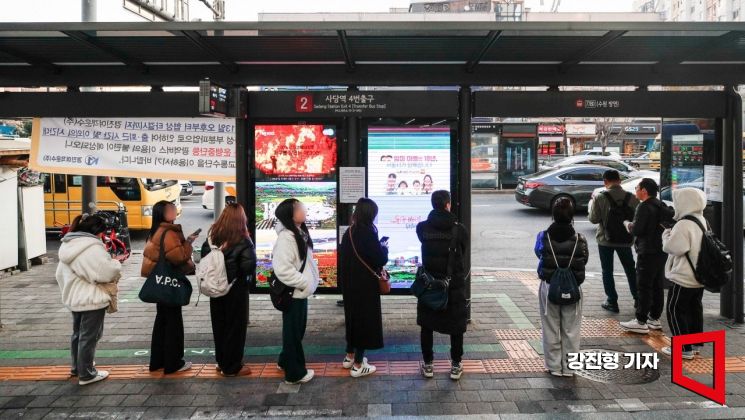 Citizens are waiting for the bus at the Sadang Station Gyeonggi Bus stop in Dongjak-gu, Seoul. / Photo by Jinhyung Kang aymsdream@
Focused management zones are areas where residents have moved in or are scheduled to move in within a year, but where the implementation and execution rates of improvement measures are below 50%, or where railway projects have been delayed for more than a year.
After selecting the focused management zones in October last year, the Metropolitan Transport Commission established phased special and supplementary measures, implementing new or additional metropolitan, city, and village bus routes, and expanding DRT services.
Special measures were implemented in Hwaseong Dongtan 2, Suwon Homaesil, and Pyeongtaek Godeok districts, which have already been designated as metropolitan transport special measure zones under the Metropolitan Transport Act, while supplementary measures were promoted in other zones.
In the three districts where special measures were implemented, a total of 102 buses and DRT vehicles were added, increasing daily passengers from 45,009 to 58,861, a rise of 13,852. Dispatch intervals also improved; in Hwaseong Dongtan 2, the addition of 3 city buses on route 116-2 reduced the dispatch interval from 60 minutes to 20 minutes. Similarly, in Pyeongtaek Godeok, adding 4 city buses on route 1452 shortened the dispatch interval from 30 minutes to 15 minutes.
Supplementary measures were applied in Hanam Gam-il and Misa, Goyang area, Incheon Geomdan, Gwacheon Knowledge Information Town, and Yangju Okjeong and Hoecheon. In these zones, a total of 92 buses and other vehicles were added, increasing daily passengers from 80,668 to 137,617, a rise of 56,949. Dispatch intervals were reduced by 40 minutes in Gwacheon Knowledge Information Town with the addition of 4 village buses on route 3, and by 17 minutes in Incheon Geomdan with the addition of 4 DRT vehicles.
The Metropolitan Transport Commission plans to regularly inspect and continuously monitor the implementation status of some projects under the metropolitan transport special and supplementary measures that have not yet been initiated due to timing or lack of transport workers.
Kim Young-han, Director of the Metropolitan Transport Policy Bureau at the Metropolitan Transport Commission, said, "The effects of the metropolitan transport special and supplementary measures prepared to improve commuting inconveniences for new town residents have been confirmed numerically," adding, "We will also ensure that follow-up actions to the 'Rapid Construction Plan for New Town Metropolitan Transport Networks' announced earlier this month proceed without delay to enable swift progress of metropolitan transport improvement projects."
© The Asia Business Daily(www.asiae.co.kr). All rights reserved.
![Clutching a Stolen Dior Bag, Saying "I Hate Being Poor but Real"... The Grotesque Con of a "Human Knockoff" [Slate]](https://cwcontent.asiae.co.kr/asiaresize/183/2026021902243444107_1771435474.jpg)
















