Argentina Facing Economic Hardship
Current Highest Denomination 2,000 Pesos Worth Only '2 Dollars'
Considering Issuance of Highest Denomination Over '20,000 Pesos'
The government of Javier Milei in Argentina is reportedly considering issuing the highest denomination banknotes of over 20,000 pesos. This move comes as a result of the drastic depreciation of the Argentine peso following the brutal inflation rate and economic crisis.
On the 25th (local time), local media reported that the Milei administration is considering issuing new highest denomination banknotes exceeding 20,000 pesos, which is more than 10 times the current highest denomination of 2,000 pesos. Currently, the highest denomination banknote in Argentina is 2,000 pesos. Converted at the official exchange rate, this equals approximately $2.43 (3,166 KRW), but at the unofficial exchange rate commonly used by Argentinians, it is only about $2, roughly 2,600 KRW.
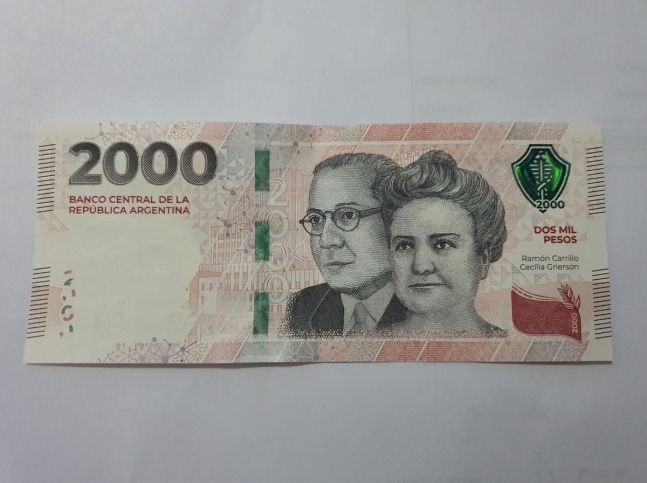
The current peso, which was introduced in 1991 during Carlos Menem’s administration by reforming the then currency '10,000 Australes' into '1 peso,' started with a value of '1 peso = 1 dollar.' If Argentina’s economy had remained stable, the current highest denomination banknote of 2,000 pesos would be worth nearly $2,000 (about 2.6 million KRW). However, as the economic crisis prolonged, its value against the dollar dropped to about one-thousandth.
In this context, some sectors in Argentina have long advocated for the issuance of new high-denomination banknotes. However, the previous administration under Alberto Fern?ndez opposed this, citing concerns that high-denomination notes could be used for tax evasion and money laundering, and could further fuel inflation.
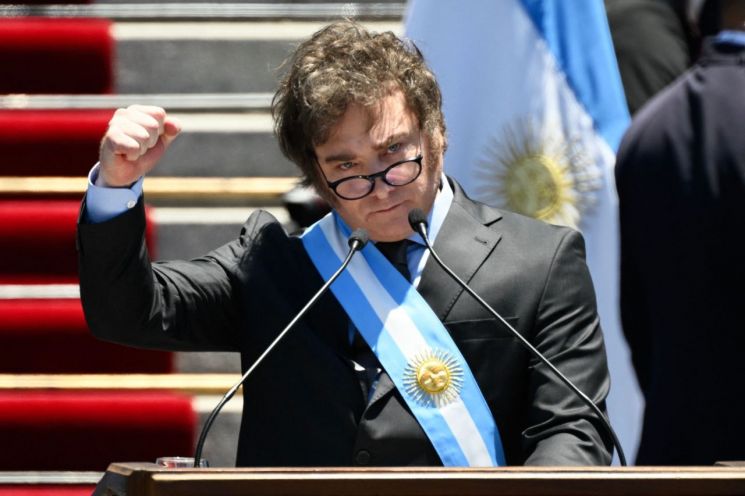 Javier Milei, President of Argentina, is gesturing while delivering his inaugural speech in front of the crowd at the Federal Congress in Buenos Aires on the 10th (local time).
 [Image source=AFP Yonhap News]
On the other hand, the Milei government believes that issuing new high-denomination banknotes is inevitable to overcome the economic crisis. During the presidential campaign, President Milei even argued for abolishing the peso and adopting the dollar. However, for now, the government is acknowledging the peso’s depreciation and maintaining it while proceeding with the issuance of new high-denomination banknotes.
Santiago Bausili, the inaugural central bank governor, initially considered issuing new 5,000 and 10,000 peso banknotes, but local media report that the plan now seems to be shifting toward issuing new 20,000 and 50,000 peso banknotes. Due to the steep inflation, by the time the new banknotes circulate, another issuance of even higher denomination notes may be necessary because of further currency depreciation.
Meanwhile, Argentina’s National Institute of Statistics and Census (INDEC) announced last month that the consumer price index (CPI) rose by 12.8% over the month. This is a sharp increase compared to the 8.3% monthly inflation rate in October. Additionally, the year-on-year inflation rate reached 160.9% in November, surpassing the 142.7% recorded in October and setting a new record since the hyperinflation period of 1989?1990.
© The Asia Business Daily(www.asiae.co.kr). All rights reserved.
![Clutching a Stolen Dior Bag, Saying "I Hate Being Poor but Real"... The Grotesque Con of a "Human Knockoff" [Slate]](https://cwcontent.asiae.co.kr/asiaresize/183/2026021902243444107_1771435474.jpg)

















