Aviation Engine Meeting at Seoul Chamber of Commerce and Industry
Development for Domestic Fighter Jets by Mid to Late 2030s
Our government has decided to directly develop advanced aircraft engines. Advanced aircraft engines are important technologies in terms of economy and security, as they are included in both the 12 national strategic technologies selected by the Ministry of Science and ICT and the 10 defense strategic technologies selected by the Ministry of National Defense.
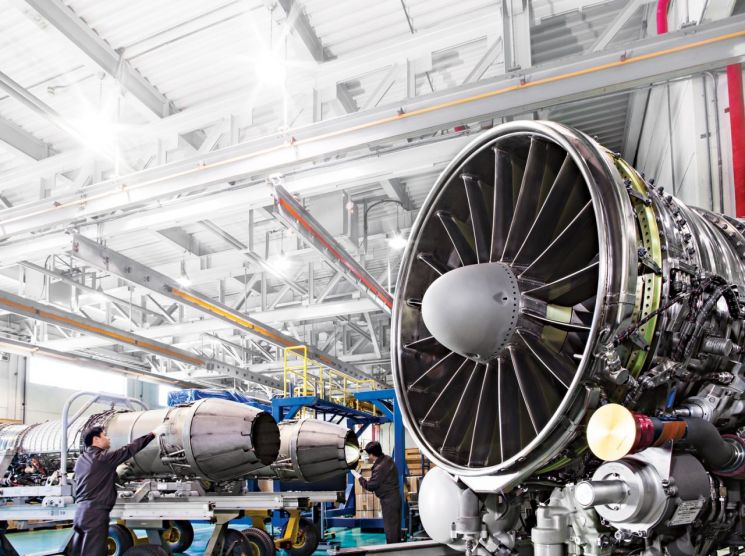
According to the Defense Acquisition Program Administration on the 26th, it plans to complete the development of a 15,000 lbf-class turbofan engine that can be installed on domestically produced fighter jets by the mid-to-late 2030s. lbf is a unit of engine thrust, and engines with more than 10,000 lbf are classified as jet-grade. Only a few advanced countries such as the United States and the United Kingdom possess the technological capability to develop aircraft engines.
Private companies have manufacturing and assembly technologies for some parts of aircraft gas turbine engines through licensed production, but they lack the technology to independently design and manufacture aircraft engines. Therefore, it is expected that developing aircraft engines will require enormous budgets and a long time.
Until now, the engines that serve as the heart of the supersonic advanced trainer T-50, light attack aircraft FA-50, and tactical introduction trainer TA-50 have all been imported from abroad. These are GE Aerospace’s F404 engines. The F404 engine is designed to maximize flight time, simplify maintenance, and have low life cycle costs.
The only company producing aircraft engines domestically is Hanwha Aerospace. Hanwha Aerospace has produced engines not only for the Republic of Korea Air Force’s main aircraft such as the F-15K fighter and T-50 advanced trainer but also participated in the Korean Helicopter Program (KHP), producing the engine for the Korean helicopter ‘Surion.’ In 2016, it joined the KF-21 project, which aims to replace Korea’s aging fighter jets and develop fighters with performance suitable for future battlefield environments, taking a leading role in integrated engine development. Hanwha Aerospace plans to promote localization through three stages: ‘direct purchase, assembly localization, and parts localization’ after receiving related technology transfers from GE.
Once the engine parts of the Korean fighter jet are localized, the supply system for frequently replaced parts will stabilize, enhancing combat power and reducing operating costs. It is expected to lead a new leap in Korea’s defense industry by continuously utilizing domestic production facilities and technological cooperation infrastructure in the Air Force’s force modernization projects.
On the afternoon of the same day, the ‘Advanced Aircraft Engine Concept Research Plan Announcement and Aircraft Engine-related Companies Meeting’ was held at the Korea Chamber of Commerce and Industry in Seoul. The meeting was attended by officials from the Defense Acquisition Program Administration, Agency for Defense Development, Air Force, Ministry of Trade, Industry and Energy, and about 20 related companies. Aircraft engine-related companies agreed on the insufficient technological level of Korea’s aircraft engine industry and suggested to the government that public-private cooperation is necessary to overcome shortages of specialized personnel and infrastructure.
© The Asia Business Daily(www.asiae.co.kr). All rights reserved.

















