1992 Supreme Court Precedent Maintained for 31 Years
Court: "Perceptions Have Changed and Health Sanitation Control Is Possible"
A court ruling that cosmetic eyebrow tattoos are not unlicensed medical practices is expected to spark serious discussions on legalizing tattoo procedures performed by non-medical personnel, which have been illegal until now.
On the 22nd, the Busan District Court East Branch Criminal Division 1 (Chief Judge Park Ju-young) announced that it acquitted a woman in her 20s, A, who was prosecuted for violating the Medical Service Act. A, who is not a medical professional, was accused of performing tattoo procedures on three people from November 2021 to May last year by applying anesthetic cream to the eyebrows and then injecting pigment into the eyebrow epidermis using a needle dipped in artificial pigment.
According to Article 27, Paragraph 1 of the current Medical Service Act, tattoo procedures are illegal. This provision does not explicitly prohibit tattoos but states that only medical professionals can perform medical acts. However, since a 1992 Supreme Court precedent regarded tattoo procedures by non-medical personnel as 'medical acts' and has been maintained for over 30 years, tattoos have effectively been illegal. In other words, the most critical issue in legalizing tattoos lies in whether tattoos are considered medical acts.
This ruling is expected to activate discussions on tattoo legalization. The court judged that nearly 30 years have passed since the Supreme Court ruling, and social perceptions of tattoos have changed, concluding that tattoo procedures do not violate the Medical Service Act. It also noted that with improvements in medical technology and dye quality, and with proper guidance and regulation by authorities, procedures by non-medical personnel can be controlled for public health and hygiene.
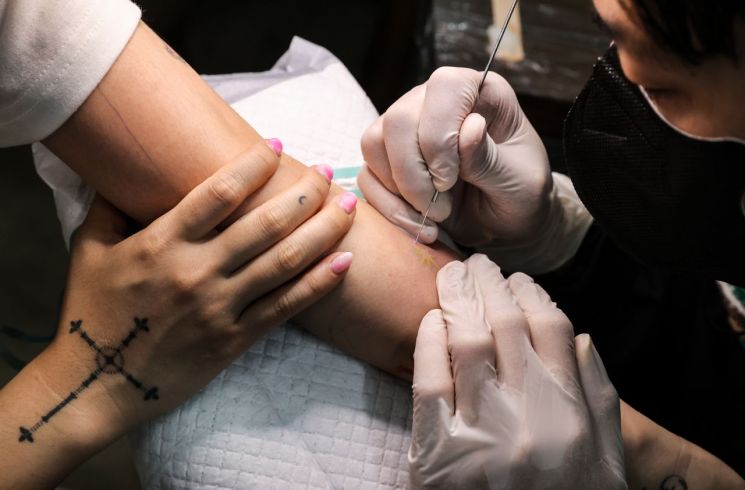 On April 22, 2021, a tattoo artist is working with a needle in a studio in Seoul. [Image source=Yonhap News]
Tattoo industry workers have long demanded tattoo legalization. They have argued that defining tattoo procedures as illegal drives the tattoo industry underground, which could harm public health. In 2020, the Tattoo Union collaborated with Green Hospital to create the 'Tattoo Hygiene and Infection Control Guidebook.'
However, there is still a long way to go before tattoo legalization. Currently, several bills related to tattoo legalization are pending in the National Assembly under names such as the Tattoo Artist and Semi-Permanent Makeup Artist Act (proposed by Kang Ki-yoon of the People Power Party), the Tattoo Artist Act (proposed by Park Ju-min of the Democratic Party), and the Tattoo Industry Act (proposed by Ryu Ho-jeong of the Justice Party). This is due to opposition from the medical community, which argues that indiscriminate procedures by non-medical personnel could harm public health. The Korean Medical Association and others have opposed tattoo legalization, stating that tattoos involve invasive methods using needles to inject pigment under the skin, which can affect the body.
© The Asia Business Daily(www.asiae.co.kr). All rights reserved.