Naju City in Jeollanam-do secured a total of 451.3 billion KRW for 61 projects in the 2024 government budget, giving momentum to the promotion of key projects in the 8th local government administration.
According to the city on the 22nd, the government budget allocated to Naju next year increased by 82.6 billion KRW from 368.7 billion KRW last year.
Despite unprecedented tax revenue declines and the government's fiscal austerity policy, the city achieved the highest-ever level of 451.3 billion KRW.
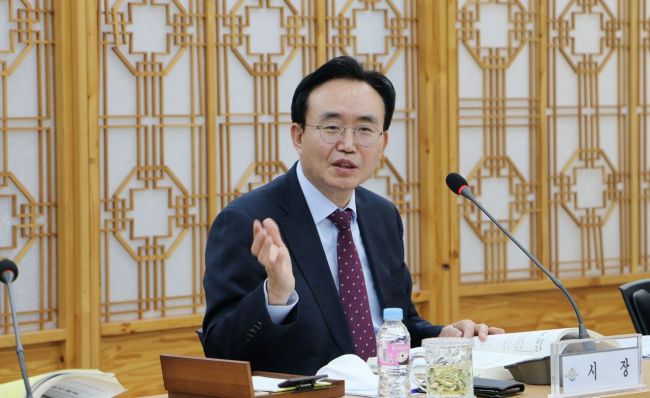
Mayor Yoon Byung-tae’s on-the-ground administration, actively appealing the necessity and validity of key projects by frequently visiting central government ministries, the National Assembly, and Jeollanam-do during the government budget formulation and National Assembly review process, was evaluated as effective.
Mayor Yoon utilized a broad personal network, including Naju-Hwasun National Assembly member Shin Jeong-hoon and members of the ruling and opposition parties’ Budget and Accounts Committees, maintaining organic cooperation until the budget was finalized.
In particular, through this effort, eight projects initially not reflected in the National Assembly budget review were newly included or increased by a total of 17.2 billion KRW.
The additionally reflected budgets include ▲ Construction of the National Energy Specialized Science Museum (200 million KRW) ▲ Creation of Bitgaram Children’s Sports Experience Center (1 billion KRW) ▲ Establishment of Global Innovation Special Zone (competitive project, 7.9 billion KRW) ▲ Industry-Academia Cooperation Incubating Smart Farm (2.5 billion KRW) ▲ Historical and Cultural Area Maintenance (1.8 billion KRW) ▲ Support for Korea Energy Engineering University projects (3.3 billion KRW), among others.
The city secured 200 million KRW for a feasibility study for the construction of the National Energy Specialized Science Museum, expected to become an energy-specialized landmark integrating industry, education, and experience in connection with Korea Electric Power Corporation and other power and energy-related public institutions.
Additionally, 7.9 billion KRW was secured for the ‘Global Innovation Special Zone Development Project’ led by the Ministry of SMEs and Startups. Through the establishment of the special zone, Naju, which has built energy industry-academia-research infrastructure, aims to upgrade the existing free special zone and establish global technology standards through direct current power grid demonstrations.
The government support budget for Korea Energy Engineering University, which was expected to face difficulties in university operations next year due to a reduction in government subsidies, was increased by 3.3 billion KRW to a total of 20 billion KRW after continuous persuasion on the necessity of nurturing world-class talent.
Furthermore, the city carefully secured budgets for ongoing projects to revitalize the energy industry-academia-research ecosystem, including the establishment of the Korea Polytechnic University Power Technology Education Center (11.3 billion KRW), the Energy New Material Industrialization Platform Construction (5.6 billion KRW), Intelligent LVDC Core Technology Development (900 million KRW), Power Equipment Digital Transformation Infrastructure Construction (1.9 billion KRW), Low-Voltage Direct Current Core Equipment Certification Support Infrastructure Construction (1.2 billion KRW), and the Electric Vehicle Battery Full-Cycle Carbon Neutral Environmental Management Center Construction (5 billion KRW).
The city secured 1.8 billion KRW (total 30 billion KRW) for the ‘Historical and Cultural Area Historical and Cultural Environment Maintenance Project’ to enhance the value of historical and cultural resources and promote tourism, and 600 million KRW (total 71.7 billion KRW) for the ‘Southern Region Wide-Area Tourism Development Project,’ which includes the Yeongsan River Panorama Tourist Attraction Project.
Budgets for tourism activation, a core goal of the 8th local government administration to realize Naju as the number one historical and cultural tourism destination and usher in the era of 5 million tourists, were also fully reflected, including 2.7 billion KRW for the restoration and maintenance of Naju Eupseong Fortress, government office, and Confucian school, 3.9 billion KRW for the construction of the National Naju Museum Digital Complex Cultural Center, and 800 million KRW for the preservation and maintenance of Mahan historical and cultural heritage sites.
The city also carefully secured budgets for the proud development of Bitgaram Innovation City and the establishment of disaster and safety infrastructure.
At the National Assembly budget review stage, the increased budgets of 1 billion KRW for the ‘Bitgaram Children’s Sports Experience Center’ (total 18 billion KRW) and 600 million KRW for ‘Support for Attracting Companies Related to Innovation City Public Institutions’ were finally reflected, which is expected to greatly improve residential conditions and urban revitalization in the innovation city, where the child population ratio is high.
For permanent disaster prevention, the city secured a total of 8.5 billion KRW for water and sewage-related projects, including 500 million KRW for the newly promoted ‘Ichang Samyoung District and Samdo District Sewerage Maintenance Priority Management Project’ (total 75.3 billion KRW).
By securing 6.4 billion KRW for the improvement of disaster risk zones such as Ichang disaster risk zone, the city will establish safe living infrastructure from frequent natural disasters.
In agriculture, 2.5 billion KRW (total 18 billion KRW) was secured for the ‘Industry-Academia Cooperation Incubating Smart Farm’ to nurture young and new smart agricultural talents.
Budgets for rural space maintenance projects focused on improving residential conditions for returning rural areas, such as Geuman in Noan-myeon and Oryong district in Munpyeong-myeon, were also reflected with 4.2 billion KRW, giving momentum to full-scale projects after detailed design.
The city plans to make every effort to secure national funds related to food tech industrialization by early applying for the ‘Food Upcycling Industrialization Support Center’ competitive project reflected in the Ministry of Agriculture, Food and Rural Affairs budget next year.
In the SOC sector, a total of 345 billion KRW was reflected for SOC projects including 200 million KRW for the ‘New National Road No. 58 from Naju Geumcheon to Hwasun Doam,’ which passed the preliminary feasibility study in 2021 (total 285.5 billion KRW), the ongoing ‘Honam High-Speed Railway Phase 2’ project, and the ‘Gwangju-Wando Expressway Construction’ project, further strengthening Naju’s position as a transportation hub in Honam with a dense wide-area transportation network.
Mayor Yoon Byung-tae said, “Many of Naju’s key projects for next year, including future advanced energy industry, historical and cultural tourism, agriculture, and residential condition improvement, were reflected in the government budget,” adding, “We will maximize regional development synergy through thorough management and prompt project implementation of the secured national budget during these difficult times.”
He continued, “I thank all those who helped secure the government budget, including Budget Committee Chairman Seo Sam-seok and National Assembly member Shin Jeong-hoon, regardless of party affiliation,” and added, “We will do our best to thoroughly supplement projects not reflected in next year’s budget and ensure their inclusion in the year after next.”
Naju = Kim Yuk-bong, Honam Reporting Headquarters, Asia Economy baekok@asiae.co.kr
© The Asia Business Daily(www.asiae.co.kr). All rights reserved.

















