Cabinet Reshuffle Focuses on 'Han Dong-hoon' Resignation Acceptance... Emphasis on Policy Implementation and Follow-up Measures
From Politician to Public Official and Professor... Remaining Replacements Also to Be 'Experts'
"Time to Bring Changes That Citizens Can Feel"... Considering Year-End Livelihood Message Delivery
President Yoon Suk-yeol's 'cabinet reshuffle for the general election' has virtually been completed. With President Yoon accepting the resignation of Minister of Justice Han Dong-hoon, who took the position of the People Power Party's emergency committee chairman the day before (21st), the remaining posts to be filled are the Minister of Justice's successor, and the Ministers of Employment and Labor, and Science and ICT. Given that President Yoon appointed many experts in the previous reshuffle, it is interpreted as an intention to focus on policy implementation and follow-up measures from the third year of his administration.
According to the Blue House and political circles on the 22nd, President Yoon is considering announcing the successor to the Minister of Justice along with additional replacements for the Ministers of Employment and Labor and Science and ICT around the year-end and New Year. A senior Blue House official said, "The most urgent task is to appoint a successor to the Ministry of Justice, which has immediately become vacant, but since replacements have been made quickly recently, more preparation time is needed at this point," hinting at a pace adjustment and the possibility of an additional reshuffle.
Out of 19 Ministries, 8 Ministers Replaced... Remaining Appointments Also All 'Experts'
President Yoon has replaced ministers in 8 out of 19 ministries this month. Following the announcement of appointments for the Ministry of Economy and Finance, Ministry of Land, Infrastructure and Transport, Ministry of Patriots and Veterans Affairs, Ministry of SMEs and Startups, Ministry of Agriculture, Food and Rural Affairs, and Ministry of Oceans and Fisheries on the 4th, appointments for the Ministry of Trade, Industry and Energy were made on the 17th, and for the Ministry of Foreign Affairs on the 19th.
This reflects the Blue House's plan to prepare for the third year of the administration beyond the general election. Most of the eight ministerial candidates nominated sequentially were appointed from experts such as public officials and professors. In particular, ministries that previously had politicians as ministers?Ministry of Economy and Finance (Choo Kyung-ho, Deputy Prime Minister and Minister of Economy and Finance → Choi Sang-mok, former Blue House economic secretary), Ministry of SMEs and Startups (Lee Young → Oh Young-joo, former ambassador to Vietnam), Ministry of Patriots and Veterans Affairs (Park Min-sik → Kang Jeong-ae, president of Sookmyung Women's University), Ministry of Land, Infrastructure and Transport (Won Hee-ryong → Park Sang-woo, former president of Korea Land and Housing Corporation), and Ministry of Foreign Affairs (Park Jin → Cho Tae-yeol, former 2nd Vice Minister of Foreign Affairs)?were replaced by experts such as public officials and professors.
The rumored successors for the Minister of Justice, and candidates for the next Ministers of Employment and Labor and Science and ICT are also all experts. For the successor to former Minister Han, names such as Gil Tae-gi (65, 15th Judicial Research and Training Institute class), Park Sung-jae, former Seoul High Prosecutor (60, 17th Judicial Research and Training Institute class), and Lee No-gong, Deputy Minister of Justice (53, 26th Judicial Research and Training Institute class), who have extensive experience in prosecution and the Ministry of Justice, are being mentioned. For the Minister of Employment and Labor candidate, Professor Cho Jun-mo of Sungkyunkwan University's Department of Economics, and for the Minister of Science and ICT candidates, Lee Yong-hoon, president of Ulsan National Institute of Science and Technology (UNIST), and Yoo Ji-sang, former president of Kwangwoon University, are being discussed.
Full Preparation for the Third Year of Administration... Actual Policy Implementation and Follow-up Measures to Address Issues
Through this reshuffle, President Yoon plans to send election-related appointments to the party and place experts, aiming to focus on the actual implementation, enforcement, and subsequent review of policies from the third year of his administration. While the first reshuffle in June, which replaced two ministers and twelve vice ministers, involved deploying many Blue House secretaries to reflect the president's will in state affairs and to break so-called 'interest cartels,' the current approach is to pursue policy precision and speed. A Blue House official said, "It is time to focus more on the government's core national tasks such as the three major reforms and to bring about changes that the public can feel."
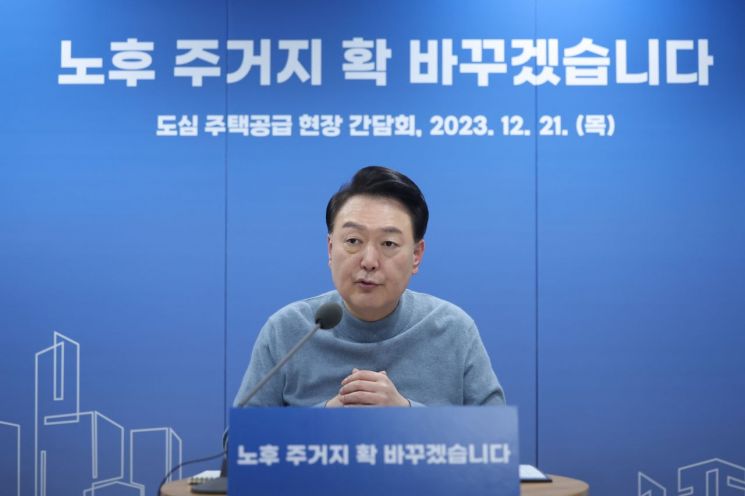
Recently, focusing on livelihood issues and directly voicing support for related bills is also to bring about 'tangible changes.' The day before, President Yoon inspected the 'Moatown' site in Jungnang-gu, Junghwa 2-dong, which was selected as a New Town area in Seoul about 20 years ago but where redevelopment projects have not progressed, and instructed, "Re-examine the redevelopment and reconstruction project procedures from the beginning so that more housing can be supplied in urban areas."
Earlier, during a weekly meeting with Prime Minister Han Duck-soo on the 18th, President Yoon said, "Next year, macro indicators such as the current account balance, growth, employment, and inflation are expected to improve. Please work hard so that the public can feel the economic improvement," and ordered, "Strongly promote meticulous support measures for housing, education, and welfare for youth and vulnerable groups."
This week at the Cabinet meeting, he also conveyed a message to focus on 'livelihood.' He criticized the behavior of giant monopolistic companies in the online platform sector, announcing 'corrective efforts' along with 'strong law enforcement,' and raised the social issue of 'caregiving,' urging related ministries to establish a 'caregiving service system.' The bills discussed that day mainly included the Industrial Bank Act, Space and Aviation Agency Act, the 'Basic Supply Chain Act' to respond to the diesel exhaust fluid crisis, and the 'Housing Act Amendment' to abolish the mandatory residence obligation for housing subject to the price ceiling system, which has yet to pass the National Assembly.
© The Asia Business Daily(www.asiae.co.kr). All rights reserved.


















