Housing Industry Research Institute 2024 Housing Price Outlook
"Rising Jeonse Prices Due to Supply Shortage... May Also Increase Sale Prices"
The Korea Research Institute for Human Settlements (KRHIS) has forecasted that Seoul housing prices will show an upward trend next year. Despite nationwide housing prices declining next year due to high interest rates and difficulties in project financing (PF), Seoul is expected to perform relatively well. Jeonse prices are projected to rise across both Seoul and other regions. KRHIS urged the government to implement supply-demand balance policies to prevent the persistent supply shortage from overheating the housing market.
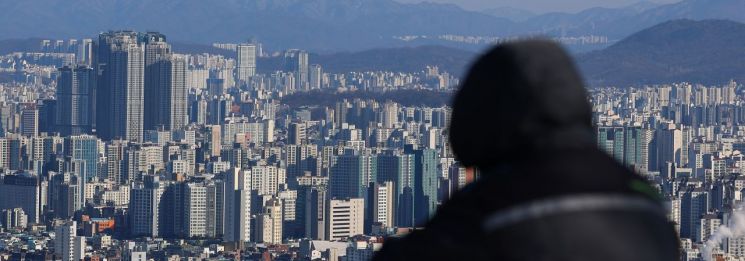
Popular Areas Expected to Turn Upward After Q2 Next Year
On the 22nd, KRHIS released its '2024 Housing Market Outlook,' forecasting a 1.5% decline in nationwide housing prices next year. By region, the metropolitan area is expected to decrease by 0.3%, while other regions are projected to fall by 3.0%.
In contrast, Seoul's housing prices are expected to rise by 1% next year. This forecast comes after two years of declining housing prices in Seoul. KRHIS estimated that housing prices will fall by 1.8% this year, following a 4.8% drop last year.
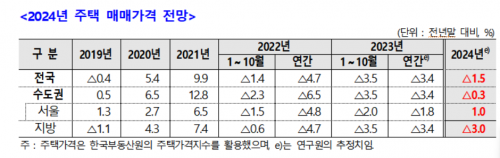
The institute anticipates that from the second quarter of next year, housing prices in popular metropolitan areas may stabilize or show slight increases. A KRHIS official stated, "Although housing prices will continue to decline next year due to high interest rates, PF financing difficulties, and delays in the full normalization of real estate taxation, there is a high possibility that prices in popular areas will turn upward due to loan rate reductions following a U.S. federal funds rate cut in the first half of the year, economic recovery, and supply shortages." They added, "In the second half of the year, the upward trend is expected to expand to metropolitan cities in other regions."
Housing transaction volume next year is projected at 650,000 households, recovering from 509,000 households last year and an estimated 534,000 households this year. However, this remains lower than the five-year average of 980,000 households from 2017 to 2021.
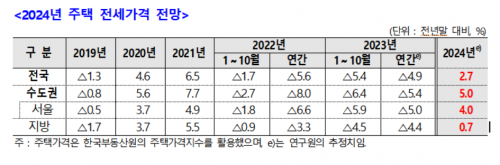
Supply Shortage Driving Jeonse Price Increase... Up 2.7% Next Year
Jeonse prices nationwide are expected to rise by 2.7%. The metropolitan area is projected to increase by 5.0%, Seoul by 4.0%, and other regions by 0.7%. A KRHIS official explained, "As demand shifts from purchases to apartment jeonse, the number of move-in units is expected to decrease again next year," adding, "The worsening supply shortage will push jeonse prices higher." They also noted, "There is a possibility that the rising trend in jeonse prices could spill over into purchase prices, as seen in the past." The expected number of move-in units next year is 328,000 households, which is 46,000 fewer than the recent five-year average of 374,000 households from 2018 to 2022.
"Sharp Decline in Supply Could Overheat the Housing Market"
Housing supply next year is expected to remain at levels similar to this year. KRHIS forecasts approximately 300,000 housing permits, 250,000 housing starts, 250,000 housing sales, and 300,000 completions. A KRHIS official said, "Due to a sharp decline in land preparation, permits, and housing starts last year and this year, housing supply has drastically decreased," adding, "Since PF financing conditions are unlikely to improve quickly, housing supply next year will not significantly exceed this year's level."
KRHIS advised the government to formulate policies to balance supply and demand to prevent the persistent supply shortage from overheating the housing market. A KRHIS official stated, "If housing transactions recover in the second half of next year and the economy improves the year after, the accumulated supply shortage of 760,000 households over the past three years and the backlog of household segmentation waiting could cause the housing market to overheat," emphasizing, "The focus should be on optimizing supply."
They also stressed that land supply expansion and deregulation of permits should be implemented appropriately to match the basic demand increase by region, alongside the activation of financing for actual buyers and project financing.
KRHIS also advocated for the complete removal of housing market regulation zones. Additionally, they emphasized banning arbitrary price regulations by local governments, simplifying the complex subscription system and point system, and abolishing mandatory residence periods.
© The Asia Business Daily(www.asiae.co.kr). All rights reserved.
![Clutching a Stolen Dior Bag, Saying "I Hate Being Poor but Real"... The Grotesque Con of a "Human Knockoff" [Slate]](https://cwcontent.asiae.co.kr/asiaresize/183/2026021902243444107_1771435474.jpg)


















